Functional groups: the working parts of organic molecules
Back to chemistryEthane is a gas that reacts slowly with many common aqueous reagents under ordinary conditions, although it can burn and undergo reactions initiated by light. Ethanol, the alcohol in drinks, is a liquid that mixes with water. Ethanoic acid, the sour part of vinegar, is an acid. Yet all three are built on the same two-carbon skeleton. What makes them so different is a small group of atoms attached to that skeleton: an in ethanol, a in ethanoic acid. Such a group is called a functional group, because it helps us predict characteristic chemical behaviour: which reactions it takes part in, whether it dissolves in water, how high it boils.
This page continues from the covalent bonding page: two atoms joined in a bond share a pair of electrons. Molecules with the same functional group often share typical reactions. Their chain length and branching still affect physical properties, so the same group does not mean the same solubility or boiling point. Recognising a group can help us predict how a molecule might react. To explain these patterns, we need to understand polar bonds and attractions between molecules. These ideas will help us compare hydrocarbons—alkanes, alkenes, alkynes and benzene—with oxygen-containing groups in alcohols, ethers, aldehydes, ketones, carboxylic acids and esters. For each group, the 3D structure lets us connect its shape with its name and behaviour. The names use the rules from the naming and drawing page.
Skeleton and functional group
Think of an organic molecule as two parts. The carbon skeleton, chains and rings of carbon with hydrogens on them, is the frame. Its C–C and C–H framework contributes to size, shape and attractions between molecules; we will explain those attractions in the next section. Many of its bonds react slowly with common polar reagents under ordinary conditions, but the framework is not chemically inactive. The functional group is the part that is different: a multiple bond, or atoms such as oxygen. That local arrangement often provides a characteristic reaction site. The rest of the molecule still affects access to it and interactions with water and other molecules.
Molecules with the same functional group and chains that differ by one at a time form a family called a homologous series: methanol, ethanol, propanol and so on are all alcohols. Their reactions are alike, and their properties change gradually along the series, for example the boiling point rises as the chain gets longer.
The model below compares the same two-carbon framework with different attached groups. “Molar mass” is the mass of one mole, a batch containing about molecules; g/mol means grams per mole, not grams for one molecule. The boiling points are for approximately ordinary atmospheric pressure. A lower boiling point means the liquid changes to gas at a lower temperature under that pressure.
- Family
- alkane (single bonds only)
- Formula
- Molar mass
- 30.1 g/mol
- Boiling point
- -88.6 °C
- Where you meet it
- in natural gas
The functional group is coloured · grey: carbon · white: hydrogen · red: oxygen · drag to turn
Two tools: polar bonds and attractions between molecules
First tool: polar bonds. In a covalent bond two atoms share a pair of electrons, but they do not always share it equally. Some atoms pull shared electrons towards themselves more strongly; this pulling power is called electronegativity. On the Pauling scale hydrogen is , carbon and oxygen . Carbon and hydrogen are close, so a C–H bond is shared almost equally and is called non-polar. Oxygen is much more electronegative, so in C–O and O–H bonds the electrons spend more time near the oxygen. The oxygen end becomes slightly negative, written (delta minus), and the other end slightly positive, . Such a bond is polar.
Second tool: attractions between molecules. A liquid boils when its molecules get enough energy to escape from each other, so the more strongly molecules attract each other, the higher the boiling point. All molecules attract weakly, because their electron clouds flicker and induce matching flickers in neighbours; these dispersion forces are larger for larger molecules. Polar molecules also attract through their and ends. For the small neutral molecules compared here, hydrogen bonding provides an especially important additional attraction: an H atom joined to oxygen is so that it is pulled towards a lone pair of electrons on an oxygen of another molecule.
Here is the effect on three molecules of almost the same mass. Propane () has no polar bonds and boils at . Methoxymethane () has polar C–O bonds and boils at . Ethanol, also and with exactly the same formula , has an O–H group that forms hydrogen bonds, and boils at , more than higher. The chart shows the boiling points; select a molecule to see it.
Choose a molecule below, or select its bar, to show the same molecule in 3D.
- Molar mass
- 46.1 g/mol
- Family
- alcohol ()
ethanol
Ethanol and methoxymethane are both . Why does ethanol boil about higher?
Alkanes: single bonds only
Alkanes have no functional group at all: only C–C and C–H single bonds, every carbon tetrahedral with angles of . Their bonds are non-polar, so the only attractions between their molecules are dispersion forces, which grow with the size of the molecule. That is why the small alkanes are gases (methane, the main component of natural gas), the middle ones liquids (petrol) and the long ones waxy solids (candle wax), and why boiling points rise steadily along the series, as the chart shows. Alkanes do not mix with water: water molecules hold on to each other by hydrogen bonds and an alkane cannot offer any.
Choose a molecule below, or select its bar, to show the same molecule in 3D.
- Molar mass
- 86.2 g/mol
- Family
- alkane (single bonds only)
hexane
Alkanes are unreactive. Their strong, non-polar bonds offer nothing for a charged or polar reagent to attack. They do burn in oxygen, releasing a great deal of energy, which is why they are our main fuels, and in ultraviolet light they react with chlorine, swapping hydrogens for chlorines. That second reaction is a substitution, explained on the organic reactions page.
Alkenes: the carbon–carbon double bond
An alkene contains a carbon–carbon double bond, . The two carbons of the double bond and the four atoms joined to them all lie in one flat plane, with angles of about ; turn the model of ethene to see that it is completely flat. The double bond is shorter than a single bond ( against ) and the molecule cannot twist about it.
Why is the double bond the working part? Its two bonds are not alike. One, the (sigma) bond, lies along the line between the carbons, like a single bond. The other, the (pi) bond, is made of electrons above and below the flat plane of the molecule, as the hybrid orbitals page shows. These electrons are held less tightly and stick out, so a reagent that is attracted to electrons can reach them. Then the bond opens and two new atoms join the two carbons: an addition reaction. Ethene is used this way to make polythene, and plants release it to ripen fruit.
- Family
- alkene ()
- Formula
- Molar mass
- 28.1 g/mol
- Boiling point
- -103.7 °C
- Where you meet it
- makes polythene; ripens fruit
The functional group is coloured · grey: carbon · white: hydrogen · red: oxygen · drag to turn
Alkynes: the triple bond
An alkyne contains a triple bond, : one σ bond and two π bonds. The two carbons and the atoms joined to them lie on a straight line, , and the bond is shorter still, . With two π bonds, alkynes also undergo addition reactions, twice over. Ethyne (acetylene) burns with oxygen in a very hot flame, used for welding steel.
- Family
- alkyne ()
- Formula
- Molar mass
- 26.0 g/mol
- Boiling point
- -84 °C
- Where you meet it
- welding torches
The functional group is coloured · grey: carbon · white: hydrogen · red: oxygen · drag to turn
Benzene and the phenyl group
Benzene, , is a flat ring of six carbons, each with one hydrogen. Its skeletal formula is usually drawn as a hexagon with alternating double and single bonds. But measure the bonds in the model: all six carbon–carbon bonds are the same length, , between a single bond () and a double bond (). There are no separate double bonds. The six π electrons are spread evenly round the whole ring, above and below it; we say they are delocalised. The alternating drawing is a shorthand, sometimes replaced by a hexagon with a circle inside.
- Family
- benzene ring / phenyl
- Formula
- Molar mass
- 78.1 g/mol
- Boiling point
- 80.1 °C
- Where you meet it
- a starting material for plastics and dyes
Ring C–C bonds in the model: 1.39, 1.39, 1.39, 1.39, 1.39, 1.39 Å
Compare: single , double
The functional group is coloured · grey: carbon · white: hydrogen · red: oxygen · drag to turn
Sharing the π electrons round the ring makes benzene unusually stable. So, unlike an alkene, it resists addition, which would destroy the ring of shared electrons. Instead it undergoes substitution: a hydrogen on the ring is replaced and the ring survives. When a benzene ring is attached to something else, it loses one hydrogen and is called a phenyl group, . Methylbenzene (toluene) is a phenyl group with a methyl; phenol is a phenyl group with an .
All six C–C bonds in benzene are . What does this show?
Alcohols: the hydroxyl group
An alcohol has an group, called a hydroxyl group, attached to a saturated carbon, meaning a carbon whose bonds here are all single. OH directly attached to a benzene ring is instead the phenol group we just met. The oxygen has two bonds and two lone pairs of electrons, so the C–O–H unit is bent, at about . Its name ends in “-ol”: methanol, ethanol, propan-2-ol, with a locant to show which carbon carries the .
The O–H bond is very polar, so alcohol molecules hydrogen-bond to each other and to water. That explains why ethanol boils at while ethane, almost the same size, boils at , and why the small alcohols mix with water in any proportion. As the chain gets longer, the non-polar part grows and alcohols mix less well with water. Alcohols can burn and some can be oxidised: in these examples oxidation removes hydrogen or adds oxygen. The product depends on the carbon carrying OH. If that carbon is joined to one other carbon, the alcohol is primary; two makes it secondary and three tertiary. Primary alcohols such as ethanol can give an aldehyde and then a carboxylic acid; secondary alcohols give a ketone; tertiary alcohols resist the usual mild oxidation. We draw and explain those product groups below. Alcohols can also react with carboxylic acids to make esters, another group we will examine. These are reactions under suitable conditions, not changes caused by merely rotating the model.
- Family
- alcohol ()
- Formula
- Molar mass
- 32.0 g/mol
- Boiling point
- 64.7 °C
- Where you meet it
- a fuel; toxic to drink
The functional group is coloured · grey: carbon · white: hydrogen · red: oxygen · drag to turn
Ethers: an oxygen between two carbons
In an ether the oxygen sits between two carbons: . Methoxymethane, , has the same formula as ethanol, : they are isomers. But an ether has no hydrogen on its oxygen, so its molecules cannot hydrogen-bond to each other. This is a major reason why, at the same external pressure, methoxymethane boils at and ethanol at . Ethers are fairly unreactive and are useful as solvents. In English names the smaller side becomes an “alkoxy” prefix: methoxy- is .
- Family
- ether ()
- Formula
- Molar mass
- 46.1 g/mol
- Boiling point
- -24 °C
- Where you meet it
- aerosol propellant; clean fuel
The functional group is coloured · grey: carbon · white: hydrogen · red: oxygen · drag to turn
The carbonyl group: aldehydes and ketones
A carbon joined to an oxygen by a double bond, , is called a carbonyl group. Like the double bond it is flat, with angles of about , and has a π bond. But it is also very polar: the oxygen is and the carbon , so the carbonyl carbon attracts reagents that carry spare electrons. We first compare two carbonyl-containing families, aldehydes and ketones. They differ in what is attached to the carbonyl carbon. Carboxylic acids and esters, introduced below, contain a carbonyl too.
In an aldehyde the carbonyl carbon is at the end of the chain and carries a hydrogen: . Its name ends in “-al”: ethanal, , is what the body first turns ethanol into. That hydrogen makes aldehydes easy to oxidise further, into carboxylic acids.
In a ketone the carbonyl carbon is inside the chain, joined to two other carbons: . Its name ends in “-one”: propanone, , also called acetone, is the solvent in nail-polish remover. With no hydrogen on the carbonyl carbon, ketones are much harder to oxidise than aldehydes, which gives a simple test to tell them apart.
- Family
- aldehyde ()
- Formula
- Molar mass
- 44.1 g/mol
- Boiling point
- 20.2 °C
- Where you meet it
- made from ethanol in the body
The functional group is coloured · grey: carbon · white: hydrogen · red: oxygen · drag to turn
A molecule has in the middle of its chain, bonded to two carbons. Which family is it?
Carboxylic acids
A carboxylic acid has a carboxyl group, : a carbonyl group and a hydroxyl group on the same carbon. Its name ends in “-oic acid”: ethanoic acid, , also called acetic acid, makes vinegar sour. With both and O–H, the molecules hydrogen-bond strongly, often in pairs, so ethanoic acid boils at .
Why does a carboxylic acid donate a proton to water much more readily than an alcohol with an O–H group? Alcohols are very weak acids, not substances that can never donate a proton. An acid is a substance that gives a hydrogen ion, , to water (see the acids and bases page). When ethanoic acid gives up its , the negative charge left behind is not stuck on one oxygen: it is shared equally between the two oxygens of the group, which makes the ion more stable. Losing the is therefore much easier than for an alcohol, whose negative charge would stay on a single oxygen.
- Family
- carboxylic acid ()
- Formula
- Molar mass
- 60.1 g/mol
- Boiling point
- 118 °C
- Where you meet it
- the acid in vinegar
The functional group is coloured · grey: carbon · white: hydrogen · red: oxygen · drag to turn
Esters
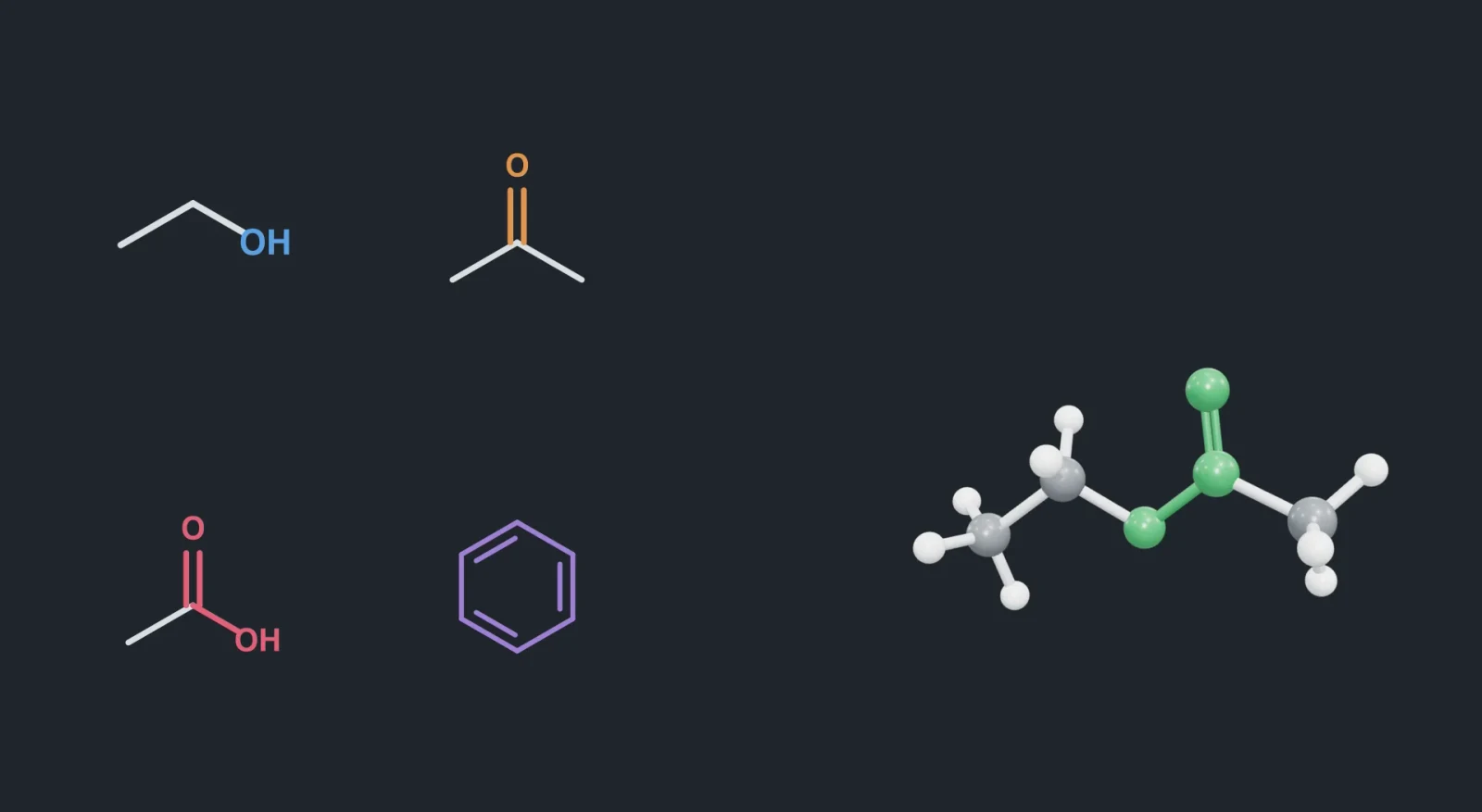
An ester has the group : a carbonyl group whose carbon is joined to an oxygen that leads to another carbon. Esters are made from a carboxylic acid and an alcohol. The OH of the acid and the H from the OH of the alcohol leave together as a molecule of water, and the two remaining parts join through the alcohol’s oxygen. Follow the coloured atoms in the scheme below.
An ester is named from its two parts. In an English name, the alcohol part supplies an alkyl word at the beginning. The acid part supplies the following word, ending in “-oate”: ethanoic acid and ethanol give ethyl ethanoate. Esters have no O–H, so they cannot hydrogen-bond to each other and boil lower than the acids they come from (ethyl ethanoate , ethanoic acid ). Many have fruity smells and are used in flavourings and perfumes.
- Family
- ester ()
- Formula
- Molar mass
- 88.1 g/mol
- Boiling point
- 77.1 °C
- Where you meet it
- fruity smell; glue solvent
The functional group is coloured · grey: carbon · white: hydrogen · red: oxygen · drag to turn
Which molecule of water is lost when ethanoic acid and ethanol form an ester?
Recognising functional groups
To recognise a functional group in a skeletal formula, look away from the plain zigzag lines and find what is different: a double or triple line between carbons, a hexagon with a ring of double bonds, or a letter O. Then look at the oxygen’s neighbours. An O with an H on a chain carbon is an alcohol; an O between two carbons is an ether; a doubly bonded O at the end of a chain is an aldehyde, inside the chain a ketone; a doubly bonded O with an OH on the same carbon is a carboxylic acid, and with an O–C on the same carbon an ester. Practise below: pick the family of each molecule.
Which family does this molecule belong to?
The 3D model of the same molecule · drag to turn