Follow the gold hydrogen. Which oxygen does it end up attached to?
Preparing the model…
Red is oxygen. White and gold are hydrogen. Only the reacting pair is shown.
A titration uses a solution of known concentration to measure an unknown concentration. An indicator helps us recognise when to stop adding solution.
Vinegar, lemon juice, soap, oven cleaner, and the hydrochloric acid secreted in the stomach are all acids or bases, yet dilute hydrochloric acid, sodium hydroxide solution, and the salt water they produce are all colourless liquids. Explaining what makes a solution acidic or alkaline, why they cancel one another out, and how to measure an unknown acid’s concentration accurately requires looking at ions in water. As ions separate when an ionic crystal dissolves, acids transfer protons to water to form H3O+ and alkalis supply hydroxide ions (OH−), so neutralisation is the reaction in which those two ions combine to form water.
We begin by following proton transfer in 3D, distinguishing bases from soluble alkalis, and reading six indicators across pH 0–14. We then perform a full 3D titration on the laboratory bench: measuring 25.00cm3 of acid by pipette, adding phenolphthalein, reducing the burette tap to single drops, reading the meniscus to two decimal places, and combining concordant titres with the mole ratios from moles and the Avogadro constant to determine the acid concentration.
After this page, you should be able to solve
Write both the ionic equation H+(aq)+OH−(aq)→H2O(l) and the overall equation for neutralisation, distinguish a base from a soluble alkali, and separate strong/weak acid strength from concentrated/dilute solution concentration.
Read a pH 0–14 indicator chart to select an appropriate indicator such as phenolphthalein or methyl orange, and distinguish the observed colour endpoint from the stoichiometric equivalence point.
Carry out an accurate acid–alkali titration on the 3D bench by aligning the pipette mark, reading the burette meniscus to two decimal places, swirling thoroughly, and adding reagent drop by drop near the faint persistent colour change without exceeding the endpoint.
Select concordant titres within 0.10cm3, calculate their mean, and determine the unknown concentration of hydrochloric acid in moldm−3.
What makes a solution acidic or alkaline?
An acid transfers protons to water
Begin with hydrochloric acid. A proton is the positive particle in an atom’s nucleus, and a hydrogen atom has one. Hydrogen chloride (formula HCl: H is hydrogen, Cl is chlorine) transfers its proton to water, as the first equation below shows. Below, the (aq) beside a formula means that particle is dissolved in water. H₃O⁺ is the hydronium ion, and the proton interacts with surrounding water molecules. We will use the common shorthand H⁺(aq) when counting the reaction; it does not mean an isolated bare proton in water.
HCl(aq)+H2O(l)→H3O+(aq)+Cl−(aq)
An alkali increases hydroxide-ion concentration
An alkali dissolves in water and increases its concentration of hydroxide ions, OH⁻. This ion contains oxygen and hydrogen and has a negative charge. Sodium hydroxide supplies OH⁻ as it dissolves. Ammonia instead reacts with water. Both make the solution alkaline; the two equations below show each route.
Now suppose we mix the two solutions. The positive H⁺ and the negative OH⁻ attract each other. Opposite charges attract: that is the basic rule of electric force. They join to form water. The Coulomb’s law page has more on that rule. The sodium and chloride ions are left in the water, and if the water were evaporated they would form salt. These two equations record the ionic change and the overall reaction:
In the proton-transfer description used here, a base accepts a proton. OH⁻ forms water by accepting H⁺; NH₃ forms NH₄⁺. Many metal oxides and hydroxides react with acids, but not every metal oxide is basic. An alkali is a soluble base that increases the concentration of OH⁻ in water; its aqueous solution is an alkaline solution. For example, copper(II) oxide accepts acid but is insoluble in water, so it is a base and not an alkali.
Diagram: the alkalis are a smaller group inside the bases.
Some common acids and bases
Acids
Name
Formula
Where you meet it
Hydrochloric acid
HCl
In your stomach, where it helps digest food
Sulfuric acid
H₂SO₄
Car batteries; making fertilisers
Nitric acid
HNO₃
Making fertilisers and explosives
Ethanoic (acetic) acid *
CH₃COOH
Vinegar
Citric acid *
C₆H₈O₇
Lemons, limes and oranges
Carbonic acid *
H₂CO₃
Fizzy drinks: carbon dioxide dissolved in water
An asterisk marks a weak acid: at a given concentration it does not all ionise, and ionising means handing a proton to water. A strong acid such as dilute hydrochloric acid ionises almost completely. Polyprotic acids (ones that can lose more than one proton) lose protons in stages; sulfuric acid has a very strong first stage, while the next is an equilibrium. Acid strength and solution concentration are different questions.
Household cleaners; it makes OH⁻ by reacting with water
Copper(II) oxide
CuO
No
A black powder; does not dissolve in water
Magnesium hydroxide
Mg(OH)₂
No
Indigestion tablets (“milk of magnesia”); almost insoluble
Iron(III) hydroxide
Fe(OH)₃
No
A rust-brown solid; insoluble
Zinc oxide
ZnO
No
Sun creams and nappy creams; insoluble
pH and indicators
For the aqueous solutions discussed here, take the temperature as about 25 °C: pH below 7 is acidic, 7 is neutral, and above 7 is alkaline. Neutrality means equal concentrations of H₃O⁺ and OH⁻; its pH changes with temperature. The displayed range 0–14 is common, not an absolute limit.
Hydrochloric acid, sodium hydroxide solution and the salt solution they make are all colourless, so our eyes cannot tell when neutralisation is complete. An indicator solves this. An indicator is a special solution, usually of a dye, whose colour changes with the pH. Each indicator changes colour over its own small range of pH. So we choose the indicator to suit the job. For a titration we want one that changes within the steep pH rise near the equivalence point, where acid and alkali have reacted in the required ratio. The observed colour endpoint is close to that point, rather than its definition.
Colour of common indicators from pH 0 to 14
Indicator
0
1
2
3
4
5
6
7
8
9
10
11
12
13
14
Changes at pH
Universal indicatorred → orange → yellow → green → blue → violet
pH 0
pH 1
pH 2
pH 3
pH 4
pH 5
pH 6
pH 7
pH 8
pH 9
pH 10
pH 11
pH 12
pH 13
pH 14
0–14
Litmusred → purple → blue
pH 0
pH 1
pH 2
pH 3
pH 4
pH 5
pH 6
pH 7
pH 8
pH 9
pH 10
pH 11
pH 12
pH 13
pH 14
4.5–8.3
Phenolphthaleincolourless → pink
pH 0
pH 1
pH 2
pH 3
pH 4
pH 5
pH 6
pH 7
pH 8
pH 9
pH 10
pH 11
pH 12
pH 13
pH 14
8.2–10.0
Methyl orangered → orange → yellow
pH 0
pH 1
pH 2
pH 3
pH 4
pH 5
pH 6
pH 7
pH 8
pH 9
pH 10
pH 11
pH 12
pH 13
pH 14
3.1–4.4
Methyl redred → orange → yellow
pH 0
pH 1
pH 2
pH 3
pH 4
pH 5
pH 6
pH 7
pH 8
pH 9
pH 10
pH 11
pH 12
pH 13
pH 14
4.4–6.2
Bromothymol blueyellow → green → blue
pH 0
pH 1
pH 2
pH 3
pH 4
pH 5
pH 6
pH 7
pH 8
pH 9
pH 10
pH 11
pH 12
pH 13
pH 14
6.0–7.6
Colours are approximate and depend on concentration. Litmus is a mixture of natural dyes, used mainly to distinguish acidic from alkaline conditions. Universal indicator also contains several components, selected to give different colours across a wider pH range. Phenolphthalein slowly loses its colour again above about pH 13.
The titration lab
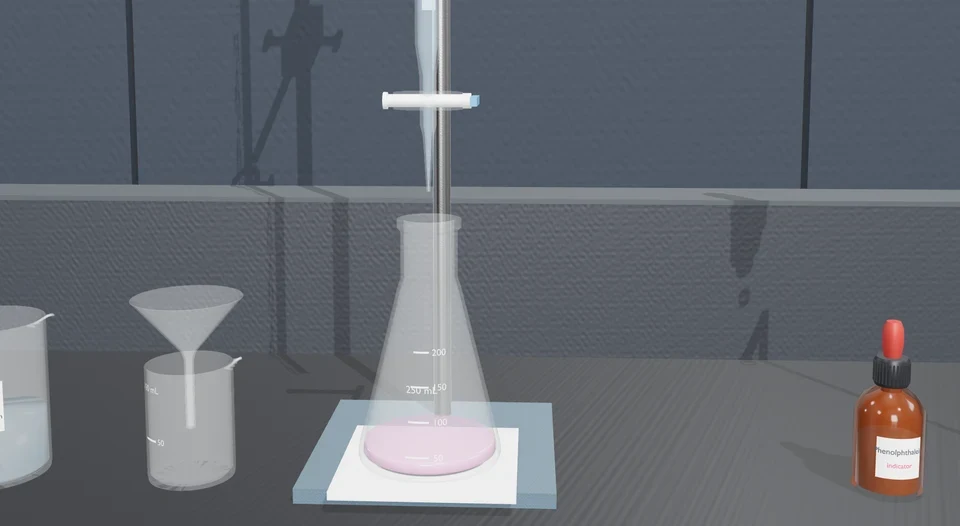
In a titration we use one solution of known concentration to find the concentration of another. We count particles using the mole: 1 mol contains about 6.022×10²³ of the specified particles. Concentration in mol/dm³ tells us how many moles are dissolved per cubic decimetre of solution; 1 dm³ is 1 litre. Here the sodium hydroxide concentration is 0.100 mol/dm³, meaning 0.100 mol of NaOH per litre of solution, and the hydrochloric acid’s concentration is unknown. We measure exactly 25.00 cm³ of the acid, then add the alkali from a burette until the acid has just been neutralised. Because H⁺ and OH⁻ react one to one, the volume of alkali needed tells us how much acid there was.
This is a free lab. You may put either solution anywhere, use as much as you like and carry on after the colour changes; nothing will stop you. Only some actions end the experiment, as they would in a real laboratory: spilling, overfilling, or breaking glassware. When you finish, the lab compares what you did with the procedure on the right and tells you where your result could have gone wrong. If you are not sure how to start, play the example first.
Move a piece Drag it; it follows the pointer. While held, the mouse wheel, a two-finger trackpad scroll, or ↑/↓ raises or lowers it; on touch, drag it to the spot. Near a funnel, flask, beaker or the sink it snaps into place and a note says so.
Use a piece Click it. Its buttons appear under the picture and in the Object tab. Buttons marked “hold” work only while you press them.
Follow the steps Each step in the Steps tab names the piece and the button. Point at a step, or open it, to light that piece up; “Show me” brings it into view.
Look and walk Drag an empty part of the picture to turn your head; W A S D walk and the up and down arrows rise and sink (Settings changes the keys). On a phone, use the joystick and arrows. If the apparatus leaves the picture, press “Back to the bench”.
Further along the bench A sink with a three-outlet water tap, and a gas tap with a Bunsen burner and a lighter. Click a lever to turn it; drag the burner’s hose onto a gas outlet to connect it.
You can see or change the keys for moving around in Settings (the gear at the top right of the page).
Drag at a fixed height · wheel or Height changes elevation
Preparing the model…
Free explorationDrag at a fixed height · wheel or Height changes elevationSpilled 0.0 mL · 0.00 g
Your results
Record each reading to 2 decimal places as you take it. Tick the titres that agree within 0.10 cm³ to include them in the mean.