Moles and the Avogadro constant
A box with twelve eggs saves us some counting. We can ask for two boxes instead of twenty-four separate eggs. Chemists face a much larger counting problem: even a small sample contains an enormous number of atoms and other particles. We need a way to connect that hidden count to something we can measure on a balance.
We will use multiplication and division. Powers of ten and chemical formulas are explained when we meet them; you do not need to know what a mole is already.
01Twenty-four eggs, two dozen
Two shoes make a pair. Twelve eggs make a dozen. These names tell us how many objects to put in one group. A dozen eggs and a dozen pencils contain the same number of objects, even though the objects are different. A dozen is not a kind of egg.
We have 24 eggs below. Each tray holds 12. Press Next step to move the same eggs into trays, then inspect the calculation. No eggs are created or removed: only the way we count them changes. You can also try 12 or 36 eggs.
We have 24 eggs. Each shallow tray has 12 places. Keep the total in mind while the eggs move.
02A much bigger counting group
An atom is a tiny building unit of matter. A sample of carbon contains carbon atoms. Some atoms join into a separate group called a molecule; a water molecule contains two hydrogen atoms joined to one oxygen atom. These objects are far too small to pick up and count one by one in an ordinary laboratory sample.
The idea of a dozen still helps, but twelve particles would be too small a group. Chemistry uses a much larger fixed count. One mole, written 1 mol, contains exactly the number below of the specified objects. We must say what we are counting: atoms, water molecules, or another clearly identified kind of particle.
The notation means multiplying 10 by itself 23 times. It is 1 followed by 23 zeros. Multiplying that by 6.02214076 gives the long integer shown here. The shorter form is scientific notation: it lets us write very large or very small numbers without losing track of their size.
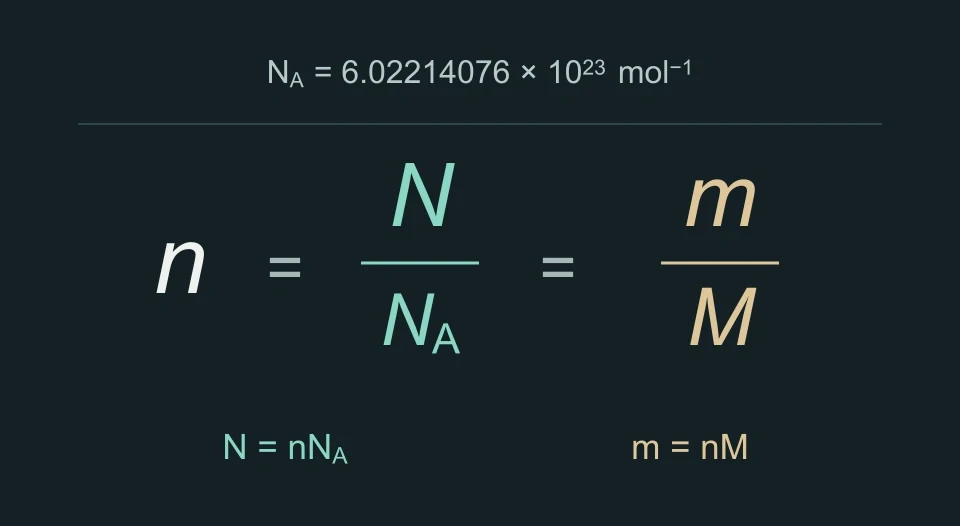
This conversion factor is the Avogadro constant, written . Its unit is , which means “per mole”. The amount of substance, written , tells us how many moles we have. The particle count, written , tells us how many individual objects that amount contains.
Recall the trays: number of groups × objects per group = total objects. We use exactly that counting step here. Moles × particles per mole = particles. If we already know the particle count instead, division by the count in one mole tells us how many moles it makes.
Change the amount below. Half a mole contains half the count in one mole; it does not mean half of an individual particle. The units in the calculation show why the result is a particle count.
specified particles
The constant stays fixed. Only how many moles we have changes. A mole of carbon atoms and a mole of water molecules have the same count, but each counted object is different.
Is a mole only a nickname for a number?
The dozen analogy explains the counting, but the formal distinction matters. The mole is the SI unit of amount of substance. is a constant with unit per mole, not the name of a collection. We say “a mole of atoms”, not “an Avogadro constant of atoms”. We could count eggs in moles too, though such a quantity would be wildly impractical.
03How heavy is one atom?
Knowing how many particles a mole contains does not yet tell us its mass. A dozen eggs is heavier than a dozen paper clips because each egg has more mass. In the same way, a mole of heavier atoms has more mass than a mole of lighter atoms. We need a way to compare the mass of one atom with another.
Writing each tiny atomic mass in grams is cumbersome. We therefore compare it with one fixed reference mass. That reference is one-twelfth of the mass of a carbon-12 atom. We call it the atomic mass constant, ; a mass of is also called one unified atomic mass unit, written 1 u.
Carbon-12 has 6 protons and 6 neutrons in its centre, with 6 much lighter electrons around it. A proton and a neutron each have mass approximately 1 u. Ignoring the small electron masses for a rough calculation, those twelve heavy particles give about 12 u. The reference itself is defined by the whole carbon-12 atom; the individual particle masses are approximations.
A negative exponent makes a small number: . So grams means 1.66054 divided by a 1 followed by 24 zeros, measured in grams. We will keep the short form to make the calculation readable.
Suppose an atom has a mass 16 times this reference. We can record the ratio, 16: divide the atomic mass by the reference mass. The relative atomic mass, , is this comparison. In the equation below, means the mass of one atom of the chosen kind X. Both masses use the same unit, so the units cancel: has no unit. Multiplying the ratio by the reference mass recovers the atomic mass.
A hydrogen atom has mass about g, approximately the reference mass, so its relative atomic mass is about 1. Carbon-12 has relative atomic mass exactly 12, by the choice of reference. Tables for ordinary carbon give an average near 12.01 because not every carbon atom has the same mass. We will use the stated rounded values, such as C = 12, in our school calculations.
04Why does a tiny mass turn into grams?
Now return to our original problem: we can weigh a sample, but cannot count its atoms one by one. If we know the mass of one atom, multiplying by the number of atoms in one mole gives the mass of that mole. This is the same multiplication we used for eggs, now applied to mass.
Why is a count near convenient? Ask how many copies of the reference mass make 1 gram. Divide 1 g by about g per copy. The answer below is close to the number of particles in one mole. Thus a mole of reference masses adds up to about 1 gram. This rounded calculation explains the convenience of the count; it does not determine every digit of the exact constant.
Let us keep carbon-12 as our example. One atom has mass . One mole contains atoms. Press Next step below to multiply these quantities, regroup the numbers, and inspect the powers of ten. The particle count will tell us the total mass.
Start with one carbon-12 atom. Its mass is 12 times the reference mass. The mass in grams is tiny.
We have found that 1 mol has mass about 12 g. Divide that mass by 1 mol to find the mass for each mole: 12 g ÷ 1 mol = 12 g/mol. This mass per mole is called the molar mass, written . Notice the distinction: compares one atom with a reference; gives mass per mole. The numbers correspond at school precision, but the meanings and units differ.
The same multiplication works for another kind of atom: its mass is , so its molar mass is . Since , we get . A relative atomic mass near 40 therefore corresponds to a molar mass near 40 g/mol.
05What does CaCO₃ tell us to count?
Carbon is an element: its atoms are all carbon atoms. Calcium carbonate contains several elements and has the formula . The symbols Ca, C and O mean calcium, carbon and oxygen. A small lower number belongs to the symbol just before it. The 3 means three oxygens; no lower number means one.
Calcium carbonate does not consist of separate CaCO₃ molecules. Here we count formula units: each unit records the proportion 1 calcium : 1 carbon : 3 oxygens given by the formula. The model puts those five atoms together on a counting tray. It shows what to include in the sum, not a separate CaCO₃ molecule floating by itself.
Use the rounded relative atomic masses Ca = 40, C = 12, O = 16. We must include every atom named by the formula. Press Next step and watch which part contributes to the running total. The three oxygen contributions are kept separate before being added.
The formula begins with one Ca. Its contribution is 1 × 40 = 40. The calcium sphere is highlighted.
Colours identify elements; they are not their real colours. The spheres help us count. The rods mark the carbon-and-oxygen group, and calcium stands beside it. This is a counting model, not a picture of a separate CaCO₃ molecule or a scale drawing of atoms.
For a formula unit, we call the sum the relative formula mass. It is not the relative atomic mass of a new element: calcium carbonate still contains calcium, carbon and oxygen. Multiplying each atomic contribution by the same mole-sized count gives a molar mass of approximately 100 g/mol.
06From moles to a mass we can weigh
One mole of calcium carbonate has mass approximately 100 g. Two moles contain twice as many formula units, so their mass is twice as large. Half a mole contains half as many units, so its mass is half as large. Remember that 100 g/mol is a rate, not the mass of every sample.
Write the sample mass as . The amount tells us how many moles there are, and the molar mass tells us the mass of each mole. Therefore : number of moles × mass per mole = total mass. The mol units cancel and leave grams. Try changing below before stepping through the multiplication.
We have 1 mol of calcium carbonate. Each full tile below represents 1 mol; a partial tile represents that fraction of a mole. These are amount markers, not individual particles.
A balance gives us mass, so we often need the reverse calculation. Suppose we weigh 25 g of calcium carbonate. Each mole would weigh 100 g, so the sample contains mol. Algebra says the same thing: divide both sides of by the nonzero molar mass . The factor cancels on the right, giving .
07What do the big numbers in an equation mean?
A reaction changes how atoms are joined and arranged. It does not change one element into another in an ordinary chemical reaction. Consider sodium carbonate reacting with hydrochloric acid in water. The products are sodium chloride, water and carbon dioxide gas. This reaction does not require heating to begin.
The arrow means “reacts to form”. A number in front of a formula counts whole copies of that formula. Thus 2HCl contributes two H atoms and two Cl atoms. By contrast, the lower 2 in H₂O belongs only to H: one water molecule has two H atoms and one O atom. Changing a lower number would change the substance, not merely how much we have.
Read the balanced equation as a counting recipe: 1 formula unit of sodium carbonate corresponds to 2 units of HCl, producing 2 formula units of sodium chloride, 1 water molecule and 1 carbon dioxide molecule. As with CaCO₃, we call the salt groups formula units, not separate molecules. This statement tracks the overall counts; it does not say that all these objects collide in one single event. The table checks that every element has the same count on both sides.
| Element | Before reaction | After reaction |
|---|---|---|
| Na | 2 | 2 × 1 = 2 |
| C | 1 | 1 |
| O | 3 | 1 + 2 = 3 |
| H | 2 × 1 = 2 | 2 |
| Cl | 2 × 1 = 2 | 2 × 1 = 2 |
Now multiply every count by the same Avogadro number. The ratio does not change. One mole of sodium carbonate therefore needs two moles of HCl, and forms two moles of sodium chloride, one mole of water and one mole of carbon dioxide. This is why equation coefficients give mole ratios, not mass ratios.
Choose how many moles of sodium carbonate will react. This example supplies exactly the required acid and assumes complete reaction. Step through “mass → moles → mole ratio → new mass”. Keeping the intermediate mole amounts visible prevents us from applying the coefficient ratio directly to grams.
Each small amount marker represents the same 0.5 mol. The coefficients tell us how many markers each substance needs: one, two, two, one, one. Two markers therefore mean 0.5 + 0.5 = 1 mol, not twice as many grams.
The given sodium carbonate sample has mass 53 g. Its molar mass is 2 × 23 + 12 + 3 × 16 = 106 g/mol. Divide mass by molar mass to get 0.5 mol.
If the other reactant runs out first, we cannot use all of the given sample. For example, 1 mol Na₂CO₃ needs 2 mol HCl. With only 1 mol HCl, only 0.5 mol Na₂CO₃ can react. The ingredient that runs out limits the reaction; the same recipe explains why.
All reaction masses here use rounded values: H 1, C 12, O 16, Na 23, Cl 35.5 and Ca 40. Small differences in more precise atomic masses do not change the counting method.
08Try the same reasoning yourself
Use the worked examples above if you need a reminder. Explain the counted object and the unit as well as entering a number; the answer button reveals every calculation.
We have 0.5 mol of water molecules. How many moles of hydrogen atoms do those molecules contain? Each water molecule is H₂O. Enter the amount in mol.
We began by counting eggs in groups. The mole extends that idea to microscopic objects. N = nNₐ connects moles to particle count; m = nM connects moles to mass. A balanced equation then connects the mole amounts of different substances. Keep those three connections separate, and a mass calculation can be rebuilt rather than memorised.
Definitions and precision
The mole definition follows the BIPM, and relative atomic mass follows IUPAC. The illustrations are counting models. The numerical examples use the rounded masses stated above.