Naming and drawing organic compounds: IUPAC names and skeletal formulas
Back to chemistryPetrol, candle wax, sugar, alcohol, vinegar, plastics and the DNA in your cells all have one thing in common: they are built around carbon atoms. Compounds of carbon (apart from a few simple ones such as carbon dioxide) are called organic compounds, and chemists know of more than a hundred million of them. With so many, two practical problems appear. How do we draw a molecule quickly without losing any information? And how do we give each compound a name from which anyone, anywhere, can rebuild exactly the same molecule?
To answer both questions, we need to understand how carbon atoms join into different molecules. We will compare four ways of drawing the same molecule, including the skeletal formula, a shorter way chemists use to show its structure. Seeing these drawings also reveals why a molecular formula cannot always identify one molecule. A name needs to tell us more: the main chain, branches, their positions, rings, double and triple bonds, and other atoms. We will work through the naming rules of the International Union of Pure and Applied Chemistry (IUPAC) using examples, and use a name to draw the molecule it describes. This page assumes you have seen the covalent bonding page: the atoms are joined by covalent bonds, in which atoms share pairs of electrons.
Why carbon builds so many molecules
A carbon atom has four electrons in its outer shell. As the covalent bonding page explains, it completes its shell by sharing them, one in each of four covalent bonds. A hydrogen atom has one outer electron and forms one bond. So in every molecule on this page, each carbon has exactly four bonds and each hydrogen exactly one. This simple rule of four will let us check every drawing we make.
The second fact is that carbon atoms bond strongly to each other. A carbon can use one of its four bonds to join another carbon, which joins another, and so on, forming chains of any length. A chain can branch, when one carbon joins three or four other carbons, and it can close into a ring. Each arrangement is a different molecule. That is why carbon builds so many more compounds than any other element.
Molecules are three-dimensional. As the molecular geometry page shows, the four bonds of a carbon with four single bonds point to the corners of a tetrahedron, apart. Look at the models below: methane is one carbon with four hydrogens; in ethane, propane and butane the carbons join into a chain, and because of the angles the chain is not straight but zigzags. Grey balls are carbon, white ones hydrogen. Drag to turn each molecule.
- Name
- methane
- Molecular formula
- Condensed formula
- Boiling point
- -161.5 °C
Grey: carbon · white: hydrogen · red: oxygen · green: chlorine · drag to turn
Four ways to write one molecule
Take butane, the gas in a cigarette lighter. There are four common ways to write it, and each one throws away a different amount of information. Switch between them below while the 3D model stays beside them.
The molecular formula, , only counts the atoms: four carbons and ten hydrogens. It says nothing about how they are joined.
The full structural formula draws every atom and every bond as a line. It shows how the atoms are connected, but it is slow to draw and becomes crowded for bigger molecules. It is drawn flat, so the angles on the page are not the real ; only the connections count.
The condensed formula writes the atoms of each carbon together, in order along the chain: . Each group such as is one carbon with the hydrogens attached to it. It is quick to type, but branches must be shown with brackets.
The skeletal formula is what chemists draw every day. It keeps only the carbon skeleton, drawn as a zigzag line: every corner and every end of a line is a carbon atom, and the hydrogens on carbon are not drawn at all. For butane that leaves a zigzag with three lines. It looks like very little, but nothing is lost, because the rule of four tells us how many hydrogens each carbon must have. The zigzag is not decoration: it is roughly the shape of the real chain seen from the side, as the model shows.
The full structural formula draws every atom and every bond as a line. It shows how the atoms are connected, but it is slow to draw and becomes crowded for bigger molecules. It is drawn flat, so the angles on the page are not the real ; only the connections count.
Butane in 3D: the carbon chain zigzags · drag to turn
Reading a skeletal formula
Here are the rules for reading a skeletal formula. First, every unlabelled corner and unlabelled free end is a carbon atom. A written O or Cl identifies that atom instead: do not add an extra carbon there. Second, a line between two carbons is a single bond, two parallel lines a double bond and three lines a triple bond. Third, atoms other than carbon and hydrogen, such as oxygen (O) or chlorine (Cl), are written with their letters, together with any hydrogens on them, as in . Fourth, each carbon carries enough hydrogens to make its total number of bonds four.
So the number of hydrogens on a carbon is four minus the number of bonds drawn to it, where a double bond counts as two and a triple bond as three. An end carbon with one line has hydrogens: it is a . A carbon in the middle of a chain with two lines has : a . A carbon with three lines has one hydrogen, and a carbon with four lines has none. Click any corner in the drawings below to check; the same atom lights up in the 3D model, with its hydrogens.
Bonds drawn to this carbon (a double bond counts 2):
Hydrogens: , so it is
Click any corner, end or letter
The orange atom is the one you chose · drag to turn
In a skeletal formula, a corner carbon has three lines drawn to it, all single bonds. How many hydrogens does it carry?
Same formula, different molecules
Now an important discovery. There are two different compounds with the formula . In butane the four carbons form one chain. In the other, three carbons form a chain and the fourth hangs from the middle one: a branched chain. Both obey the rule of four, both have ten hydrogens, yet they are different substances: butane boils at , the branched one at . Compounds with the same molecular formula but different structures are called isomers.
Left: butane · right: 2-methylpropane · same atoms, joined differently
With five carbons there are three isomers, with six there are five, and with ten there are 75. So the molecular formula cannot serve as a name. A name must describe the structure itself, and it must do so in a way everyone agrees on. That is the job of the IUPAC rules, which we now build up one at a time.
Butane and 2-methylpropane are both . What are they called?
Naming straight chains
We start with molecules that contain only carbon and hydrogen, joined only by single bonds. They are called alkanes. In an unbranched alkane each end carbon is a and each inner carbon a . With carbons there are two ends and inner carbons, so the hydrogens number . This end-count argument uses an unbranched chain with at least two carbons. To include branches, count all bond ends: carbons supply ends. Start with one carbon, then attach each new carbon by one bond. After adding the other carbons, there are carbon–carbon connections. Branching changes where we attach them, but adds no extra connection unless we make a ring. Each connection uses two bond ends. The remaining ends bind hydrogen. Methane is the case, with four hydrogens. Thus every acyclic alkane, branched or not, has the formula ; for butane, gives .
An IUPAC name is built from parts. The stem tells how many carbons are in the main chain, and the ending tells what kind of bonds or groups the molecule has. For alkanes the ending is “-ane”. The stems for one to four carbons, meth-, eth-, prop- and but-, are old names kept from history; from five onwards they come from Greek numbers: pent- (5), hex- (6), hept- (7), oct- (8), non- (9), dec- (10). So unbranched is hexane.
| Carbons | Stem | Alkane | Formula |
|---|---|---|---|
| 1 | meth- | methane | |
| 2 | eth- | ethane | |
| 3 | prop- | propane | |
| 4 | but- | butane | |
| 5 | pent- | pentane | |
| 6 | hex- | hexane | |
| 7 | hept- | heptane | |
| 8 | oct- | octane | |
| 9 | non- | nonane | |
| 10 | dec- | decane |
How many hydrogens does an alkane with 8 carbons have?
Branches are named after alkanes
Branches are named after the alkane with the same number of carbons. Take methane, , and remove one hydrogen: what remains, , has one free bond with which it can attach to a chain. This group is called methyl: the stem meth- with the ending “-yl”. Removing one hydrogen from ethane gives ethyl, , and from propane, propyl. Groups like these, made from an alkane by removing one hydrogen, are called alkyl groups.
The naming procedure, step by step
We can now name branched alkanes. The procedure has four steps, which the tool below lets us practise on several molecules. With a molecule selected, each press of Next reveals one step. The main chain turns orange and the branches blue in both the drawing and the model.
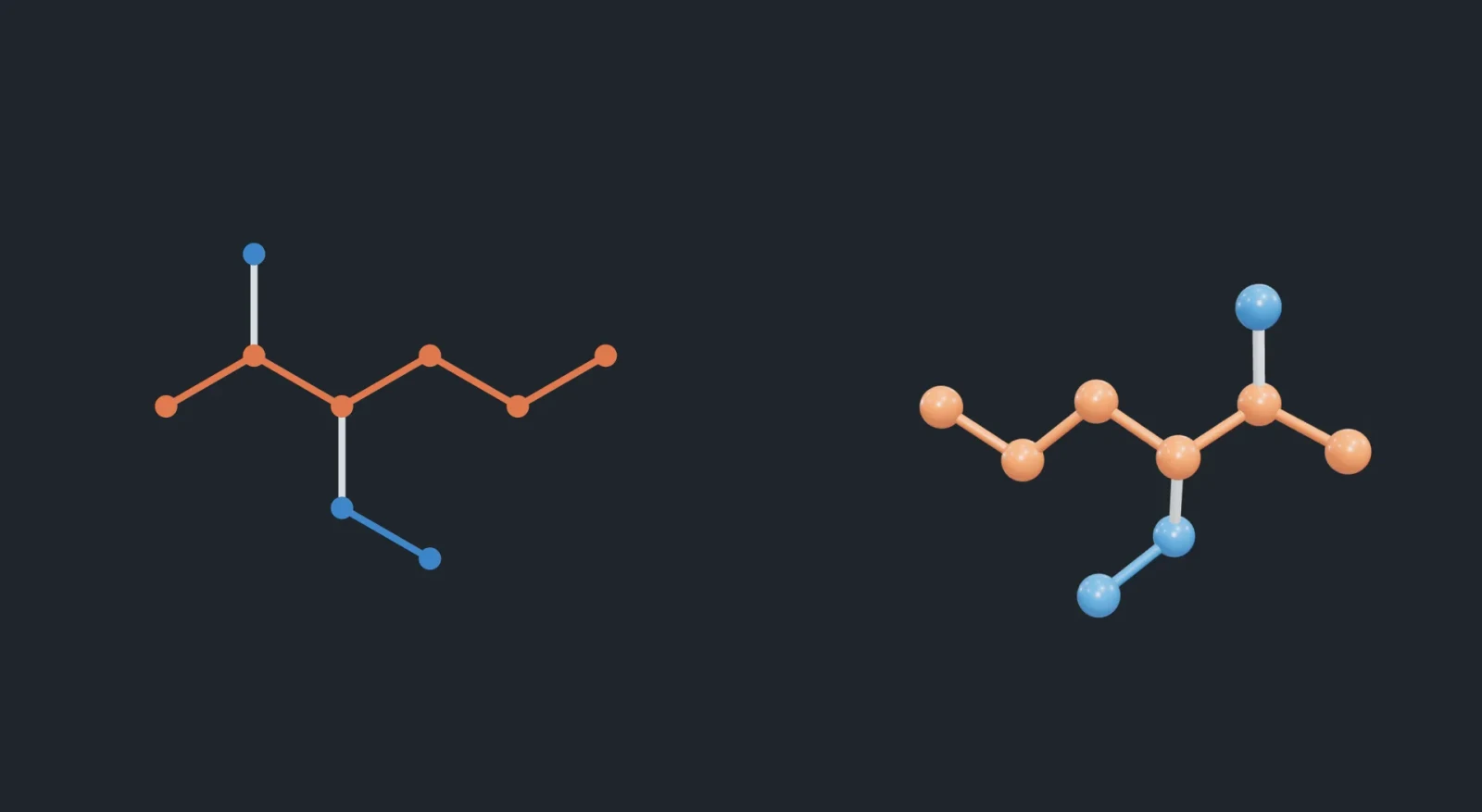
Step 1: find the longest continuous chain of carbons. This is the main chain, or parent chain, and it gives the stem of the name. Be careful: the longest chain is not always the straight line on the page. Follow every path from one end carbon to another and count. In 3-methylhexane, for example, the line drawn straight across has only four carbons, but turning up into the branch gives six.
Step 2: number the carbons of the main chain from one end to the other. Choose the end that gives the branches the lowest numbers. To decide, number from both ends and write down the list of branch positions each time, from smallest to largest; then compare the lists number by number and choose the one that is smaller at the first place where they differ.
Step 3: name each branch and give its position, the number of the main-chain carbon it is attached to. This number is called a locant. If the same branch appears more than once, use a multiplying prefix: di- (2), tri- (3), tetra- (4), and give one locant for each, even when two are the same, as in 2,2,4-trimethylpentane.
Step 4: assemble the name. Write the branches in front of the stem, each with its locant, then the stem and the ending. Numbers are separated from each other by commas and from words by hyphens. When there are different kinds of branches, English lists them in alphabetical order, ignoring di-, tri- and so on: 3-ethyl-2-methylhexane, because e comes before m.
Look at the molecule. Press Next to find its main chain.
Hydrogens hidden so the carbon skeleton is clear · orange: main chain · blue: branches
Numbering from one end gives branch positions 2, 4, 4; from the other, 2, 2, 4. Which numbering is correct?
When two chains tie
Sometimes two different chains are equally long. Then the rule is: choose the chain with more branches. In the molecule below, the chain running straight across and the chain turning down through the ethyl group both have six carbons. The straight one carries two branches (a methyl and an ethyl); the other carries only one, a larger branch. So the straight one is the main chain, and the name is 3-ethyl-2-methylhexane. Choosing the chain with more, smaller branches keeps the branches simple to name.
Look at the molecule. Press Next to find its main chain.
Hydrogens hidden so the carbon skeleton is clear · orange: main chain · blue: branches
The first-point-of-difference rule from step 2 also decides cases that look like ties. For 2,2,4-trimethylpentane, numbering from the left gives the branch positions 2, 2, 4 and from the right 2, 4, 4. Comparing number by number, the first numbers are both 2, but the second numbers are 2 and 4, so the left-hand numbering wins. We do not add the numbers up; we compare them in order.
Rings
When a chain of carbons closes into a ring, the prefix “cyclo-” is added to the alkane name with the same number of carbons. Six carbons in a ring is cyclohexane. In a skeletal formula a ring is drawn as a regular polygon, here a hexagon, with a carbon at every corner. Each ring carbon has two lines, so it carries hydrogens, and the formula is , two hydrogens fewer than hexane, because closing the ring uses one more bond between carbons.
The hexagon is flat on the page, but the real ring is not: with angles at every carbon it cannot lie flat, and it puckers into a shape called the chair. Turn the model to see it. With one branch on a ring, no number is needed, since every ring carbon is equivalent: methylcyclohexane.
- Name
- cyclohexane
- Molecular formula
- Condensed formula
- Boiling point
- 80.7 °C
Grey: carbon · white: hydrogen · red: oxygen · green: chlorine · drag to turn
Double and triple bonds
Hydrocarbons with a carbon–carbon double bond are called alkenes, and those with a triple bond alkynes. Their names change the ending: “-ene” for a double bond and “-yne” for a triple bond. Ethene, , is the simplest alkene, and ethyne, , the simplest alkyne. Each carbon in a double bond uses two of its four bonds on its partner, so it has fewer hydrogens; check this with the rule of four.
With four or more carbons the double bond can sit in different places, and the name must say where. Number the chain from the end nearer the double bond, and give the number of the first of its two carbons. A double bond between carbons 1 and 2 of butane gives but-1-ene; between carbons 2 and 3, but-2-ene. The double bond takes priority over branches when choosing the direction of numbering.
Multiple bonds also change the shape. The two carbons of a double bond and the four atoms joined to them lie in one flat plane, with angles of ; the two carbons of a triple bond and their neighbours lie on a straight line, . Compare the models: the skeletal formula of propyne draws the triple bond and its neighbour in a straight line for exactly this reason.
- Name
- ethene
- Molecular formula
- Condensed formula
- Boiling point
- -103.7 °C
Grey: carbon · white: hydrogen · red: oxygen · green: chlorine · drag to turn
Which name is correct for ?
Other atoms in the molecule
Atoms other than carbon and hydrogen are named in two ways. Halogen atoms (fluorine, chlorine, bromine, iodine) are treated like branches, with the prefixes fluoro-, chloro-, bromo-, iodo- and a locant: 2-chloropropane, has a chlorine on the middle carbon. In a skeletal formula the chlorine is written as Cl at the end of its line.
Groups containing oxygen usually change the ending instead. An OH group bonded to a saturated carbon (a carbon with only single bonds) identifies an alcohol in these examples, ending “-ol”: ethanol is the alcohol in drinks, and propan-2-ol has its on carbon 2. Other endings include “-al”, “-one” and “-oic acid”. These groups give molecules their typical behaviour, so they have a page of their own, functional groups.
- Name
- 2-chloropropane
- Molecular formula
- Condensed formula
- Boiling point
- 35.7 °C
Grey: carbon · white: hydrogen · red: oxygen · green: chlorine · drag to turn
From a name to a drawing
Naming also works backwards. Given a name, you can draw the molecule by reading the name from the end to the beginning. Take 2,3-dimethylpentane, and press Next to follow the steps.
2,3-dimethylpentane
The ending “-ane” says single bonds only, and the stem “pent-” says five carbons in the main chain. Draw a zigzag with five corners and ends.