Organic reactions: addition, substitution, elimination and rearrangement
Back to chemistryIn a chemical reaction some bonds break and new ones form. Organic chemistry has millions of reactions, but most of them belong to just four types, named after what happens to the molecule. In an addition, two pieces join a molecule across a multiple bond. In a substitution, one atom or group is swapped for another. In an elimination, a small molecule is removed and a multiple bond is left behind. In a rearrangement, atoms inside one molecule change places.
Knowing the four names is only a start. To understand a reaction, we need to follow the bonds that break or form and the electrons involved. This step-by-step explanation is called a mechanism. The symbols we introduce below will let us describe those changes. We can use them to follow a real example of each reaction type in 3D, atom by atom. Two ideas from the functional groups page will be useful: a polar bond has an uneven sharing of electrons, and a double bond has two shared electron pairs between the carbon atoms.
Bonds break, bonds form
A covalent bond is a pair of electrons shared between two atoms. So when a bond breaks, the question is what happens to its two electrons. There are only two possibilities. Either both electrons go to one of the atoms, which makes one atom negative and the other positive; this is called heterolytic breaking. Or the electrons split one each, leaving two atoms that each have one unpaired electron; this is homolytic breaking, and the atoms with unpaired electrons are called radicals.
Forming a bond is the same thing run backwards. Either one atom brings both electrons, a lone pair, to an atom that has none to offer, or two radicals each bring one. Most reactions of polar molecules break and form bonds the first way, with whole pairs; reactions in light or at high temperature often go the second way, with single electrons.
Following the electrons: curly arrows
Chemists show where electrons go with curly arrows. An arrow always starts where a pair of electrons is now, either a bond or a lone pair, and ends where that pair goes: between two atoms, to make a new bond, or onto one atom, which then keeps it. A half-headed arrow (a fish-hook) moves a single electron, for radical reactions. The arrows never show atoms moving; they show electrons, and the atoms follow.
In the 3D models on this page, the orange arrows are curly arrows for the step about to happen; yellow, thinner arrows move single electrons. A faint thin bond is one that is half made or half broken. An orange ring around an atom marks a positive charge, a blue ring a negative charge, and a yellow dot an unpaired electron. Use the step buttons, or press Play, and watch the atoms follow the arrows.
A curly arrow starts at a lone pair on O and ends between O and C. What does it show?
Who attacks whom
Who gives the electron pair, and who receives it? A species with a pair of electrons it can share, usually as a lone pair, often with a negative charge, is called a nucleophile, “nucleus-loving”, because it seeks out positive centres. Examples are the hydroxide ion , the bromide ion , water and the π electrons of a double bond.
A species that is short of electrons, either positively charged or the end of a polar bond, is called an electrophile, “electron-loving”. Examples are the hydrogen of H–Br, the carbon of a C–Br bond, and carbocations, carbons with only three bonds and a positive charge. In a polar reaction, the curly arrow almost always runs from a nucleophile to an electrophile. A radical is different again: it has a single unpaired electron and reacts by pairing it up.
How stable is a positive carbon?
Two of our reactions pass through a carbocation, a carbon with only three bonds and a positive charge. It has lost a share in one electron pair, so it is flat (, like an alkene carbon) with an empty orbital above and below its plane. Carbocations are unstable and short-lived, but some are much less unstable than others, and that decides which product forms.
For the simple alkyl carbocations compared here, attaching more carbon groups usually makes the positive centre more stable. Nearby double bonds or strongly electron-withdrawing groups require additional comparisons, so this is not a rule for every carbocation. A carbocation is called primary () when the positive carbon is joined to one other carbon, secondary () when joined to two, and tertiary () when joined to three, and stability increases in that order: tertiary > secondary > primary. The reason is that neighbouring C–H and C–C bonds can lean their electrons towards the empty orbital, spreading out the positive charge; more neighbouring carbon groups means more bonds to help.
Which carbocation is the most stable?
Addition
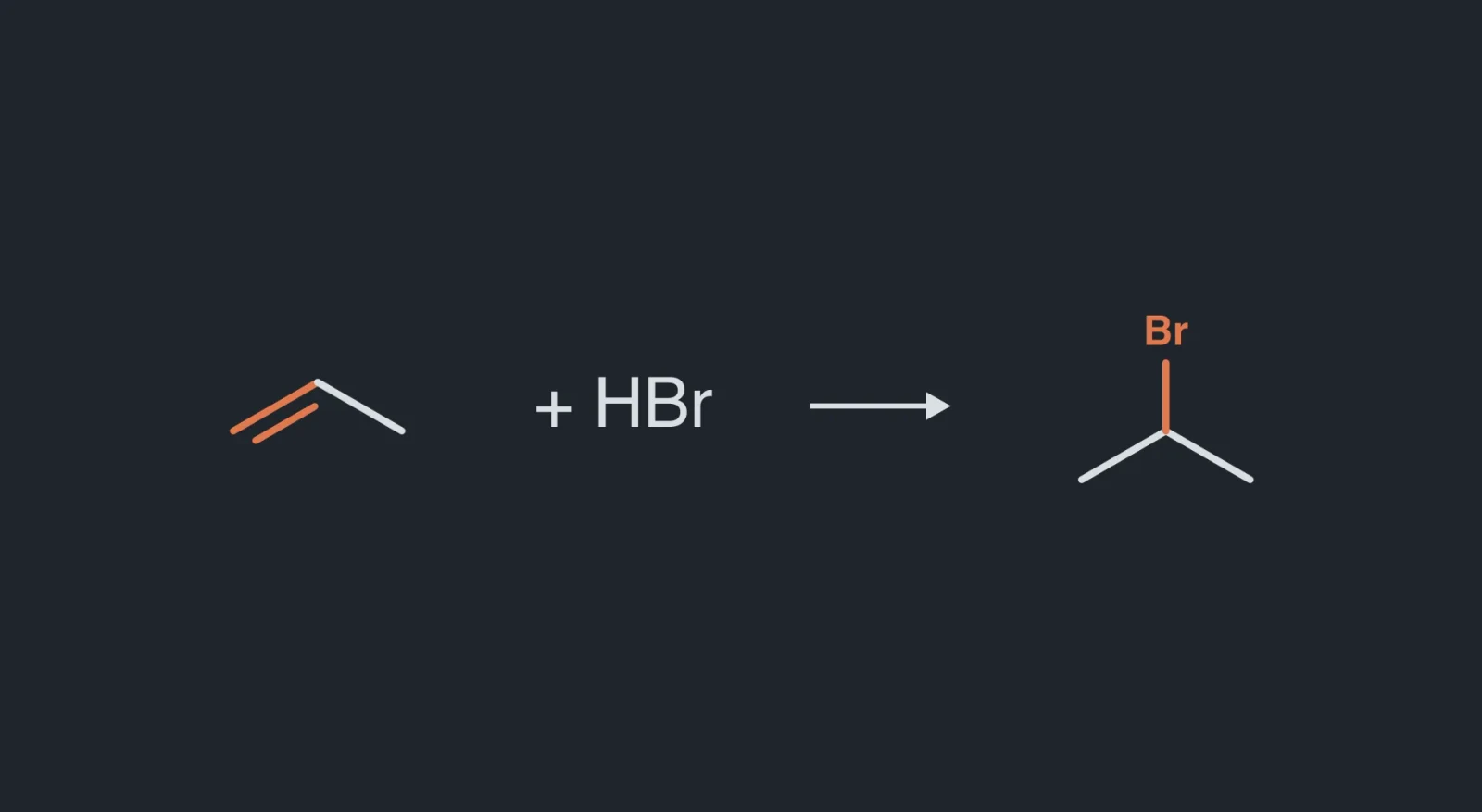
Alkenes undergo addition because their π electrons are exposed and weakly held: they are a nucleophile. Our example is propene with hydrogen bromide, which gives 2-bromopropane. It happens in two steps, through a carbocation. Step through it in the model and follow the energy profile below it: a peak is a moment of high energy that the molecules must pass (a transition state), a valley between peaks is an intermediate that exists briefly (here the carbocation).
Propene and hydrogen bromide. The π electrons of the bond sit above and below the flat alkene; the H–Br bond is polar, H and Br . The arrows show step 1: the π electrons reach out to the hydrogen, and the electrons of the H–Br bond move onto bromine.
Orange arrows: electron pairs · yellow: single electrons · orange ring: + · blue ring: − · yellow dot: unpaired electron · drag to turn
Why does the bromine end up on the middle carbon, giving 2-bromopropane rather than 1-bromopropane? It is decided in step 1. If the hydrogen joins the end carbon, the positive charge is left on the middle carbon, which has two carbon neighbours: a secondary carbocation. If the hydrogen joined the middle carbon instead, the positive charge would sit on the end carbon with only one carbon neighbour: a primary carbocation, much less stable and so much slower to form. The bromide then simply bonds wherever the positive charge is. This is Markovnikov’s rule: the hydrogen adds to the carbon of the double bond that already has more hydrogens.
Other additions to alkenes follow the same idea. Bromine water, , adds across the double bond and loses its orange colour, which is the classic test for a bond. Hydrogen adds with a metal catalyst (hydrogenation), turning liquid vegetable oils into solid fats. Water adds with an acid catalyst, which is how ethanol is made from ethene industrially.
HBr adds to propene. Where does the bromine end up, and why?
Substitution by a nucleophile
In a substitution, an atom or group on a carbon is replaced. Our example is bromoethane with hydroxide ions, giving ethanol and a bromide ion. The carbon joined to bromine is , an electrophile; the hydroxide ion is a nucleophile. The group that leaves, here , is called the leaving group.
This substitution happens in one step. The hydroxide must approach from the side exactly opposite the bromine, because the bromine and its electrons block the near side. As the new O–C bond forms, the C–Br bond breaks, both at the same time; halfway, the carbon has five partial connections and its three other groups lie flat. Then the groups swing through to the other side, like an umbrella turning inside out in the wind. Chemists call this mechanism : substitution, nucleophilic, with two reacting species participating in the elementary step; one may be an ion, as hydroxide is here. The 2 refers to this step’s molecularity, not to two successive steps.
Bromoethane and a hydroxide ion. The C–Br bond is polar, so the carbon carrying Br is ; the hydroxide ion, with lone pairs and a negative charge, is a nucleophile and approaches from the side opposite the bromine. The arrows show the single step: a lone pair on O forms the new O–C bond while the C–Br electrons move onto bromine.
Orange arrows: electron pairs · yellow: single electrons · orange ring: + · blue ring: − · yellow dot: unpaired electron · drag to turn
In the reaction, from which direction does the hydroxide approach?
Substitution by radicals
Alkanes have no polar bonds, so nucleophiles and electrophiles ignore them. But in ultraviolet light, methane and chlorine react, replacing hydrogens of methane with chlorine. This substitution goes by radicals, and it is a chain reaction with three stages.
Initiation: light has enough energy to split the weak Cl–Cl bond homolytically into two chlorine radicals. Propagation: a chlorine radical takes a hydrogen from methane, forming HCl and a methyl radical; the methyl radical then takes a chlorine atom from a molecule, forming chloromethane and a new chlorine radical. These two steps repeat over and over, because each one makes the radical the other needs. Termination: when two radicals meet they pair up and the chain stops, for example .
Methane and two chlorine molecules, in ultraviolet light. The half-headed arrows show initiation: light splits one Cl–Cl bond evenly, one electron going to each chlorine.
Ultraviolet light starts radicals by breaking a chlorine bond. Propagation regenerates a radical and can continue the chain, but radicals can also meet and terminate it; the chain does not continue indefinitely.
Orange arrows: electron pairs · yellow: single electrons · orange ring: + · blue ring: − · yellow dot: unpaired electron · drag to turn
Because the radicals are so reactive, the reaction is hard to stop at one chlorine: chloromethane can lose a hydrogen too, giving dichloromethane and so on. Benzene also undergoes substitution, but by electrophiles rather than radicals, keeping its stable ring of shared electrons.
Elimination
An elimination removes two atoms or groups from neighbouring carbons and leaves a double bond between them. Remarkably, it can start from exactly the same reagents as our substitution, bromoethane and hydroxide. The difference is in the conditions: hot, concentrated hydroxide dissolved in ethanol rather than water favours elimination.
This time the hydroxide does not attack the carbon. It acts as a base: it pulls a hydrogen ion off the carbon next to the C–Br carbon. Three things happen in one step, shown by three arrows. The hydroxide’s lone pair bonds to the hydrogen; the electrons of the C–H bond swing into the space between the two carbons, forming the second bond of ; and the C–Br electrons leave with the bromide ion. Look along the bond between the two carbons: the C–H and C–Br bonds chosen here lie in one plane and point to opposite sides. This is called an anti-periplanar arrangement. It lets the changing electron distributions overlap in the orientation needed to form the new π bond as the two old bonds break. The arrows record changes in bonding; they are not straight trajectories of individual electrons. This mechanism is called .
Bromoethane and hydroxide again, but now hot and concentrated, in ethanol. The hydroxide approaches a hydrogen on the carbon next to the C–Br carbon, the one pointing directly away from the bromine. Three arrows, one step: the hydroxide’s lone pair takes that hydrogen, the C–H electrons swing in to form a second bond between the carbons, and the C–Br electrons leave with the bromine.
Orange arrows: electron pairs · yellow: single electrons · orange ring: + · blue ring: − · yellow dot: unpaired electron · drag to turn
Substitution and elimination compete whenever a nucleophile that is also a base meets a haloalkane. Heat, a strong base and a crowded carbon favour elimination; a good nucleophile in water at lower temperature favours substitution. Alcohols also eliminate water when heated with concentrated acid, which is another way to make alkenes.
Bromoethane with hot, concentrated hydroxide in ethanol mainly gives:
Rearrangement
Sometimes an intermediate can make itself more stable before it reacts, by moving atoms within its own molecule: a rearrangement. A neighbouring hydrogen or methyl group can sometimes move with its bonding electrons, producing a more stable carbocation. Rearrangement still competes with other reactions and needs an accessible path; greater product stability alone does not guarantee that every possible shift occurs. Our example is the addition of HBr to 3-methylbut-1-ene. By Markovnikov’s rule we would expect 2-bromo-3-methylbutane, but the main product is 2-bromo-2-methylbutane.
3-Methylbut-1-ene and hydrogen bromide. The arrows show step 1, just as in the addition above.
Orange arrows: electron pairs · yellow: single electrons · orange ring: + · blue ring: − · yellow dot: unpaired electron · drag to turn
Follow the stages. Step 1 gives a secondary carbocation on carbon 2, as expected. But carbon 3 next to it is joined to three carbons. Its hydrogen moves over to carbon 2, taking its bonding pair of electrons with it: a hydride shift. The hydrogen and its bonding electron pair move together within this reacting structure; a free hydride ion is not first released into the solution. Now carbon 3 is positive, and it is a tertiary carbocation, more stable than the secondary one: the energy profile steps down into a deeper valley. The bromide ion then bonds to carbon 3. Methyl groups can shift in the same way. Rearrangements are why reactions that pass through carbocations sometimes give products whose skeleton or substituent positions seem unexpected.
The four types side by side
| Type | What changes | Typical start | Our example |
|---|---|---|---|
| Addition | Two pieces join across a multiple bond; the multiple bond becomes single | Alkenes, alkynes | |
| Substitution | One atom or group is swapped for another | Haloalkanes, alkanes (radicals), benzene | |
| Elimination | A small molecule is removed from neighbouring carbons; a multiple bond forms | Haloalkanes, alcohols | |
| Rearrangement | Atoms move within one molecule, often to make a more stable intermediate | Carbocations | a hydride shift from carbon 3 to carbon 2 |