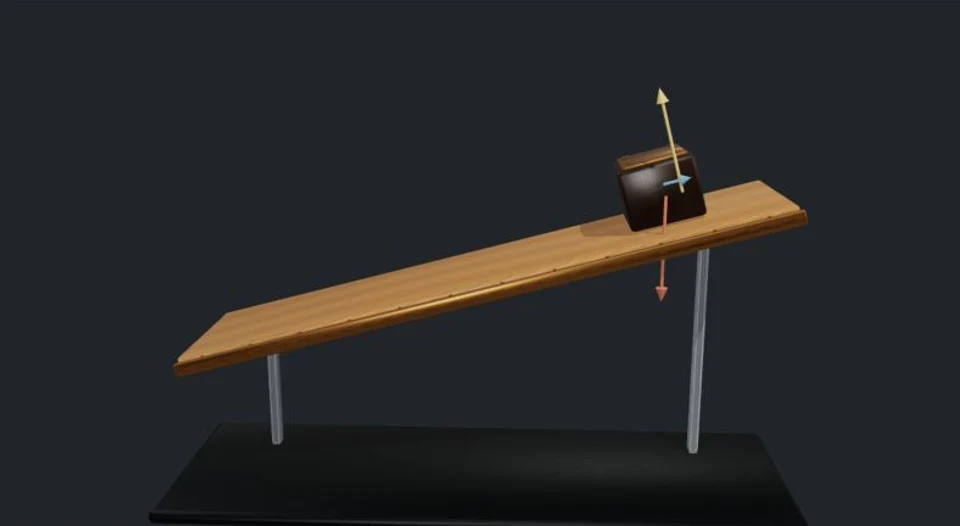
Incline experiment
Before you start
A block rests on a slope. Does that mean gravity has stopped acting? Earth is still pulling it down; we have simply not considered the other effects yet. The surface supports the block, and friction may prevent it from sliding. No motion does not mean no forces.
Let us stay with this resting block for a moment. Identify where its weight, supporting force and friction come from, then inspect their directions. Gravity points vertically down, but motion along the slope follows a different direction. To compare their effects, we will describe the same weight in two parts: along the slope and perpendicular to it. These are two components of one force, not two extra forces acting on the block.
If that split is difficult to picture, use the arrows before doing the calculation. Slowly raise the slope, watch the two components change, and check when the block starts sliding. The sine and cosine used later are the length ratios introduced on the unit circle page. Newton’s laws will connect the forces to changes in motion.
The setupRelease the block from rest over a 4.7 m run. Gravity points downward, the normal force is perpendicular to the slope, and friction opposes slipping. Playback ends before any collision at the bottom.
What to do and noticeTreat the slope as a right triangle: the part of gravity along the slope matches the side opposite , the part pressing into the slope matches the adjacent side, and the slope itself is the hypotenuse. So the along-slope part is times opposite/hypotenuse, which is , and the into-slope part is times adjacent/hypotenuse, which is . Start with a gentle slope and look at the forces before pressing Play. The surface pushes back with . While the block rests, friction is only as large as it needs to be to stop sliding, up to a limit of . Raise the angle slowly and find where becomes larger than that limit. From there the block slides, friction stays at , and the force left over along the slope makes it speed up.
Predict firstWith the block resting on the incline, does the normal force point straight up?
Tell real forces, components, and the friction threshold apart.
Prerequisites: A force has magnitude and direction; the net force determines acceleration, not velocity directly.Find only the real forces
Predict firstWith the block resting on the incline, does the normal force point straight up?
First, consider the block on its own as the object of study. Earth pulls it downward with weight , where is mass and is gravitational force per kilogram. The surface prevents the block from passing through it, giving a normal force perpendicular to the surface. Friction acts along the surface against relative sliding or its tendency. Leave components off and identify these actual forces first. The page also uses (the slope angle), (the friction coefficient), (acceleration) and (speed). Friction is . The unit of force is the newton, also written N. So the N after a number is a unit, not the normal force.
Weight and support both act on the block, so they are not an action–reaction pair. The partner of weight is the block’s pull on Earth; the partner of support is the block’s push on the slope. We identify who acts on whom before adding forces.
How to observe
- Rotate the scene and check the direction of the normal force
- Vary the incline angle and the friction coefficient
- Release the block and compare staying at rest with sliding
What this model simplifies
An ideal rigid incline with gravitational acceleration 9.81 metres per second squared. To keep the friction threshold in view, the static and kinetic friction coefficients share a single value; the block is released from rest. Components are not extra forces acting on the block.