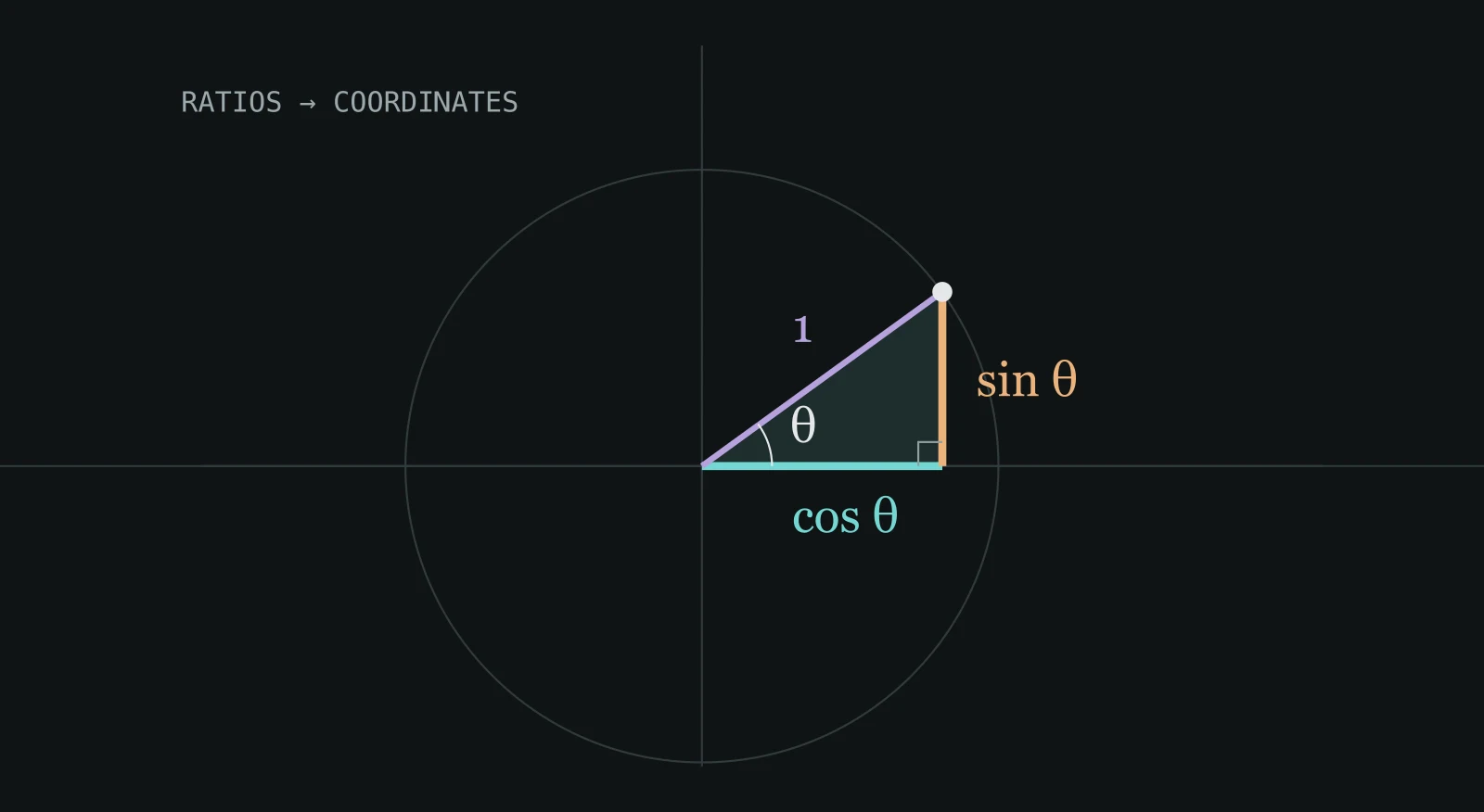
Unit circle & Trigonometry
Angles appear all over physics. In the incline experiment, only part of a block’s weight pulls it along the slope, and the size of that part depends on the angle of the slope. In a right triangle, sine and cosine give us such parts as ratios of side lengths. However, a turning wheel, like the rotors on the rotation page, passes through angles greater than 90°, and it keeps turning after a full circle. We cannot draw those angles inside a right triangle, so what should their sine and cosine mean?
Before we draw a whole circle, let us identify the three sides of a right triangle and make the hypotenuse 1 unit long. This lets us read the ratios as the coordinates of a point. Once that is clear, the same point can keep moving around the circle, and the definition will keep working for every angle.
01First, name the three sides.
Choose the acute angle at the lower-left corner. The hypotenuse is opposite the 90° angle and is the longest side. The opposite side faces ; the adjacent side touches and is not the hypotenuse.
Sine, cosine and tangent: ratios of the sides
, and are abbreviations for these three side lengths, not points. For a fixed acute angle , similar right triangles share the same ratios, even when their sizes differ.
02Make the hypotenuse exactly 1.
Place at the origin and the adjacent side on the positive x-axis. Scale the triangle without changing until . Similar triangles have the same side ratios. Now its hypotenuse is a radius of the unit circle, the set of points with , so every point on it is exactly 1 unit from the origin. Its tip is . For example, take , and . Divide every side by 5 to get , and . Scaling every side by the same factor keeps the angles unchanged, and the opposite-to-hypotenuse ratio is still . With the adjacent side on the horizontal axis, the endpoint is (4/5,3/5). In general, dividing all three sides by gives the coordinates , which are and .
In the first quadrant
Here x and y are positive. The horizontal leg has length , the vertical leg has length , and the hypotenuse has length .
This coordinate rule follows directly from the ratios above. Try changing : the two legs change, while the radius stays 1.
03Coordinates extend the definition to every angle.
Measure from the positive x-axis: counterclockwise is positive, clockwise is negative. Beyond the first quadrant, a triangle’s lengths alone cannot describe the signs. Define as the x-coordinate and as the y-coordinate of the point on the unit circle. This agrees with the acute-angle definitions and keeps working all the way around.
| Quadrant | cos θ · x | sin θ · y |
|---|---|---|
| 1 | + | + |
| 2 | − | + |
| 3 | − | − |
| 4 | + | − |
After another full turn, the point returns to the same place: adding 360° leaves sine and cosine unchanged. For example, 450° and 90° give the same coordinates.