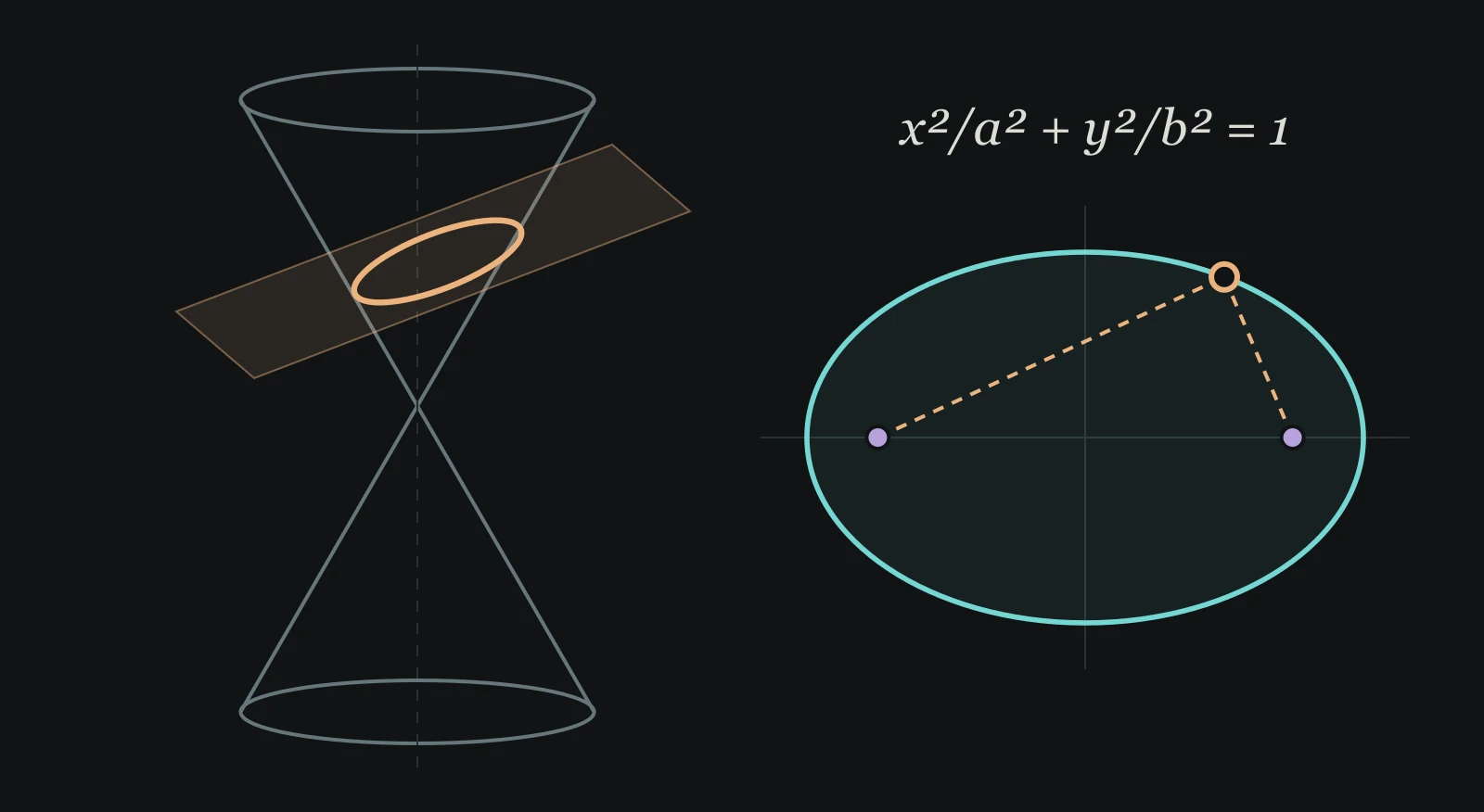
Conic sections: what a flat cut through a cone leaves
Begin with simplified models of familiar situations. Treating the Sun and one planet as point masses, with no other forces, gives a bounded, non-colliding orbit that is an ellipse; a circle is a special case. An ideal conical beam meeting a flat wall can also have an elliptical edge. Ignoring air resistance and treating gravitational acceleration as constant gives a parabola for a ball thrown at an angle. These curves look quite different, yet all of them can be cut from one object: a cone. The ancient Greeks found that when a flat plane cuts a cone, the cut is a circle, an ellipse, a parabola or a hyperbola, depending on how steeply the plane is tilted, which is why these curves are called conic sections. We have already used the equation of a circle on the unit circle page; if that equation is not familiar, read that page first. Here we will see that an ellipse is just a stretched circle.
Tilt the cutting plane and watch when the cut closes and when it extends outwards. These cuts distinguish the different curves. There is another useful construction for an ellipse: separate the two foci that coincide at a circle’s centre, keeping the sum of the distances to them fixed. This construction helps us derive its equation. To compare the shapes, we also need a number called eccentricity, which connects ellipses with parabolas and hyperbolas.
What curve does a flat cut through a cone leave?
Take a straight line that crosses a vertical axis at one point, and turn it round that axis while the crossing point stays still. The line sweeps out two cones joined tip to tip: a double cone. Each position of the turning line is called a generator of the cone; here every generator leans 30° away from the axis, so it rises at 60° from the horizontal. Now cut the double cone with a flat plane through the point 1.6 units above the tip, and tilt the plane. The orange line is where the plane meets the cone: the outline of the cut.
Drag the picture to look around the cones; scroll to zoom.
Why does the comparison with the generators decide everything? Each generator is a straight line through the tip, and a straight line meets a plane at most once. If the plane is less steep than every generator, each generator meets it once, on the same cone, and the points join up into a closed loop. If the plane is parallel to one generator, that one never meets it, so the loop cannot close. If it is steeper, the meeting points fall on both cones. So one cone and one plane give four kinds of curve: the circle, the ellipse, the parabola and the hyperbola.
The circle and the ellipse are the closed curves, and the ones studied most widely. We will start with them, and at the end of the page one number will lead us back to the parabola and the hyperbola.
How does a circle become an ellipse?
A circle has one centre, and every point on it is the same distance from that centre. Let us split the centre into two points and move them apart, one to the left and one to the right, while the circle stretches in the same direction. Its height above and below the middle stays . The two points are called the foci of the ellipse (one of them is a focus). The distance between them is the focal distance, written , so each focus is from the middle. Why these two points deserve a name, and why they sit exactly here, we will check in the next section.
One centre , and every point of the circle is from it.
Which equation describes an ellipse?
To describe the ellipse with an equation, put its middle at the origin and its foci on the x-axis. The distance from the middle to either end along the x-axis is called a, the semi-major axis. The distance from the middle to the top is , the semi-minor axis. The standard equation of the ellipse is . Let us see where it comes from, using the idea of the previous section: an ellipse is a stretched circle.
Start from a circle
Take the circle of radius round the origin. A point (, ) is on it when its distance from the origin is ; by Pythagoras’ theorem that distance is , so squaring gives the equation below.
Stretch it sideways
Move every point straight away from the y-axis, multiplying its x-coordinate by and keeping its height. The ends of the circle, at , move to , and the top stays at . We call the new coordinates (, ).
Substitute and divide
The stretched point came from a point of the circle, so put and into . Dividing both sides by gives the standard equation; we write and again instead of and .
When , the ellipse is a circle
If , the stretch multiplies by 1, so nothing changes. Call both semi-axes :
Multiplying both sides by gives , the standard equation of the circle of radius . A circle is an ellipse whose two semi-axes are equal, and both of them are the radius.
Why are the foci where they are?
Put the foci at and , with , so that . Take any point on the ellipse. From the equation, . Then
Since and , the bracket is positive, so . Working the same way with gives . Adding them, the terms with cancel: , for every point of the ellipse. That is the special property of the foci: the two distances always add up to the same length, . At the top point the two distances are equal, so each is , and Pythagoras gives — the relation the stretching in section 02 kept.
How far is an ellipse from a circle?
An ellipse is a stretched circle, so we would like one number that says how far it has moved away from being a circle. We want that number to be 0 for a circle and to grow as the ellipse gets flatter. Look back at section 02: the further apart the foci, the flatter the ellipse. The size of the whole ellipse matters too, so we compare the distance with a, and define the eccentricity
A circle has , so , exactly as we wanted. Enlarging an ellipse multiplies and a by the same factor, so does not change: it depends only on the shape. And in an ellipse with , so , which means and . What happens if becomes larger than a, so that ?
Fix a focus and the nearest point
In the picture the focus and the nearest point of the curve stay 1.5 apart. is a from the middle and is from it, so . Put and solve for a. As gets close to 1, the denominator gets close to 0 and a grows without limit: the far end runs away.
An equation without a
Measure a point by its distance from and its angle from the direction of . In section 03 we found , with measured from the middle; here is that focus, so . Collect the terms: .
Follow it past
We can extend this coordinate formula beyond ellipses. For this extension, r is a signed radial coordinate: a negative value means move |r| in the direction opposite θ, while the actual distance to F is |r|. At , the denominator vanishes at ; no finite point occurs there, and the curve is a parabola. For , two directions have zero denominator. Between them the signed r is negative, producing the second branch of a hyperbola. The graph uses , in every case.
For the hyperbola,
For , the two branches cross the axis at , where , and at , where is negative: that point is from , on the same side as . Half the distance between these two points is , and the middle between them is from . So the same describes the hyperbola, and here , which is exactly .
One number, four curves
gives a circle, an ellipse, a parabola and a hyperbola: the same four curves the plane cut from the double cone in section 01.
What is the parabola we just found?
In section 04 we reached and saw an open curve. We named it a parabola. Now we want more than its appearance: how do we calculate points on it, and what makes these points belong to the same curve?
Keep the coordinates from that section for a moment: the focus is the origin, the positive horizontal direction points towards , and . Put into . The result is . The horizontal coordinate is . Also, the right triangle from to gives . Therefore:
Subtract from both sides. We get , or . Since a square is never negative, cannot exceed 1.5. It equals 1.5 only when . This gives the turning point , called the vertex. Opposite values of have the same square, so the two halves mirror each other across the horizontal axis.
Squaring has not introduced extra points here. In the resulting equation , so is positive. Taking the nonnegative square root recovers . This checks the reverse direction too.
Move the origin so the rule is easier to read
The curve currently opens to the left. To compare it with an upward quadratic graph, put the origin at . Let the new horizontal coordinate equal the old , and let the new vertical coordinate measure how far left we have moved from : . These are perpendicular directions with the same unit lengths as before. Substituting gives:
For example, the old point (0, 3) becomes (3, 1.5). The old focus (0, 0) becomes (0, 1.5), and the vertex becomes (0, 0). The button below shows these same points in the two coordinate systems. From the next section onwards, we will call the new coordinates and again; the upward curve then has equation .
Press the button to compare the two coordinate descriptions. The distances have not changed. We have moved the origin to and chosen the direction towards the left of the old picture as the new upward direction.
A fixed point and a fixed line
The equation lets us calculate points, but it does not yet tell us a simple distance rule. In our new coordinates the focus is 1.5 above the vertex. Draw a horizontal line 1.5 below the vertex. We will compare a point’s distance to with its distance to this line. If the distances are equal, the point has just as far to travel to reach either target.
To study different widths too, call the vertex-to-focus distance , where . Thus and the line is . This fixed reference line is called the directrix. It does not run along the curve. We keep and the line fixed while testing different points .
What does distance to a whole line mean?
There are many points on the line. Distance to the line means the shortest distance to any of them. The point on the line with the same horizontal coordinate as is . It has the same horizontal coordinate, so . Why is this the shortest? Any other point also adds a horizontal separation . The right-triangle calculation gives . The first square is never negative and is zero at . Thus really is the nearest point. The absolute value keeps a distance nonnegative even when is below the line.
The same calculation for uses horizontal separation and vertical separation . It gives . In the model, orange marks PF, blue marks the directrix and the perpendicular segment PD. Move and separately before asking the model to make the lengths equal.
Why do perpendicular distances give a sum of squares?
Take four identical right triangles with perpendicular sides and , and sloping side . Place them at the corners of a square of side , as shown below. The middle has four sides of length . Its corners are right angles because the two acute angles of each right triangle add to 90°, leaving between adjacent triangles. The middle is therefore a square.
Each triangle is half a rectangle of area , so the four triangles have total area . The large square has area . Subtracting the triangle areas leaves . This is the Pythagorean theorem. For horizontal and vertical coordinate differences, use their absolute values as and . Squaring removes their signs, which explains the distance calculation even when a coordinate difference is negative.
Begin at : , while . Press “Make the two distances equal”: becomes 1.50: and . Then move off the curve to see the equality disappear. Readouts round to two decimal places; the comparison uses the unrounded values.
Derive the curve from equal distances
Write . Both sides are nonnegative lengths, so squaring keeps exactly the same solutions. Expand the two brackets, then subtract the shared and terms:
The first line implies the last, and every step can be reversed: the last equation gives the same squared distances, and equal squares of nonnegative lengths give equal lengths. We have proved both directions. A point has equal distances exactly when it satisfies . At this is , the very parabola obtained in section 05.
We can now read the width. At a fixed nonzero , increasing enlarges the denominator, so decreases: the curve is wider. If an upward parabola is written with , compare coefficients: , hence . For example has , so , focus (0, 2) and directrix . This statement uses a vertex at the origin and a vertical axis; shifted or turned axes need the corresponding coordinate change.
A locus: all the points that obey a rule
A single point is only one answer to our distance condition. If we collect every answer in the plane, we obtain a set of points called a locus. Here the locus of points equidistant from and the directrix is the parabola. “Every” matters: we must include all the points that pass the distance test, and none that fail it. A moving dot helps us inspect the set; the locus itself does not depend on how fast, or in which direction, we move.
Return to . Choose a horizontal coordinate . Squaring it and dividing by 6 gives the required height. For , the square is 9, so the height is . This point lies at horizontal position and height 1.5. Repeat for other values. The model records individual samples; use the curve button to compare them with the full rule.
Use “Next construction step” to calculate, locate and retain one point at a time. Playback follows the same steps and can be paused. Reset clears the recorded points; the curve display is a separate comparison.
| -4 | 16 | 2.67 |
| -3 | 9 | — |
| -2 | 4 | — |
| -1 | 1 | — |
| 0 | 0 | — |
| 1 | 1 | — |
| 2 | 4 | — |
| 3 | 9 | — |
| 4 | 16 | — |
The nine plotted points do not prove the rule for infinitely many others. Section 06 supplies that proof: any point that passes the distance test must satisfy the equation, and any point that satisfies the equation passes the test. Since every real produces exactly one , this construction has no missing horizontal position. The finite window only shows part of the unbounded curve.
Try the distance test yourself
Take and directrix . Which of and lies on the locus? Calculate both distances for each point. Then find the point on the locus with horizontal coordinate .
Check each calculation
For , , and the distance to the line is . They agree, so belongs. For , , whereas its distance to the line is . Since , these positive lengths differ, so does not belong. With the equation is . At it gives , hence the required point is , the mirror of .