The speed of light is the same for everyone
Back to physicsWalk forwards at inside a moving train wagon, and someone on the platform sees you move at your speed plus the wagon’s: if the wagon moves at , the platform measures . This rule works for walkers, balls and carts (the frames of reference page explains it step by step). It seems impossible that such a simple rule could fail. Yet it fails for light, and the way it fails changed our ideas of time and space.
What does this rule predict for light, and do experiments agree? That comparison gives us the problem Einstein faced. We will follow how he took the measurements seriously and worked out what else had to change. Each calculation uses squares, square roots and fractions, with the intermediate steps shown.
What the old rule predicts
Suppose the blue observer on the wagon switches on a lamp pointing forwards. The light leaves the lamp at measured on the wagon. If the old rule held for light as it does for the walker, the platform would measure . For a wagon at the difference would be one part in ten million, far too small to notice with a stopwatch, but not too small for a clever experiment.
In the 1800s the expectation was even sharper. Light was believed to be a wave in an aether that fills space (the What is light? page tells that story), so would be the speed relative to the aether, just as sound has its speed relative to the air. An observer moving through the aether at should then measure light going the same way as themselves at and light coming towards them at . The Earth moves round the Sun at about , so it should feel an “aether wind”, and light should be slightly slower in some directions than others.
A race across a river
How could such a small difference be detected? Albert Michelson’s idea is easiest to understand with swimmers. Two swimmers who both swim at speed through the water race in a river whose current flows at . One swims a distance downstream and back up; the other swims the same distance straight across the river and back. Who wins? Try it below.
- Along and back
- Across and back
The along-river swimmer goes downstream at relative to the bank, because the current helps, and comes back upstream at . Time is distance divided by speed, so the round trip takes
To add the two fractions we gave them the common denominator .
The across swimmer must aim a little upstream, or the current would carry them downstream. Relative to the water they swim at ; the water moves at along the river; and the result must point straight across. Those three velocities form a right-angled triangle whose longest side is , so by Pythagoras the speed straight across is
and the same holds coming back, so the round trip takes
Since is smaller than , the across time is a little longer than , and the along time, with the larger factor , is longer still. The across swimmer always wins, by an amount that grows with the current. Michelson realised that light in an aether wind would run exactly this race.
In the river race with , and , how long does the along-river swimmer take?
The Michelson–Morley experiment
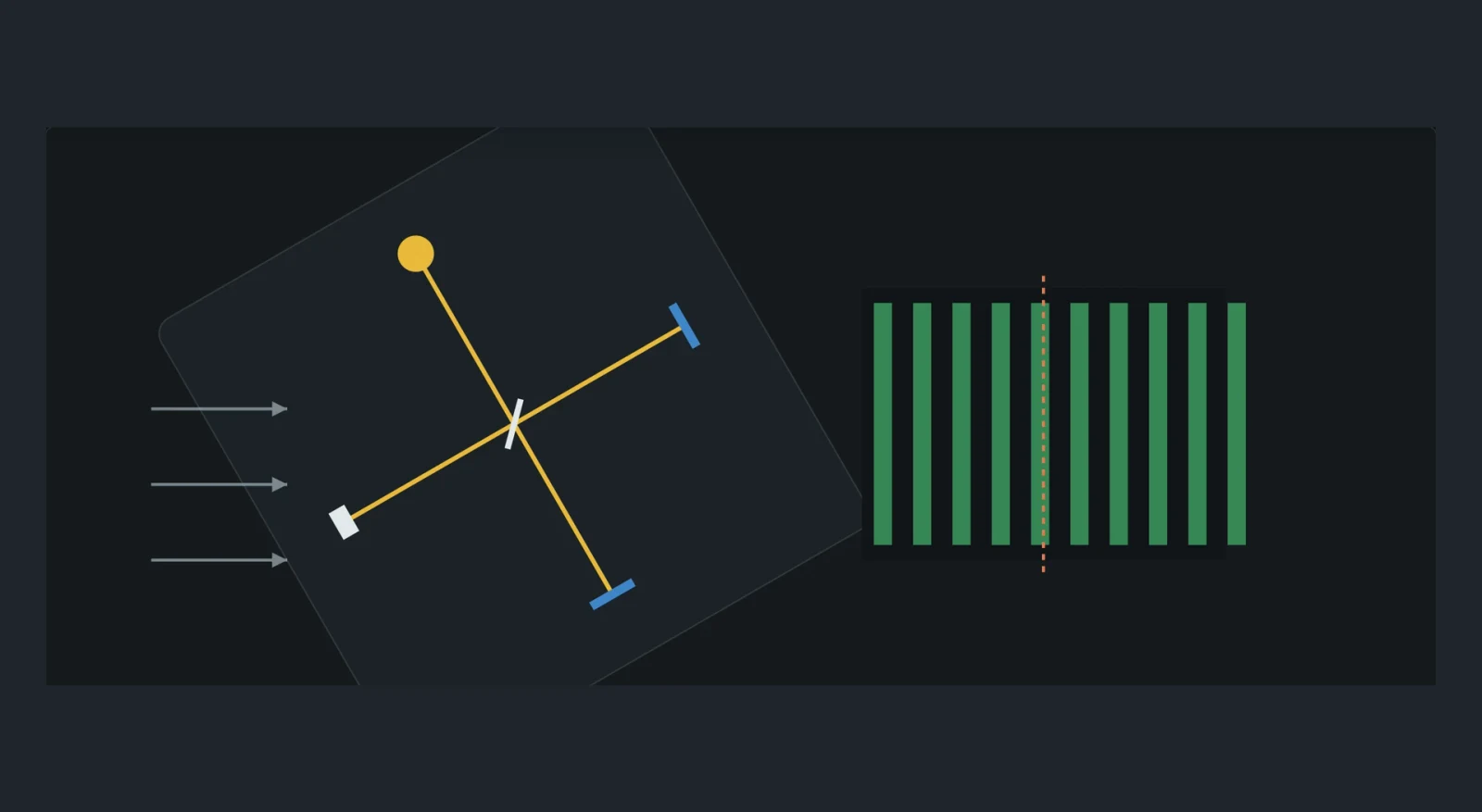
In Michelson’s interferometer a beam of light meets a half-silvered mirror, which splits it in two. One half travels along one arm to a mirror and back, the other along a second arm at right angles. The two halves then recombine and fall on a screen. Like the two slits on the light page, the recombined waves interfere: if one half is delayed by a whole period of the light, the pattern of bright and dark fringes looks the same; if it is delayed by half a period, bright and dark swap places. So the fringes are an extremely sensitive clock for the difference between the two travel times.
Michelson and Morley’s arms were about long (the light bounced back and forth between mirrors to make the path that long), and the Earth’s speed is , so . With speeds this small we can simplify the two times. Write . Then is very close to , because , and is far too small to matter. In the same way is very close to , because squaring gives . So the difference between the two times is
That is about , roughly a third of a millionth of a nanosecond. But the light’s own period, for green light of wavelength , is , so the delay is about a fifth of a period. Turning the whole apparatus through swaps the roles of the two arms, which doubles the effect: the fringes should move by about of a fringe as the apparatus turns, an easy shift to see. The stone slab carrying the apparatus floated on mercury so that it could be turned smoothly. Rotate it in the model, with and without an aether wind.
Drag to orbit · scroll to zoom
Orange dashed line: where a bright fringe was at the start
In July 1887 they turned the apparatus again and again, at noon and in the evening. The fringes moved by less than of a fringe, and even that was within the shaking of the instrument: at most a twentieth of what the aether predicted, and quite possibly nothing at all. Later versions, up to modern ones using lasers and cavities, have pushed the limit down by a factor of more than a billion. There is no aether wind. Light moves at the same speed in every direction on the moving Earth.
What did Michelson and Morley find?
Light from moving sources
Perhaps light simply takes the speed of whatever emits it, like a ball thrown from a moving wagon, so that is always relative to the source? That would also explain Michelson and Morley’s result, because their lamp moved with them. Two observations rule it out. Many stars come in pairs orbiting each other, so one star is coming towards us while the other is moving away. If their light carried their speeds, the light from the approaching star would overtake light it had sent out earlier, and over the huge distances to the stars the images would be scrambled, showing ghost stars and strange orbits. The orbits look perfectly regular.
A direct laboratory test was done at CERN in 1964. Particles called neutral pions, moving at , decay into flashes of gamma rays, which are light of very short wavelength. Measured over a path of , the gamma rays emitted forwards travelled at , within the experiment’s uncertainty. They did not travel at , almost twice as fast. The speed of light does not depend on the motion of its source either.
Einstein’s two starting points
In 1905 Albert Einstein proposed building physics on two statements. This proposal preceded the later moving-source experiments just described; those experiments test the theory rather than explain its historical origin. The two statements are. First, the principle of relativity, extended from mechanics to all of physics: the laws of physics are the same in every inertial frame, meaning a non-accelerating frame in which an isolated free body moves uniformly, so no experiment of any kind done inside a closed cabin can detect its steady motion. Second, the speed of light in empty space is the same, , in every such frame, whatever the motion of the source or of the observer.
The second statement contradicts , which we derived on the frames page. That derivation used one assumption we flagged there: that both observers can use the same time . If the speed of light is the same for everyone, that assumption must be wrong, and the rest of this page shows how. We will keep using the two statements and ordinary algebra, and see what follows.
A clock made of light
Build the simplest possible clock: two mirrors facing each other a distance apart, with a flash of light bouncing between them. Each time the flash returns to the bottom mirror the clock ticks. On the wagon, the flash goes straight up and down, a distance , so one tick takes .
Now watch the same clock from the platform, while the wagon moves at . During the flash’s trip up, taking time by the platform’s clock, the top mirror moves forward by , so the flash must travel along a slanting line, the long side of a right-angled triangle whose other sides are and . Light moves at on the platform too, Einstein’s second statement, so that slanting side has length . Pythagoras gives
Now solve for . Subtract from both sides, factor out , divide by , take the square root, and finally use :
The factor is always at least . So the platform finds that one tick of the moving clock takes longer than one tick of its own identical clock: moving clocks run slow, as measured by the frame they move through. This is called time dilation. It is not a fault of light clocks: by the principle of relativity every kind of clock on the wagon, including the walker’s heartbeat, must keep step with the light clock, or the wagon’s passengers could detect their motion. Try the speeds in the model and compare the ticks.
Drag to orbit · scroll to zoom
- Slowing factor
For everyday speeds the effect is tiny. At , an airliner, and is larger than by only half of . That is why the old assumption, one shared time for everyone, served so well. In 1971 Joseph Hafele and Richard Keating flew atomic clocks round the world on airliners and measured exactly such tiny differences.
A light clock moves at . How long does one of its ticks last, measured by the platform, if a tick lasts on the wagon?
Muons reach the ground
Nature provides fast clocks for free. Cosmic-ray collisions in the atmosphere produce particles called muons. For one illustrative calculation, take muons created above the ground and moving down at . Real muons are produced at different heights and speeds. A muon at rest lives on average only before decaying. In that time, even at nearly the speed of light, it would travel only . The trip to the ground takes much longer:
That is about fifteen lifetimes. In each lifetime the number of surviving muons falls by a factor (this is how radioactive decay works), so only about of them, a few in ten million, should reach the ground. In fact a large share of them do: muons pour through every square metre of the ground, through you, all the time.
Time dilation explains it. The muon’s internal clock, which decides when it decays, is a moving clock seen from the ground, so its lifetime measured on the ground is times longer:
Now the trip lasts only lifetimes, and : about a fifth reach the ground in this simplified example. Real detector comparisons also account for the muons’ range of energies and production heights; this single number is a model prediction, not a quoted measured survival fraction. Toggle the model between the two predictions.
- Expected share reaching the ground
“At the same time” depends on the frame
The second casualty is the idea that “at the same time” means the same for everyone. Put a lamp exactly in the middle of the wagon and flash it once. Light goes forwards and backwards at .
On the wagon, the two ends are at equal distances from the lamp and the light travels at the same speed both ways, so the flash reaches the front and the rear at the same moment.
On the platform, light also travels at both ways, by the second statement, not at . But while the light is on its way, the rear wall moves forwards to meet it and the front wall moves away from it. So the light reaches the rear first. Two events that are simultaneous on the wagon are not simultaneous on the platform. Neither observer is wrong; “at the same time” depends on the frame, like position and velocity did. This is exactly why the assumption of one shared time had to go.
An end lights up yellow when the flash reaches it
Each row advances its own frame’s clocks from emission. Distances use the same scale: the platform measures a shorter moving wagon. We hold the final state before replay so both arrivals remain visible.
A lamp in the middle of a moving wagon flashes. Which is right?
How velocities really add
If is wrong, what is right? N. David Mermin found a way to answer using only the two statements and some algebra. Put a ball and a flash of light at the rear of a wagon of length (measured on the platform), and release both at the same moment towards the front. The flash reaches the front, reflects off a mirror there and runs back, and meets the ball somewhere along the wagon. Where they meet, they leave a mark on the floor. The mark is a definite place on the wagon, so both observers must agree on what fraction of the wagon’s length, counted from the front, it lies at.
Work it out on the platform, where the wagon moves at and the ball at . The flash chases the front, which moves away at , so it gains on the front at and reaches it after a time . Coming back, the flash and the front separate at , so after a further time the flash is behind the front; the meeting happens when this equals . The ball starts behind the front and gains on it at , so after the total time it is behind the front. Setting both distances equal to :
From the first equation . Put both times into the second equation and divide every term by ; then collect the terms with on one side:
On the wagon itself the same race has and a ball moving at , so the same formula gives . The two fractions must be equal. Set them equal and solve for (the algebra is easiest in units where , then put back):
This is the true rule for adding velocities. Check it in three cases. For everyday speeds, is tiny: two speeds of give , so with a relative correction of order , and the old rule was an excellent approximation all along. For the flash itself, put : then , as Einstein’s second statement requires. And for two large speeds, gives , not : adding speeds below never reaches . Try other values below.
- Old rule
- True rule
The two statements have changed three things we took for granted: clocks in motion run slow, simultaneity depends on the frame, and velocities do not simply add. The same reasoning also shows that moving rulers are shorter along their motion, and leads to the famous ; those are stories for later pages. What remains unchanged is the principle of relativity itself, now true for light as well as for walkers and balls.
A rocket moving at fires a probe forwards at relative to itself. How fast does the probe move relative to the Earth?