Motion, gravity and time dilation
01Two good clocks can accumulate different times
Take one clock on a journey and leave an identical clock at home. Set them to the same reading when you leave. When you meet again, put them side by side and compare their readings. On some journeys they record **different amounts of time even though both work correctly**. This difference is an example of **time dilation**.
Clocks that move differently, or are held in different gravitational conditions, can record different amounts of time. Neither clock has to be broken. To compare them, we need to say which events begin and end the measurements. With that comparison defined, we can calculate how motion changes the readings and examine the effect of gravity too. This page assumes you have read the light-speed page: every inertial observer measures the same vacuum light speed, and chapter 3 starts from that result.
A clock counts repeated physical events. A pendulum swings, an electronic oscillator cycles, and an atomic clock follows a specified atomic transition. The duration a clock records along its own journey is called proper time. “Proper” means belonging to that clock’s path, not more correct than another clock.
Beside your own clock, an ordinary local process still looks ordinary. Your heartbeat and your watch do not visibly separate because you are travelling fast relative to Earth. The difference appears when we compare complete paths, or compare clock rates using a specified reference frame and account for signal travel.
02Seeing a late image is a different issue
If a distant clock flashes every second, the flashes need time to reach you. If the source recedes, successive flashes also travel farther. Their arrival spacing therefore includes a signal-travel effect. We cannot read time dilation directly from an uncorrected video of a moving clock.
One clean comparison is to bring the clocks together at the beginning and at the end. Another uses a row of clocks at rest in one laboratory, synchronised by a stated convention. Here the convention sends light to a distant clock and back, assigning the reflection the midpoint of the departure and return times. In the laboratory’s inertial frame, light has the same speed in both directions.
A reference frame supplies a consistent set of position and time measurements. An inertial frame is one in which a freely moving object continues at constant velocity when no force acts. For our first calculation, both frames move uniformly relative to each other, and gravitational effects are negligible.
03Build a clock whose mechanism we can see
Put two mirrors one above the other and let a light pulse bounce between them. Let be the mirror separation, and the speed of light in a vacuum. The half-trip is one mirror gap, so distance equals speed times duration: . The triangle-shaped symbol means a difference or an interval; labels this clock’s own time. Dividing by gives .
We use two physical starting principles: inertial observers use the same laws of physics, and each measures the same vacuum light speed . These are tested features of special relativity. The light does not inherit an extra sideways speed from its moving source in the ordinary velocity-addition way.
Keep the mirror gap; change who measures the journey
The blue bars are two mirrors, the gold dot is one light pulse, and the dashed line keeps the pulse’s earlier path. We inspect only its upward trip. In the clock’s frame the mirrors stay still. In the laboratory frame both mirrors move right; the light must reach the upper mirror at its new position.
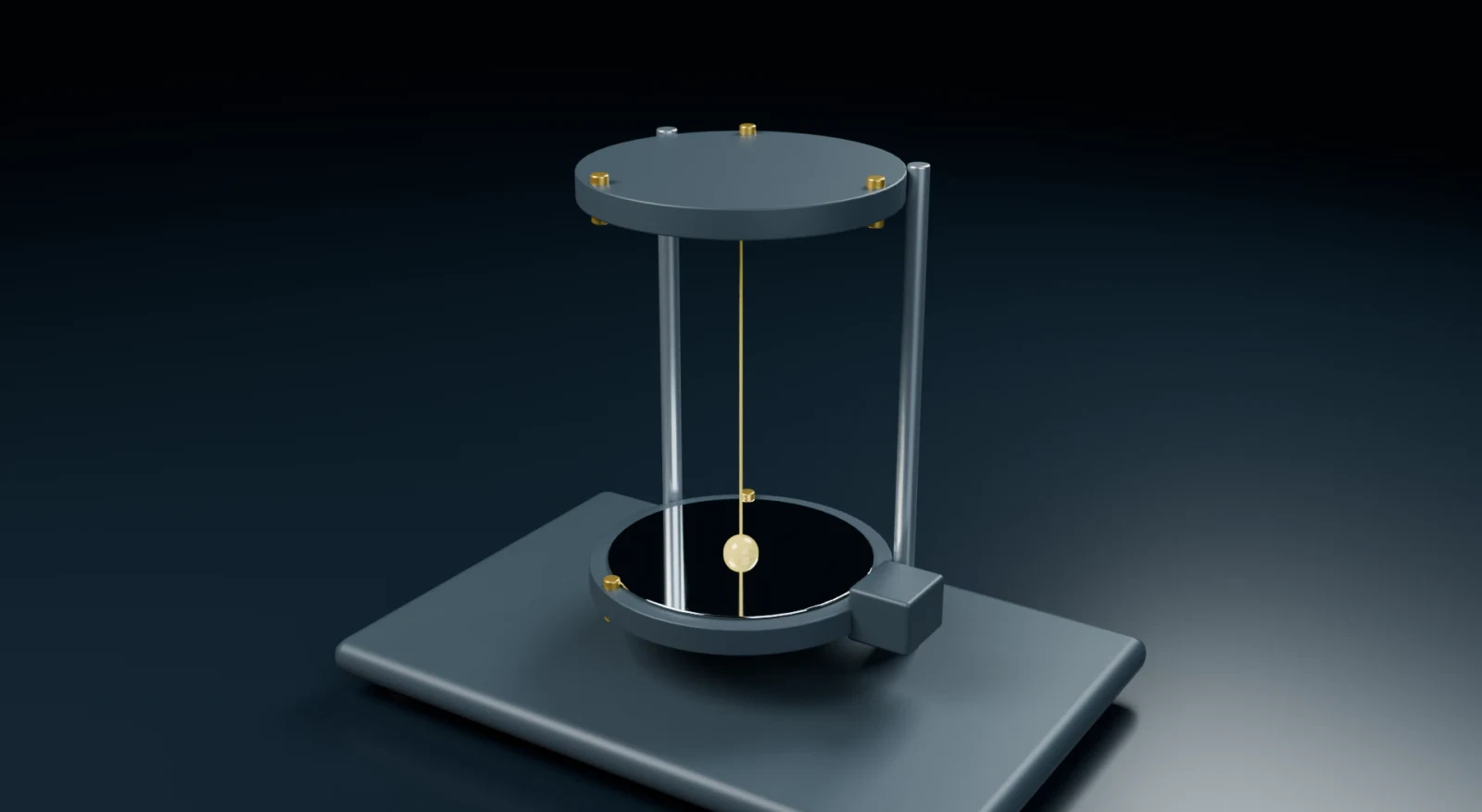
The three-dimensional instrument follows the clock, so its mirrors remain stationary. The gold pulse moves between them. Below it, the diagram can switch between this same clock frame and the laboratory frame, keeping the light trip tied to the same progress control.
Drag to inspect the apparatus, or use the view buttons. The lesson controls also change this view.
04Read the three sides, then do the algebra
In the laboratory let the half-trip last . The clock moves sideways at speed , so the orange base is . Light still travels at speed , so the gold diagonal is . The blue vertical side is the unchanged transverse gap . We use the same transverse ruler scale for these parallel frames; isotropy and reciprocity prevent one frame from assigning a different perpendicular scale to the other. More explicitly, let the perpendicular scale change be a positive factor . Reversing the frames changes the direction of motion, but isotropy gives the same . Transforming there and back must recover the original length, so and . A right triangle now relates the three lengths.
Inspect the area argument
Four identical right triangles occupy the corners of the large square. Each has two short sides called and , and a long side called . Their four long sides enclose the middle square. Switch the emphasis to see the area being subtracted and the area left behind.
The large square has side , so its area is . Each triangle has half the area of a rectangle with sides , so four of them occupy . The inner edges all have length . Each inner corner is a right angle too. Look at a point where two triangles meet on a side of the large square. The inner corner sits between an acute angle of one triangle and an acute angle of the other, and the three angles together fill the straight side: a half-turn. Those two acute angles are the two smaller angles of the same right triangle. A triangle’s three angles also add to a half-turn, which you can check by drawing a line through one vertex parallel to the opposite side and moving the other two angles along it. Taking away the right angle leaves a right angle for the two acute angles together. A half-turn minus that right angle leaves a right angle for the inner corner. Thus the inner shape is a square, and subtracting the four triangles from the large square gives the result.
The area argument shows that in a right triangle, the square of the longest side equals the sum of the squares of the other two sides: . In our light path the longest side is the gold diagonal , and the two shorter sides are the blue height and the orange base . Put these three lengths into the relationship.
We want the time measured in the laboratory. Subtracting the sideways distance squared from both sides puts both terms containing that time on one side. Factor out the shared time squared, divide by its coefficient, and take the positive square root. We use the positive root because the elapsed time is positive.
We already found . Substitute it and define the factor as a convenient name. The restriction keeps the square root positive for a material clock.
For , the squared speed fraction is ; subtracting from gives ; its square root is ; hence . A moving clock therefore records while the laboratory assigns between those clock events. The longer light path and unchanged light speed require the longer laboratory duration.
05Why an atomic clock has the same effect
The light clock makes the reasoning visible, but special relativity is a statement about all local physical laws. Imagine a light clock and an atomic clock calibrated together and carried side by side. If uniform motion alone changed their relative rate, an enclosed observer could detect a preferred absolute speed by comparing them. That would contradict the relativity principle used in our calculation. Ideal clocks therefore measure the same proper time along the same path.
Real clocks can also be disturbed by temperature, mechanical stress or acceleration that changes their mechanism. Those engineering effects must be controlled in an experiment. The prediction here concerns ideal clocks, or real clocks whose such disturbances have been measured and corrected.
06Can each inertial observer call the other clock slower?
Yes, each can, when each uses their own synchronised row of stationary clocks. The comparisons use different pairs of separated events. The laboratory compares two events on the travelling clock, using two laboratory clocks at those locations. The traveller instead compares two events on a laboratory clock, using the traveller’s own synchronisation. Different frames disagree about which distant events are simultaneous.
Which distant events are compared?
The blue vertical path is one laboratory clock; the orange slanted path is a uniformly travelling clock. Both leave the bottom meeting event. Keep the later orange event fixed, and choose whose synchronisation selects its simultaneous blue event. Gold dots mark the selected pair. This is a schematic of event selection, with no numerical scale.
This is not “both readings at one meeting are smaller than each other”. A single meeting gives one pair of local readings. For an unambiguous elapsed-time comparison, arrange two meetings. If one clock leaves and returns, its motion cannot stay in the same inertial frame throughout the whole journey. Let us construct that journey instead of treating it as two identical inertial histories.
07The travelling-clock calculation
Compare the clocks where they meet again
Blue stays at home; orange travels out and back. The horizontal direction is distance from home, in light-years. Upward is home-frame time, in years. Both axes use the same scale, and the gold dashed line is a light path, so the traveller’s slope can be compared with it directly. The two paths start and finish at the same events. Select the speed and step through the trip. This idealised drawing neglects gravity and the duration of the turnaround.
At the default speed, the home frame assigns years to each leg. A light-year is the distance light travels in one year, so the turnaround is light-years away. Each travelling leg accumulates years. Add the two legs: the traveller records years, while home records years.
The turnaround distinguishes the histories. It is not a mysterious device that suddenly subtracts two years from a clock. In this idealisation the clock reading is continuous through the turnaround; the age difference is the sum of proper time along each whole path. A realistic gradual turn is handled by dividing the motion into short nearly uniform pieces, applying the same local rule to each, and adding their durations.
08Gravity gives us another way to separate clock rates
Keep two clocks fixed at different heights, so neither circles or travels relative to the source. Their rates can still differ. For stationary clocks outside a spherical non-rotating source, the clock at the smaller radius accumulates less proper time over the same static coordinate-time interval. “Stationary” requires supports or rockets; these clocks are not freely falling.
The comparison concerns gravitational potential and the complete clock paths, not just a local force reading. In a weak static field, a potential difference describes the energy per unit mass needed to lift something slowly between two locations. It compares locations; local acceleration describes the change at one location. Two places with the same local gravitational acceleration need not have the same clock-rate relationship. And an accelerating coordinate system in flat spacetime can also assign different stationary clock rates. A rate difference by itself is not a complete measurement of curvature.
Hold two clocks at different radii
Blue is held at the larger radius; orange at the smaller radius. The clock hands turn once for every ten seconds recorded by that clock. Radius is measured in units of the source’s Schwarzschild radius, defined below. These deliberately strong-field values make the difference visible; they do not describe two ordinary floors of a building.
09State the gravitational input, then derive the comparison
We now specify the geometric law used by the model. This is the exterior Schwarzschild geometry of general relativity: an isolated, spherical, non-rotating, uncharged source, with clocks outside its matter and outside the horizon. Deriving this geometry from Einstein’s field equations is a separate problem; here it is an explicitly supplied physical model, not something our light-clock triangle proved.
The radial coordinate is defined so that a great circle on the sphere at that radius has circumference . Define the source length scale , where is the gravitational constant and is the source mass. The coordinate is chosen to agree with a stationary clock very far away. For a clock held at fixed position, the supplied geometry gives the following relation between a small coordinate interval and the clock interval ; the letter indicates a small interval.
Cancel the common positive , take the positive square root, and divide by . Because stays fixed, this factor is constant, so adding successive small intervals gives the same factor for a finite duration.
Use this once at the lower radius and once at the upper radius. Divide the two equations. Their common coordinate duration cancels, leaving the ratio of physically accumulated clock times.
For the default radii and , first calculate and . Their ratio is . Its square root is approximately . Thus ten upper-clock seconds correspond to lower-clock seconds in this stationary comparison.
10From the enlarged model to a real measurement
Near Earth, the fractional differences between ordinary heights are extremely small. NIST and JILA reported a measured gravitational frequency difference across a millimetre-scale atomic sample in 2022. Their experiment compares atomic ticking rates with extraordinary precision; it does not show a visibly slowed clock hand. This is evidence about actual clocks, beyond a geometric teaching picture.
If a clock also moves, both motion and gravitational geometry matter. We must specify its path and use a consistent coordinate system to accumulate its proper time. Multiplying unrelated “slowdown factors” without checking their frames and assumptions can give a wrong answer. The general question remains the one we began with: what duration does each clock record along its complete journey?
11Work through three comparisons
A clock moves at for five laboratory seconds. What does it record? — open the worked answer
Use the same two events on the moving clock. The speed fraction squared is , so and its square root is . Thus . This is a corrected frame comparison, not the arrival spacing of a remote video.
Why can’t the traveller use the home observer’s argument in reverse for the whole journey? — open the worked answer
The home clock remains in one inertial frame in this model. The traveller uses different outward and inward inertial frames, with different assignments of distant simultaneity. The full paths are different. Adding each leg’s proper time gives the readings at the shared reunion without any contradiction.
If both stationary clocks are placed at the same radius, what does the gravitational model give? — open the worked answer
The numerator and denominator are identical, so their ratio is and its square root is . The accumulated durations match. This checks the comparison rule; it does not say that all clocks in a gravitational field match regardless of their motion or location.
Sources and the role of each model
The mathematical steps on this page can be checked directly. The physical starting laws and experimental evidence can be checked in the following original papers, research institutions and measurement reports. The teaching diagrams are constructed for this lesson; they are not photographs of spacetime.