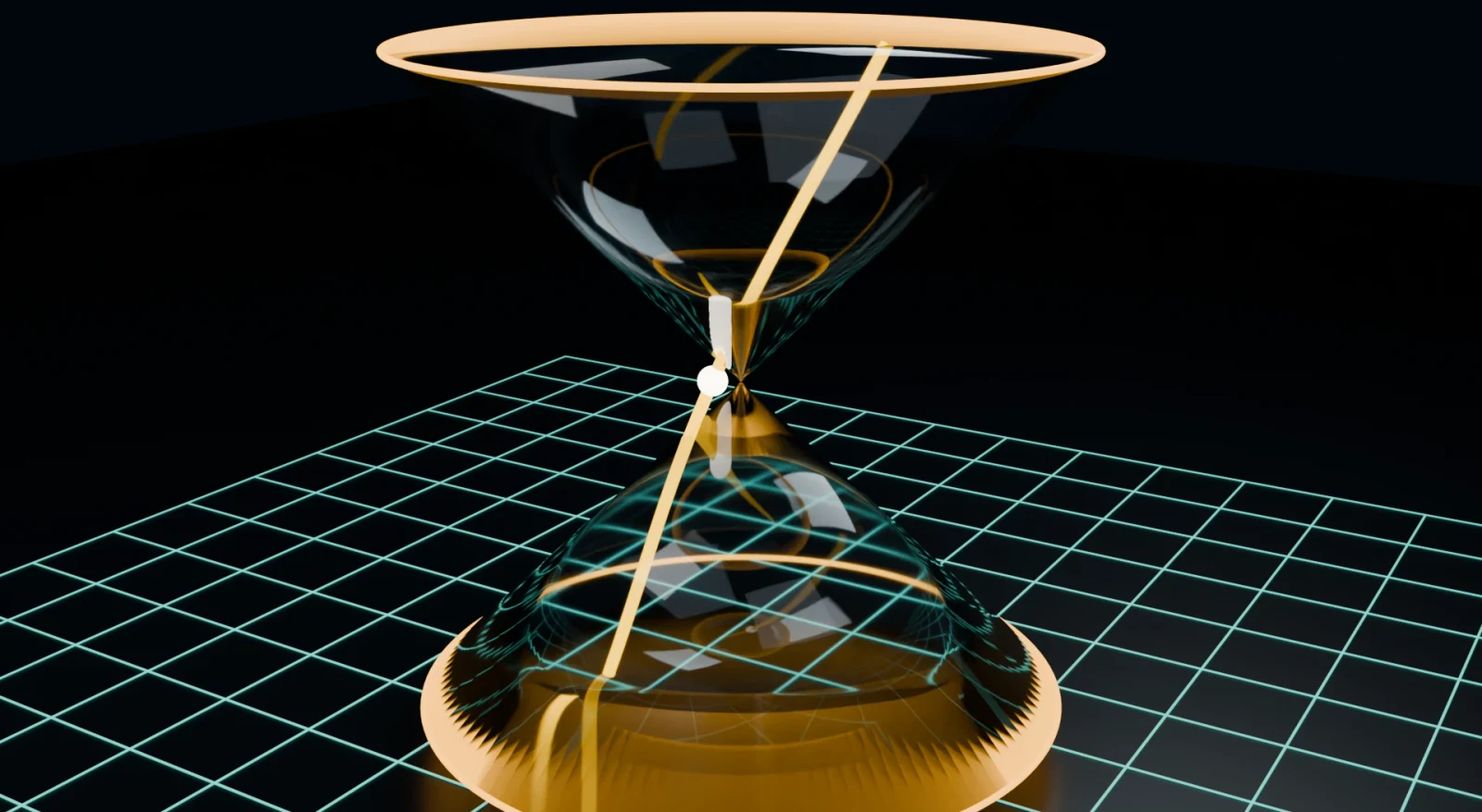
Why we need Minkowski spacetime
01Spacetime is a geometry of events
“Meet me at the station” leaves out when. “Meet me at three” leaves out where. An **event needs both**. In a room, **three independent numbers locate a small flash**: left–right, forward–back, and up–down. A **fourth number says when it happens**. **Independence** means that changing the time label does not follow merely from knowing those three position labels.
Minkowski spacetime is the flat spacetime geometry used by special relativity. Its points are events, each with a place and a time. An inertial observer uses a frame in which an object free of external forces keeps moving uniformly along a straight line. Different such observers can assign different space and time coordinates to the same events. They still agree on two things: a particular signed interval (chapter 8 shows how the coordinates produce it) and which events can influence which others. This page builds on the light-speed and time-dilation pages: every inertial observer measures the same vacuum light speed, and moving clocks record different amounts of time. We will build this answer from the ordinary appointment above.
Calling time a fourth coordinate does not call it a fourth spatial direction. A dimension here counts independent coordinates needed to locate an event. We will see that time enters the measurement rule differently from the spatial coordinates. Counting four is only the beginning, not the whole claim.
02First draw one spatial direction and time
Give a flash both an address and a time
The horizontal row represents a straight street, measured from a chosen origin. The selected flash happens at the position and second shown. Locate that position along the street. Moving its record to the matching time row gives a point on our graph. The record moves upward to show time; the flash did not travel upward.
We left out the other two spatial coordinates to make a readable page, keeping them fixed. Each dot represents a brief event, not an entire object. A sequence of events belonging to one object forms its worldline: its history on the diagram. An object waiting at one location has a vertical worldline because its time changes while its position does not. An object moving along the street has a slanted one.
Nothing needs to physically move into the page’s upward direction. We already draw temperature above a date on an ordinary graph without treating temperature as a direction in space. A spacetime plot likewise puts a non-spatial quantity on a graphical axis. The physics lies in the relationships between the measurements.
03Why write on the time axis?
A horizontal distance might be in metres while time is in seconds. To compare their roles in one geometric rule, we first give them matching units. The vacuum speed of light is a distance per time. Multiplying a duration by produces a length. Write for this rescaled time coordinate. This changes units, not the physical nature of time.
A light-second is defined as multiplied by one second. Therefore after , the coordinate is light-seconds. This does not say the waiting observer has moved three light-seconds in space. It converts their time label using a universal speed.
Light emitted at the origin travels a distance in time . Along our one spatial direction, the two possible light paths obey and . If both graph axes have the same length scale, those are diagonal lines at equal slopes. The familiar light cone begins with this distance–speed–time statement.
04Use light to sort possible connections
Can a signal reach the second event?
The first event is the origin. Horizontal is distance in light-seconds; vertical is , in the same length unit. One light-second is the distance light travels in one second. Gold boundaries show light travelling left and right. The blue region can be reached from the origin by speeds below light speed. Move the second event with the controls.
There is enough time for a slower-than-light traveller. The green segment lies inside the light boundary.
To reach a location in time , a uniform traveller needs . Dividing by gives . If the magnitude of this ratio is less than one, a slower-than-light path is available. If it equals one, the direct connection is lightlike. If it exceeds one, the connection would require faster-than-light travel. In three spatial dimensions, all possible light directions form a cone in a space-plus-time diagram; here we see one slice.
For future events, compare the squares and . Squaring removes the left–right sign without changing the comparison of their magnitudes. Their difference is positive inside the cone, zero on the light boundary, and negative outside. We name these timelike, lightlike and spacelike separations. “Spacelike” does not mean the event has no time coordinate; it describes this relationship between two events.
05Why a time axis alone is not yet Minkowski geometry
Newtonian mechanics can also draw position against time. What changes in special relativity is how inertial observers relate their measurements. They all measure the same vacuum light speed, even when their reference frames move relative to one another. The old rule “subtract the frame’s velocity from everything while keeping time unchanged” cannot preserve both left-going and right-going light speeds.
For example, that old rule would write and . Put in the right-going light path : it gives . The new frame would assign speed rather than . We therefore need a transformation that changes both position and time. The following construction finds it; we do not assume interval invariance first.
06Construct the coordinate change in small steps
Use and , so is the signed fraction of light speed. A prime marks the moving frame’s numbers. Choose the origins to meet when both clocks read zero. Assume uniform space and time, straight uniform inertial motion, and identical calibrations. These assumptions make the transformation linear: adding the same coordinate increment anywhere must produce the same transformed increment. A nonlinear rule would make that conversion depend on location or time.
The moving origin follows , and must have . The linear expression with that zero is , where the scale is still unknown. Write the most general linear time expression as . We now determine the two coefficients by requiring both light directions to retain speed .
For right-going light , the new numbers must obey . Substitute and cancel to get the first equation. For left-going light , require to get the second. Add the equations to isolate ; subtract the second from the first to isolate .
We now have . To find , reverse the roles of the two frames. By the relativity principle their scale rule is the same; reversing the spatial direction does not change a scale, so . The inverse spatial equation is therefore . Put our two expressions into it.
This must work for every , so the multiplying factor must be one: . Divide by the positive and take the positive square root, keeping the time orientation and the zero-speed scale. The resulting factor is named .
These are Lorentz transformations along one spatial direction. Notice the term in the time formula. Time coordinates change partly according to position. That is the precise reason that different frames group distant events into different “nows”. Dividing by gives the equivalent .
07Watch coordinates change while the event stays put
Keep the event; change the inertial frame
The grey grid belongs to the original laboratory: horizontal is , upward is . The moving observer starts at the origin and follows the solid blue line; this is their time axis, where . The orange dashed line through the origin is their space axis, where . The optional orange line through the selected event contains events the moving observer calls simultaneous with it. The green dot is the selected event. Both axes use the same scale, so the gold dashed diagonals are light paths through the origin. Watch the blue and orange axes as you move the slider: they lean toward the same gold diagonal by equal amounts.
The point has not moved: no new physical event occurred when we changed the slider. Its coordinate labels and the distant events grouped as “now” changed. The signed interval stays the same. For the spacelike pair, changing the frame can even reverse the sign of the time coordinate.
For the default event , and , we have . Thus and . The moving observer reaches the event at their own spatial origin. Their time is four seconds when lengths are measured in light-seconds. The original laboratory assigns five seconds and a position three light-seconds away.
Why do the coloured axes tilt? The moving time axis is the set ; from the derived transformation this means . Its space axis is , which means . Events simultaneous with a chosen event keep constant, so their coordinates satisfy . All the coloured lines are drawn from these equations. They are not ordinary right-angle rotations of a sheet of paper.
08Find the measurement all these frames share
Coordinates differ, so we ask whether any combination survives the change. Try the difference , motivated by the light boundary where the two squared lengths match. Substitute the transformations, expand both squares, and keep the mixed terms visible until they cancel.
The final step uses , so the two factors multiply to one. The signed quantity is called the spacetime interval squared, using the positive-time sign convention. The notation is traditional; it can be negative for spacelike separation, so it is not always the square of an ordinary real length.
For any two events, use their coordinate differences: and . The same algebra works because the transformation is linear. With three spatial directions, the squared distance is . To see why, the right-triangle rule in the horizontal plane gives a squared distance of . That distance and the vertical difference form another right triangle, so we add . The full rule is therefore:
Inspect the area argument
Four identical right triangles occupy the corners of the large square. Each has two short sides called and , and a long side called . Their four long sides enclose the middle square. Switch the emphasis to see the area being subtracted and the area left behind.
The large square has side , so its area is . Each triangle has half the area of a rectangle with sides , so four of them occupy . The inner edges all have length . Each inner corner is a right angle too. Look at a point where two triangles meet on a side of the large square. The inner corner sits between an acute angle of one triangle and an acute angle of the other, and the three angles together fill the straight side: a half-turn. Those two acute angles are the two smaller angles of the same right triangle. A triangle’s three angles also add to a half-turn, which you can check by drawing a line through one vertex parallel to the opposite side and moving the other two angles along it. Taking away the right angle leaves a right angle for the two acute angles together. A half-turn minus that right angle leaves a right angle for the inner corner. Thus the inner shape is a square, and subtracting the four triangles from the large square gives the result.
A boost along leaves the transverse coordinates unchanged for parallel identically calibrated axes, so our cancellation proves this full expression invariant for that boost. To check the transverse statement, call a possible perpendicular scale factor . Reversing the frames and reversing the motion direction give the same positive factor by reciprocity and isotropy. Going there and back gives , hence . A spatial rotation preserves the sum of the three spatial squares. Combining spatial rotations and such boosts covers arbitrary relative inertial directions. This measurement rule is the Minkowski metric; “metric” means the rule assigning intervals from coordinate differences.
09Why time is not a fourth spatial axis
In ordinary space, squared distances in perpendicular directions add with the same sign. Here the time term has the opposite sign from all three spatial terms. An overall reversal of every sign is another common convention, but the one-versus-three distinction remains. The Lorentz calculation shows why this rule survives changes of observer; the picture’s vertical axis alone does not establish it.
This sign difference gives light its zero interval even between distinct events, divides separations into causal classes, and makes the clock duration depend on its path. A usual spatial rotation mixes left–right with up–down while preserving a sum of squares. A change of inertial observer mixes space with time while preserving their signed difference. The two transformations are not the same operation.
For a future timelike separation, and . Our formula gives . Since and , the product lies strictly between minus one and one. Therefore , and stays positive. Inertial observers cannot reverse the order of a cause and its slower-than-light consequence merely by changing frames.
10Recover what a travelling clock measures
For a straight timelike trip, choose the frame moving with the clock. Its two endpoint events occur at the same spatial position, so . Its coordinate duration is the clock’s proper time . In that frame the interval is . Invariance lets us equate it to the laboratory expression.
We divided by , substituted , factored out , and took the positive square root. For the event at light-seconds after seconds, the proper time is seconds. The readout in our frame experiment now has a physical meaning: it is what a clock carried straight from the origin to that event records.
For a changing-speed path, this endpoint calculation is not the whole elapsed time. Divide the path into very short, nearly straight pieces; calculate each piece’s positive proper time and add them. Taking finer pieces gives the continuous-path value. Two paths can share endpoints and accumulate different totals. The endpoint interval and the elapsed time along an arbitrary path are related concepts, not interchangeable numbers.
11What “flat” adds to the definition
Flat does not mean that all worldlines look straight or that we have removed time. It means that the geometry has no spacetime curvature. In standard inertial coordinates the same Minkowski measurement rule works throughout the region. Accelerated objects can have curved worldlines in this flat geometry, just as a car can turn on a flat road.
General relativity uses a more general geometry. In a sufficiently small freely falling region, Minkowski geometry gives the local approximation; comparisons across a larger curved region require a position-dependent metric. Thus this lesson supplies the local language of clocks, light cones and events needed for curved spacetime, without saying every gravitational situation is globally Minkowski.
12Check what the geometry lets you conclude
Two events are four light-seconds apart and two seconds apart. Can an ordinary signal connect them? — open the worked answer
The required speed is times light speed. The signed interval is light-seconds squared, so the separation is spacelike. Their order can change between inertial frames, but that does not reverse an ordinary cause-and-effect chain because no such chain can connect the two events.
If time is independent of three positions, why is it not just another spatial direction? — open the worked answer
Independence counts the coordinates needed to identify an event. Their physical character comes from the measurement rule and allowed transformations. Time enters the metric with the opposite sign, so the geometry has light cones and a causal ordering for timelike events. An ordinary four-dimensional Euclidean space, with four positive squared terms, has a different geometry.
A light ray has zero interval. Does that mean its emission and reception are the same event? — open the worked answer
No. Their nonzero time and space terms cancel in the signed rule: for one second and one light-second, . The coordinates still distinguish two events. A photon has no inertial rest frame, so we do not describe this by pretending to put a working clock at rest beside the photon.
Sources and the role of each model
The mathematical steps on this page can be checked directly. The physical starting laws and experimental evidence can be checked in the following original papers, research institutions and measurement reports. The teaching diagrams are constructed for this lesson; they are not photographs of spacetime.