Gravity and curved spacetime
01What does “curved spacetime” actually mean?
When you let go of a ball, it falls. When you stand still, the floor presses against your feet. These are different experiences: the **ball has lost its support**, while **you still have yours**. The pressure you feel is already a useful clue. We first separate “a path that changes relative to the ground” from “a push that a person or instrument actually feels”.
In general relativity, gravity is described through the geometry of space and time: the rules by which rulers measure separation, clocks measure duration, and freely moving objects continue their motion. Matter and energy help determine those rules. The ball and the floor in the opening example let us make each part of this sentence concrete. This page builds on the time-dilation and Minkowski-spacetime pages: clock readings can differ, and an event is labelled by a place and a time.
A push or pull is a force. A change of velocity is acceleration; velocity tells us both speed and direction. A bathroom scale measures how hard its surface pushes on you. It therefore reports support, not an independent measurement of the spacetime around you.
02Fall alongside the ball
Suppose we remove air resistance and release the whole room as well as the ball. Near the same place, freely falling objects have the same gravitational acceleration, to the accuracy of this small-room experiment. This universality is an observed physical starting point. We do not prove it by drawing a lift.
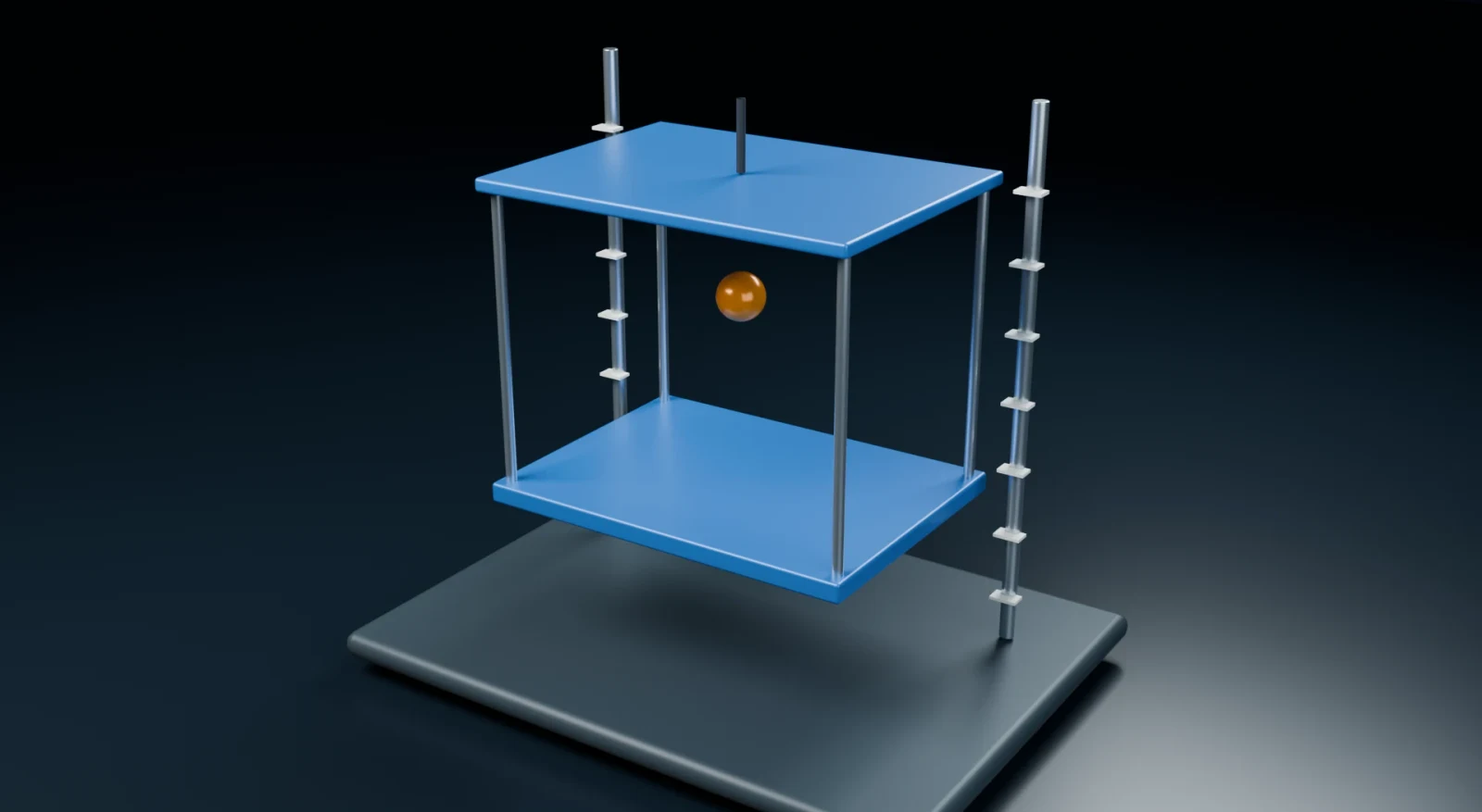
Release the ball; then release the room
Blue is the room; orange is a ball released from rest. The grey horizontal marks belong to the ground. Choose whether the room is supported or freely falling, then play. Switch to the room’s view to subtract the room’s own movement from everything we see.
The three-dimensional apparatus below is always seen from outside, relative to the fixed guide marks. Its roof and near walls are open so we can inspect the ball. The diagram below it can separately switch to the falling room’s coordinates. Both use the same release progress.
Drag to inspect the apparatus, or use the view buttons. The lesson controls also change this view.
If the room drops by the same amount as the ball, the ball stays at the same height above its floor. The ball is falling relative to the ground, yet floating relative to the room. A person falling with it feels weightless because there is no floor pushing them away from this free motion. Gravity has not disappeared from the surroundings.
The animation uses a short, slow-motion approximation with constant downward acceleration. Why does the fall distance contain a square of time? Starting from rest with acceleration , speed grows from to in time . Because this growth is linear, the average speed is . Distance is average speed times duration, so . In the falling view we subtract the room’s same from the ball’s movement, leaving no relative drop.
03What a small room can, and cannot, tell us
Now consider a rocket far from a gravitating body. If its engine pushes its floor upward toward a freely floating ball, the ball approaches the floor. Inside, this can reproduce the local behaviour of a supported room on Earth. This is the useful content of the equivalence principle: suitable acceleration and gravity can give the same local experiments.
“Local” matters. It means sufficiently close together in space and sufficiently brief in time that variations across the experiment can be neglected. We have removed one common acceleration by choosing a falling viewpoint. We have not yet checked whether every nearby object has exactly that same acceleration. Two balls will let us make that check.
04The difference that survives free fall
Can two freely falling balls detect what one ball misses?
Both balls start at the same height with no sideways motion. Dashed lines show the initial directions of falling. The small gold circle marks the source’s centre. Play a short release, then compare a uniform field with a central field. Widen the starting separation to make the difference easier to inspect.
For a central source, the left ball falls a little to the right and the right ball a little to the left. Their separation shrinks. Following either ball does not remove this relative change. Differences in gravitational acceleration across neighbouring locations are called tidal effects. They include changes of direction, as here, and changes of strength between a lower and an upper ball.
We can check the diagram’s numbers without assuming a full course in relativity. Use a weak-field, low-speed Newtonian model as our starting law. Write for the right ball’s horizontal distance from the centre line, for its height above the centre, and for its distance to the centre. A right triangle gives . Let collect the gravitational constant and the source mass ; the acceleration magnitude is the empirical Newtonian rule .
Inspect the area argument
Four identical right triangles occupy the corners of the large square. Each has two short sides called and , and a long side called . Their four long sides enclose the middle square. Switch the emphasis to see the area being subtracted and the area left behind.
The large square has side , so its area is . Each triangle has half the area of a rectangle with sides , so four of them occupy . The inner edges all have length . Each inner corner is a right angle too. Look at a point where two triangles meet on a side of the large square. The inner corner sits between an acute angle of one triangle and an acute angle of the other, and the three angles together fill the straight side: a half-turn. Those two acute angles are the two smaller angles of the same right triangle. A triangle’s three angles also add to a half-turn, which you can check by drawing a line through one vertex parallel to the opposite side and moving the other two angles along it. Taking away the right angle leaves a right angle for the two acute angles together. A half-turn minus that right angle leaves a right angle for the inner corner. Thus the inner shape is a square, and subtracting the four triangles from the large square gives the result.
The inward direction has horizontal fraction and vertical fraction , obtained from the similar triangle made by the direction arrow. Multiplying the magnitude by these fractions gives the two components. We freeze them at the initial position for this brief construction; longer motion would require updating them continuously.
From the distance calculation in the lift, the right ball moves to . The left ball is its mirror image, so separation is twice this number. For the default , , , we get , so and . Then . At , separation is . These are diagram units chosen to expose the change. A uniform downward field has , so its separation stays .
05Before spacetime curvature, what is geometry?
Geometry concerns relations we can measure: distances, angles, and which routes continue without a local turn. Coordinates are numbers we use to label positions. A map can distort coordinates while leaving all physical measurements unchanged. We must distinguish the map from the measurement rule.
Bending a drawing is not enough
The orange line is the same straight road throughout. The blue grid records the old ruler marks. Move the slider: we change the map rule for the vertical coordinate, and redraw the road and its ruler together. No physical road has bent.
Here is the rule, so the picture has no hidden operation. Keep the horizontal number and replace the vertical number by , where is the slider value. On the road, , so its new drawing obeys . At and , the new number is . That is a changed label, not a measured rise of the road. A curved line on a page cannot by itself establish curvature.
A measurement that survives a different map
Now use the surface of a globe as a geometry example. Blue and orange are two meridians a quarter-turn apart; green is the equator. Follow the three shortest local routes in order. At each corner, measure the angle on the surface, not the angle of its flattened screen image.
Each meridian meets the equator at a right angle. Their longitude difference is a quarter-turn, so their angle at the pole is also . Adding the three measured angles gives . For a flat triangle the corresponding total is : draw a line through one vertex parallel to the opposite side, transfer the other two angles by parallel-line angle equality, and the three angles fill a straight half-turn. The globe’s different result concerns measurements within its surface. It does not disappear when we choose a new map.
A route that keeps going as straight as the local geometry permits is called a geodesic. On a spherical surface, the meridians and equator are examples. The globe is a model for understanding intrinsic geometry: what measurements made within a space reveal. It is not a claim that the universe is the surface of this sphere.
06Why the word includes time
A place alone is not a complete event. A ball passing a door now and passing that door tomorrow are different happenings. We must record where and when. The collection of those events is spacetime. A clock carried by the ball measures the duration along its sequence of events; a ruler compares nearby positions. Geometry must describe both kinds of measurement.
Even a ball with no initial motion through space has successive events: here now, here a moment later. Its history still extends through spacetime. General relativity’s free-fall rule says that a sufficiently small test body, with no non-gravitational force acting on it, follows a spacetime geodesic. “Test body” means that we neglect the body’s own effect on the surrounding geometry. This rule is part of the physical theory, not a consequence proved by the globe.
A falling ball follows this free path. The floor stops you from following yours: it keeps pushing you upward relative to neighbouring free-falling bodies. This is why “I remain at the same height” does not mean “I feel no acceleration”. The floor maintains your location by continually supplying support.
07Where the two-ball experiment meets curvature
Take many neighbouring free-fall paths, with matching initial velocities in a small local frame. In flat spacetime these paths maintain their relative inertial motion. In curved spacetime they can acquire a relative acceleration. The two-ball change is a way to measure components of this curvature; different initial directions probe different components. One converging pair is not a complete map of curvature, and convergence caused only by different starting velocities would not be the same test.
This is the point of replacing a bent-sheet picture by a measurement. You can rename coordinates, and you can fall with one object. You cannot remove all genuine tidal measurements throughout a finite curved region by doing either. “Curvature” names this structure in the spacetime geometry, rather than the appearance of a grid.
08What determines the geometry?
Einstein’s field equations connect spacetime geometry with energy, momentum and stresses, including pressure. Energy measures the capacity for physical changes; momentum records motion with a direction; stresses describe how matter pushes or pulls across its interior. Mass is one contribution, but the source is not restricted to heavy objects. The equations are physical laws judged by their predictions; they are not definitions that become true by choosing coordinates. Solving them requires information about the matter and the surrounding or initial situation.
An empty region can still be curved: the region outside a star contains little matter but is influenced by the complete gravitational solution. Gravitational waves can also travel through a vacuum. Therefore “there is no matter at this point” does not imply “spacetime is flat here”. The full equations distinguish different parts of curvature; this lesson uses measurable paths and clocks rather than introducing that tensor notation without its prerequisites.
Light also follows the spacetime geometry. Its free path is a lightlike geodesic, meaning a path locally travelled at the vacuum light speed. Distant observers can find that its overall direction changes near a massive object. This does not require a photon to have rest mass. Our gravity picture has become broader than a downward pull on heavy objects: it governs clocks, free-fall paths and light signals together.
09What the rubber sheet leaves unexplained
A ball rolling into a dented sheet moves because Earth’s gravity pulls it downward and the sheet supplies contact forces. Using that picture as the cause of gravity would use gravity to explain itself. The sheet also shows two spatial dimensions embedded in a third, while our subject has three spatial coordinates and one time coordinate. Spacetime curvature does not require a material fabric, an outside downward direction, or a surrounding higher-dimensional room.
10Try using the distinction yourself
An astronaut floats in orbit. Has Earth’s gravity become zero? — open the worked answer
No. Astronaut and spacecraft are freely falling together. Their shared motion removes the need for a floor to support the astronaut. The curved orbital path and measurable tidal differences remain. Weightlessness describes the absence of support, not necessarily the absence of gravity.
A grid line looks bent after a coordinate change. Have we created gravity? — open the worked answer
No. Ask what rulers, clocks and neighbouring free objects measure. In the chart experiment the road, grid and measurement rule changed representation together; nothing physically changed. Curvature concerns invariant measurement relationships, not the shape of coordinate ink.
Two freely released balls begin to accelerate toward each other in a falling room. What should we check? — open the worked answer
First exclude mutual attraction, electrical forces, air flow and different initial velocities; use small neutral test bodies. If the measured relative acceleration is gravitational, it is a tidal effect. It cannot be removed merely by following the centre of the room, and it probes spacetime curvature.
Sources and the role of each model
The mathematical steps on this page can be checked directly. The physical starting laws and experimental evidence can be checked in the following original papers, research institutions and measurement reports. The teaching diagrams are constructed for this lesson; they are not photographs of spacetime.