Frames of reference
Back to physicsSit in a train that is pulling out of a station and look out of the window. For a moment it can feel as if you are sitting still and the platform is sliding away. Both descriptions sound reasonable: you are moving compared with the platform, and the platform is moving compared with you. So which one is really moving?
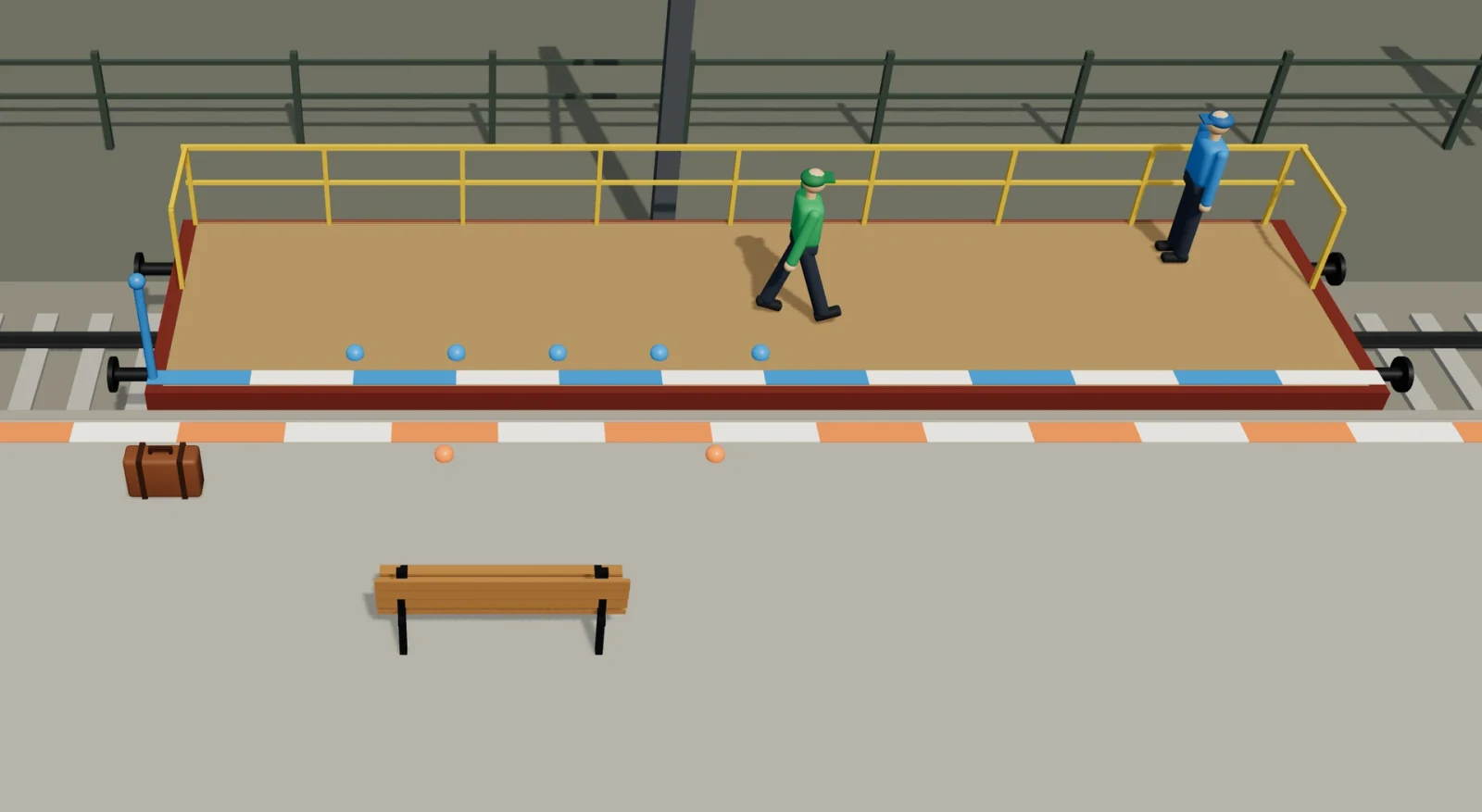
Physics answers this by first asking another question: compared with what? Every position, speed and path in mechanics is measured by someone, from something. We start from the simplest question: where is an object? Then we build up slowly. When we switch from one observer to another, what changes and what stays the same? Everything happens at one small station, with a platform, a flat wagon on the track and a few people. So you can always see what the numbers describe.
Where is it?
Let’s start with the suitcase on the platform. Suppose someone asks where it is. You could say “next to the lamp post”, or “a few steps before the bench”, or “in front of me”. Each of these answers works, and each of them names something else: the lamp post, the bench, or you. Notice that there is no way to say where the suitcase is without naming something to compare it with. Even “here” quietly uses yourself.
Words like “near” and “a few steps” are fine in everyday life, but physics needs numbers, so that two people can check each other’s measurements. To turn a place into a number we make three choices. First, a starting point, called the origin: the place whose number is zero. Second, a direction that counts as positive; the opposite direction then counts as negative. Third, a unit of length, such as the metre. Along the edge of the platform in the model runs a ruler painted in one-metre segments, orange and white, so you can count metres directly.
Now try it. Choose the clock, the lamp post or the bench as the origin, and choose which way counts as positive. The orange flag marks the origin and the orange arrow on the platform shows the positive direction. The ruler drawn under the picture repeats the same choice with numbers, and the table gives the number we would write for each object. Watch what happens to the suitcase’s number.
Orange flag: the origin · orange arrow: the positive direction · drag to look around
| Object | Position |
|---|---|
| clock | |
| lamp post | |
| suitcase | |
| bench |
Take the lamp post as the origin, and the direction the wagon travels (to the right) as positive. The suitcase is at : seven segments to the right of the lamp post. With the bench as the origin, it is at , because it is to the left of the bench, on the negative side. With the clock as the origin, it is at . The clock is to the left of the lamp post, so the trip from the clock to the suitcase contains 5 segments to the lamp post and another 7 beyond it: . Reversing the positive direction reverses every sign. Yet the suitcase has not moved. Our description changed because we changed the origin or direction. Whenever we write a position, we must also say what it is measured from.
How did we get so quickly? Think of walking along the ruler. To go from the lamp post to the suitcase, we walk . We could also go in two hops. The first hop is from the lamp post to the bench, which is . The second is from the bench to the suitcase, an amount we do not know yet. The two hops must add up to the same . So the unknown hop is . The minus sign says that the second hop goes backwards, towards the lamp post. Hops along a line add up: this is our main tool, and we will use it again for the moving wagon.
With the clock as the origin and the direction the wagon travels as positive, where is the bench?
A ruler and a clock
A description of motion needs one more thing. Motion means that a position changes as time passes. So we must also say when each position was measured. For that we need a clock and, again, a choice of zero: the moment we call . The station clock on the platform will be our clock. In every experiment here, its second hand follows the time shown beside the picture.
Now we can name these choices together. We need something we treat as standing still (here, the platform), with an origin and a positive direction marked on it. We also need a unit of length and a clock. Together they form a frame of reference, often shortened to frame. Positions and times measured this way are coordinates in that frame. The platform’s frame uses the orange-and-white ruler. We will also use a second frame belonging to the wagon.
- Something treated as standing still
- the platform
- An origin
- the lamp post (the orange flag)
- A positive direction
- the way the wagon travels (the orange arrow)
- A unit of length
- the metre (one segment of the ruler)
- A clock
- the station clock, which shows the time of each experiment
Two remarks. First, our ruler only measures along the track. That is enough for most of this lesson. But a position anywhere on the platform would need a second ruler across it and a third pointing up, so three numbers. We will use height once, in chapter 7. Second, a frame does not need a person in it. The “observers” here are just a short way of saying “measured with the platform’s ruler and clock” or “measured with the wagon’s ruler and clock”.
Motion and velocity
Now let the wagon move. The flat wagon has its own ruler painted along its edge in blue and white, which we will need later. For now, watch its rear end, where the blue post stands. Press play, or drag the time. Under the picture, the platform’s ruler shows where the rear end is at the time on the clock. The table lists the readings at whole seconds.
Watch the blue post at the wagon’s rear end
- Rear end now
| Rear end | |
|---|---|
In each second the rear end moves further along the platform’s ruler. A motion that covers the same distance in every equal stretch of time is called steady, or uniform. To describe how fast it goes with one number, we divide how far the object moved by how long that took. Take two readings from the table: at the rear end was at , and at it was at .
The symbol (the Greek capital letter delta) is read “change in”. In the table above, the position goes from to , a change of , written ; a change in position is also called the displacement. The time goes from to , a change of , written , the time interval. Their ratio is the velocity. Its unit is metres per second, , because we divided metres by seconds. Positions carry signs, so velocity does too. If the wagon went the other way, would be smaller than . Then and the velocity would both be negative. The sign tells us the direction, and the size tells us how fast. This motion is steady, so any other pair of readings gives the same result. From to the rear end goes from to , and again. If a motion is not steady, the same division gives the average velocity over the interval we chose. To describe a velocity that keeps changing, we use very short intervals, as we will in chapter 9.
One question is worth asking now: does the velocity depend on where we put the origin? Choose the bench as the origin in the experiment above. Every reading becomes smaller, because the bench is along the ruler from the lamp post: and . The displacement is , the same as before. This is not a coincidence. Call the new origin’s distance from the lamp post . Then the new readings are and , and their difference is
The appears once with a minus sign and once with a plus sign, so it cancels. Moving the origin shifts every position by the same amount. A difference of two positions does not notice the shift. So displacement and velocity do not depend on where the origin is. Keep this in mind, because the next chapters do something that looks similar but is quite different. Instead of moving the origin to another place on the platform, we will put it on something that moves.
A wagon moving steadily has its rear end at at and at at . What is its velocity?
Two observers
Now a walker marked with a green badge walks along the wagon towards its front, while the wagon moves along the platform. Two people watch. One, marked with an orange badge, stands on the platform. The other, marked with a blue badge, stands on the wagon near its front. The blue observer measures with the wagon’s blue-and-white ruler, which starts at the blue post at the rear end. The orange observer measures with the platform’s orange-and-white ruler. We need to keep the two kinds of number apart. So a position measured with the wagon’s ruler gets a small mark, (read “x prime”). A position measured with the platform’s ruler is plain . The mark is only a label meaning “measured on the wagon”.
The camera can stand on the platform next to the orange observer. Or it can move with the wagon, as if it were fixed to the wagon on a long arm. Switch between the two and play the motion. Then try the dots. Once every second, an orange dot is painted on the platform beside its ruler, level with the walker. At the same moment, a blue dot is painted on the wagon’s deck beside the wagon’s ruler, also level with the walker. The orange dots stay where they were painted. The blue dots ride along with the wagon.
Green: the walker · orange: the platform observer · blue: the wagon observer
- Walker, platform ruler
- Walker, wagon ruler
From the platform, the walker moves quickly to the right. Count the segments, and you will find the orange dots apart. From the wagon, the walker moves slowly: the blue dots are apart. And it is the platform, the lamp post and the fence that slide backwards. Neither view is wrong. They are two descriptions of one motion, made with two different rulers. The next two chapters ask how the two descriptions are connected. Can we work out one from the other?
At one moment the walker is at on the platform’s ruler and at on the wagon’s ruler. Which statement is right?
From one ruler to the other
Let’s set up the two rulers carefully. The platform’s ruler has its zero at the lamp post. The wagon’s ruler has its zero at the wagon’s rear end, the blue post. We start the clock, , at the moment the rear end passes the lamp post. So at that moment the two zeros are at the same place. The wagon moves steadily along the platform with velocity . In our experiment, .
Where is the wagon’s zero at time ? It started at the lamp post and moves metres in every second, so after seconds it has moved metres. On the platform’s ruler the rear end is therefore at . For example, at it is at .
Now take the walker. Suppose that at time the blue observer reads the walker at on the wagon’s ruler. What does the orange observer read? We can use the two-part journey from chapter 1. The part from the lamp post to the wagon’s rear end is . The part from the rear end to the walker is , because the wagon’s ruler starts at the rear end. Adding these signed distances gives the position measured from the lamp post:
For example, at the walker is at on the wagon’s ruler. The rear end is at on the platform’s ruler. So the platform’s ruler reads . Drag the time below and check this at other moments. The orange hop is , the blue hop is , and together they reach the walker.
We can also go the other way. Subtract from both sides of the rule, and we get the wagon’s reading from the platform’s reading:
These two lines are the whole rule for changing from one frame to the other. They hold when one frame moves steadily along the other, and the zeros meet at . The rule is called a Galilean transformation, after Galileo, who first argued carefully about moving frames. One assumption is hidden inside it: both observers use the same time , read from equally good clocks. At everyday speeds this has been tested so well that we hardly notice it. The last chapter shows where it eventually fails.
Compare this with chapter 3. Moving the origin to the bench shifted every reading by the same fixed amount, . Changing to the wagon’s frame shifts every reading by , an amount that keeps growing as time passes. That growing shift is why the two observers see different motions, and it is the subject of the next chapter.
A wagon moves at and the two zeros met at . At a passenger is at on the wagon’s ruler. Where is the passenger on the platform’s ruler?
Adding velocities
Now we can explain the dots of chapter 4. One key for the rest of the page: plain (position) and (velocity) are measured on the platform; and are measured on the wagon; is the wagon’s own velocity. In our experiment the walker starts at and walks along the wagon at : measured with the wagon’s ruler, the walker’s velocity is . What velocity does the platform measure?
Let’s follow the walker for one interval, from to , and measure the displacement with each ruler. On the wagon’s ruler the walker goes from to , a displacement of in , which is , as it should be. For the platform’s ruler we use the rule from the last chapter at both times:
The displacement measured from the platform has two parts. One is the the walker moved along the wagon. The other is the the wagon moved along the platform in those . Dividing both parts by the same gives the two velocities, so those velocities add. With these numbers: of the , comes from the wagon and from the walker, so in the velocities are . In one sentence: what the platform measures is what the wagon measures, plus what the wagon itself did. The letters below say the same thing once, for any two times; skip them if you like:
Dividing both sides by turns each displacement into a velocity. Here is the walker’s velocity measured on the platform. is the walker’s velocity measured on the wagon. And is the wagon’s velocity measured on the platform. In words: the velocity relative to the platform equals the velocity relative to the wagon, plus the wagon’s velocity relative to the platform.
Use the sliders to try other speeds. The arrows under the picture show how far each thing moves in one second. The orange arrow is the wagon’s . The blue arrow starts at the tip of the orange one; it is the walker’s along the wagon. The green arrow is the total , seen from the platform.
Orange dots: on the platform · blue dots: on the wagon, one every second
Try a negative : the walker turns round and walks towards the rear. With and , the platform sees : still forwards, but slowly. Now set . Then : the walker walks steadily along the wagon and yet stays beside the same metre of the platform. From the platform it looks like walking on the spot; from the wagon it looks like ordinary walking.
You may have used this rule already without naming it. Think of walking on a moving walkway at an airport, or rowing a boat on a river with a current. The rule is so familiar that it seems obvious. Keep it in mind anyway, because in the last chapter we will meet one thing it does not apply to.
A wagon moves at . A passenger walks towards the rear at relative to the wagon. What velocity does the platform measure for the passenger?
A path belongs to a frame
So far everything moved along the track. Now let’s add height. The walker stands still on the wagon, throws a ball straight up and catches it again. Meanwhile the wagon moves steadily at . For height we use a third ruler pointing up, with its zero at the level of the deck. The platform is exactly as high as the deck, and the wagon does not move up or down. So the two observers’ height rulers never slide past each other. At every moment, both observers measure the same height for the ball.
Watch the throw from the wagon first. The ball rises, slows down, stops for a moment and falls back into the hand. Its path is a straight vertical line: on the wagon’s ruler it stays at the whole time. Now watch from the platform. The ball rises and falls in the same way, but meanwhile it moves along the track, and its path is an arch. The dots, left at nine equal steps of time during the flight, record both paths.
Played about three times slower than real time · orange dots stay on the platform, blue dots ride on the wagon
- Ball, wagon ruler
- Ball, platform ruler
How can one ball have two different paths? Let’s build the arch from the straight line, using only the rule of chapter 5. In the wagon’s frame the nine snapshots stack up on one vertical line, because is always . To find where each snapshot is in the platform’s frame, keep its height and add to its position along the track, . The first snapshot, at , does not move. The second, a little later, moves a little. Each later snapshot moves further, because grows with time. Step through the construction below: the vertical stack opens into the arch.
Click a dot to see its numbers. Heights are the same in both frames, so only the position along the track changes.
Both paths are correct. A path is the set of places an object passes through. A place means a position measured in some frame, so a path belongs to a frame too. Notice also that the ball lands back in the hand in both descriptions. In the platform’s frame, the ball’s velocity along the track is . That is exactly the same as the hand’s. So after the flight, the ball and the hand are at the same place again.
A passenger in a steadily moving train drops a coin. What path does an observer on the platform see?
What every observer agrees on
Positions, velocities and paths all depend on the frame. Is anything the same for both observers? Yes, and these things matter most, because they are what physical laws are made of.
Time intervals. Both observers use the same , so they agree on how long anything takes. For example, the ball spends in the air, as the time bar in chapter 7 shows. (This is the assumption we noted in chapter 5.)
Distances between two things at the same moment. Suppose that at time the blue observer reads two points on the wagon at and . The orange observer reads and , so
The cancels, just as the origin’s position cancelled in chapter 3. So both observers agree, for example, that the wagon is long.
Changes of velocity. If the walker speeds up from to on the wagon, the platform sees the walker’s velocity change from to . The change it sees is
So both observers see the same change of velocity in the same time. The change of velocity in each second is called acceleration, so both observers measure the same acceleration. The wagon’s own velocity is not part of it, as long as stays the same.
This last point has a large consequence. The laws of motion connect forces with changes of velocity, not with velocity itself. Within this Newtonian model, the interaction forces are unchanged when we switch between frames moving at a constant relative velocity. And every observer moving steadily relative to the platform measures the same changes of velocity. So they all find the same laws. Galileo described this in 1632 with a ship. Shut yourself in a cabin below deck with some flies and butterflies, a bowl of fish and a bottle dripping into a jar. The ship may be in harbour, or sailing smoothly at a steady speed. Either way, the butterflies fly in every direction just as easily. The fish do not prefer the front or the back of the ship. The drops fall straight into the jar. Throwing a ball to a friend takes no more effort one way than the other. Nothing inside the cabin tells you whether the ship is moving.
Try it with our wagon. Hide everything outside the wagon. Then compare the wagon standing still with the wagon moving at . With the outside hidden, the two throws look exactly the same. That is because in the wagon’s frame they are the same: the same , the same heights, the same times. Only when you show the station can you see which wagon is moving.
The camera moves with the wagon · blue dots ride on the wagon
Compare the two throws with the outside hidden first.
Here is the idea in one sentence: steady motion cannot be detected by experiments done entirely inside the moving frame. This is called the principle of relativity. It answers the question we started with. “Which one is really moving, the train or the platform?” No experiment can test an answer. For the laws of motion, the platform’s frame and a frame moving steadily along it are equally good.
A platform observer and an observer on a steadily moving wagon both watch the walker. Which of these do they measure differently?
When the wagon speeds up
Everything so far assumed that the wagon moves steadily. Now let it start from rest and speed up. Its velocity grows by every second, so its acceleration is . When a velocity changes by the same amount every second, we say it has a constant acceleration . The unit is metres per second in each second, written . The wagon starts from zero and gains every second. So after seconds its velocity is
On the deck stands a small orange cart with free-turning wheels. Its wheels let it roll along the deck so easily that the deck can hardly push it forwards or backwards. Play the experiment and watch it from both frames.
Orange: the free-wheeling cart · dots every second
- Wagon, on the platform
- Cart, on the platform
- Cart, on the wagon
From the platform, the cart does nothing at all. Nothing pushes it along the track, so it stays where it was, from the lamp post, while the wagon speeds up beneath it. That is just what you would expect if a body with no push or pull keeps its velocity, which here is zero. From the wagon, the cart rolls towards the rear, faster and faster, although nothing pushes it backwards.
We can compute the cart’s velocity on the wagon. The two-hop rule of chapter 5 holds at every moment, whatever the wagon is doing. The cart’s platform reading equals the rear end’s platform reading plus the cart’s wagon reading. So over a short time interval, the same is true of displacements. The cart’s platform displacement is the rear end’s displacement plus the cart’s displacement on the wagon. Divide by the short interval, and holds at that moment. Here is the wagon’s velocity at that moment. The platform measures for the cart, so
So in the wagon’s frame, the cart’s velocity changes by every second, with no force along the track. In that frame, the rule “a body with no force on it keeps its velocity” fails. A frame in which that rule holds is called an inertial frame. A frame moving steadily relative to an inertial frame is inertial too. Chapter 8 showed why: both measure the same changes of velocity. A wagon that is speeding up is not inertial. People on it feel pushed towards the rear. To keep using the force–acceleration equation in that accelerating frame, they add a term opposite the frame’s acceleration. This is called an inertial or fictitious force. It accounts for the accelerating coordinates; it is not another object pushing the cart. The Earth turns and moves round the Sun, so the platform is not exactly inertial either. But for experiments like these, the effects are far too small to notice. The laws of motion hold in inertial frames, so that is where we use them.
A bus brakes suddenly and a ball on its smooth floor rolls forwards. Which description is right?
A question about light
Let’s end with the rule that has served us in every chapter since chapter 6, . Suppose the blue observer switches on a lamp at the front of the wagon, pointing forwards. Light leaves the lamp at about measured on the wagon. Should the orange observer then measure the light’s speed as plus the wagon’s speed?
Our rule says yes. Careful experiments say no: each inertial observer, using that frame’s own rulers and clocks, measures the same speed for light in empty space. This was one of the great surprises of physics. It means that one assumption we made along the way is only nearly true: that both observers can use the same time . This is exactly where the story of the constant speed of light begins. The walker, the ball and the cart are tiny in speed compared with light. For them, the rules here are accurate far beyond anything we could measure at a station.