Mitosis & meiosis
One cell becomes two, or four.
The tens of trillions of cells in the human body all descend from a single fertilised egg, yet cell division must solve two opposite chromosome-allocation problems. During growth and tissue repair, each daughter cell requires a complete, unchanged set of chromosomes, because losing or gaining chromosomes disrupts normal function. When forming sperm or egg cells, however, the chromosome set must be halved precisely so that fertilisation restores the standard count and avoids doubling it in every generation.
To compare both processes clearly, we follow a four-chromosome 3D model cell alongside human 46-chromosome counts, tracing mitosis and meiosis stage by stage while recording cell number, chromosomes, and DNA molecules separately. We then examine how chromosome alignment at metaphase I and crossing over generate genetic variation across the resulting cells. To review the nucleus or DNA replication beforehand, see the animal cell or DNA and RNA.
After this page, you should be able to solve
- For any stage of mitosis or meiosis, including G1, G2, metaphase I, telophase I, and telophase II, determine the exact cell count, chromosomes per cell, and DNA molecules per cell for both the 4-chromosome model and a 46-chromosome human cell without miscounting joined sister chromatids.
- Explain why meiosis differs from two consecutive rounds of mitosis, specifying that anaphase I separates homologous chromosomes with no DNA replication before meiosis II, whereas mitotic anaphase and anaphase II separate sister chromatids.
- Calculate the number of whole-chromosome combinations produced by independent alignment at metaphase I, obtaining for two pairs and for 23 human pairs, and predict how the presence or absence of crossing over alters the four final haploid cells.
- Classify concrete human examples, including rapid renewal of skin and blood cells, non-dividing neurons in G0, and egg cells paused for years in prophase I, according to whether they reflect mitosis, meiosis, or exit from the active cell cycle.
Before we watch: what is being shared out?
A chromosome consists of DNA and associated proteins. Replication means copying a DNA molecule, so that two identical copies stay joined together. Before replication it contains one long DNA molecule. After replication it has two joined sister chromatids, each containing one DNA molecule. While the centromere holds the sisters together, they are one object, so we count one chromosome; after separation, each is a chromosome. We will count chromosomes and DNA molecules separately to see when those counts differ. Homologous chromosomes form a pair with the same genes in the same order, one inherited from each parent. The drawings below distinguish chromosomes, sister chromatids and homologous pairs.
MITOSIS · 01
Interphase, G1: the cell grows
What has changed
- The cell grows, making more proteins, membranes and organelles.
- Each chromosome is a single long DNA molecule, spread out in the nucleus as thin chromatin threads.
- There is one centrosome, lying just outside the nucleus.
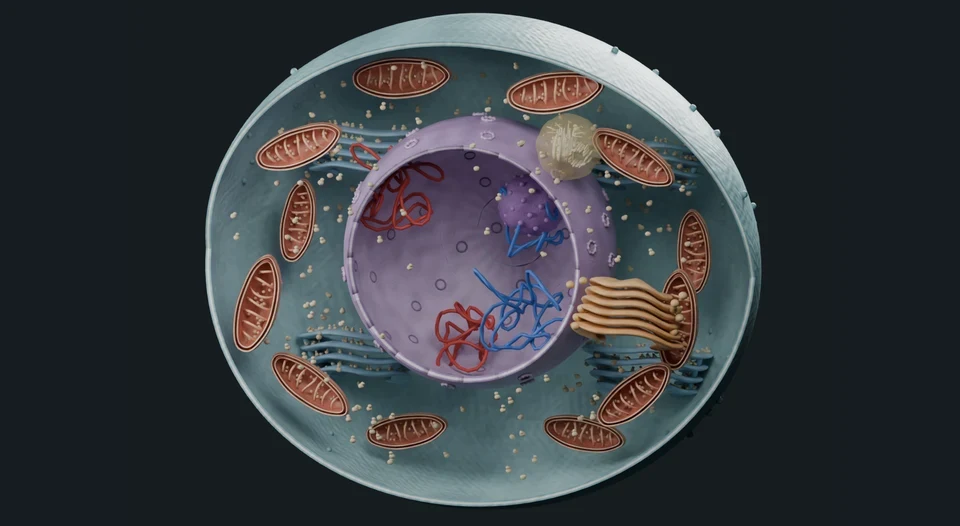
Most of a cell’s life is spent in interphase, not in dividing. In the first part, called G1, the cell grows and does its ordinary work. Look inside the nucleus. You cannot see separate chromosomes yet. Each chromosome is one very long DNA molecule, loosely spread out as chromatin.
Our model cell has 4 chromosomes, two long and two short. Each long chromosome has a partner of the same length and with the same genes in the same order, called its homologous chromosome. One of the pair came from the mother, drawn red, and the other from the father, drawn blue. The short pair is arranged the same way. Those four chromosomes belong to the model; the numbers that follow belong to a human cell. For the human comparison we use a typical diploid body cell with a nucleus: 46 chromosomes, arranged as 23 pairs. Diploid means two chromosome sets, one inherited from each parent; a cell with only one set is haploid. Mature red blood cells lack a nucleus, and sex cells have one set instead. The X and Y sex chromosomes also differ over much of their lengths; our matching long and short pairs illustrate ordinary homologous pairs.
Click a structure in the model, or choose its name here, to read what it does while the cell divides.
Why do some cells use mitosis, and others meiosis?
Start with what each kind of division is for. Growth and repair require new cells to receive a complete set of genetic instructions. In the error-free model, mitosis distributes the copied chromosomes so that each daughter receives the same chromosome set as the parent. This does not require every cell to use the same genes or perform the same job; cells can later develop different specialisations. Almost every cell in the body that divides at all divides by mitosis.
Sex cells face a different problem. Suppose an egg and a sperm each kept all 46 chromosomes. The fertilised egg would then have , the cells of the next generation 184, and the number would double in every generation. To keep the number at 46, each sex cell must carry exactly 23, one from each pair. Halving the number is the first job of meiosis, and it happens in anaphase I, when the two chromosomes of each pair go to different cells.
The second result of meiosis is variety. In metaphase I each pair lines up in one of 2 ways, independently of the others. For two pairs we multiply, , because each way of placing the first pair can go with either way of placing the second. Continuing in the same way, 23 pairs give = 8,388,608 possible combinations of whole chromosomes in one person’s sperm or eggs. It is the same counting as choosing one term from each bracket on the binomial expansion page. Crossing over then mixes pieces within the chromosomes, greatly increasing the possible combinations without guaranteeing that every pair of gametes is different. These mechanisms help explain why siblings usually inherit different genetic combinations. Identical twins begin from one fertilised egg whose early descendants separate into two embryos; even they can later acquire genetic and developmental differences.
Mitosis and meiosis side by side
| Feature | Mitosis | Meiosis |
|---|---|---|
| What it is for | Growth, repair and replacing cells | Making sex cells (gametes) |
| Where in the human body | Almost all body cells that divide | Only cells in the testes and ovaries |
| Divisions | One | Two, with no DNA copying in between |
| Cells produced | 2 | 4 equal-sized products in this model; egg formation is unequal |
| Chromosomes in each new cell | Same as the parent: 46 → 46 | Half: 46 → 23 |
| Homologous chromosomes pair up | No | Yes, in prophase I |
| Crossing over | No | Yes, usually at least once in every pair |
| What separates in anaphase | Sister chromatids | Anaphase I: homologous chromosomes. Anaphase II: sister chromatids |
| Genetic result | Same DNA sequence in this error-free model; cell contents need not be identical | Haploid products with varied combinations; not necessarily all different from one another |
How long does it take, and how often does it happen?
For human cells grown in a dish, one whole cycle, from one division to the next, takes about 24 hours. Interphase uses about 23 of them: roughly 11 hours in G1, 8 in S and 4 in G2. Mitosis itself, from prophase to the end of cytokinesis, takes about an hour, and anaphase only a few minutes. These are typical numbers rather than fixed ones; cells inside the body often divide more slowly, and some leave the active cycle from G1 and enter G0. In G0 they can carry out their usual functions; some later re-enter the cycle. Years without division are not years spent in G1.
Your body makes about 330 billion new cells every day, roughly 3.8 million every second, almost all of them by mitosis. Most are blood cells, made by dividing stem cells in the bone marrow; a red blood cell cannot divide itself and lasts about four months. The lining of the small intestine is replaced every few days, and the outer layer of the skin every few weeks. Other cells hardly divide at all in adults: most nerve cells in the brain, and heart muscle cells, of which only about one per cent are renewed each year in a young adult.
Meiosis happens far less often, and it takes far longer. In the testes, sperm are made continuously from puberty onwards, on the order of a hundred million a day. The meiosis of one cell takes about three and a half weeks, most of it in prophase I, and the whole journey from stem cell to sperm takes about two and a half months.
In the ovaries, meiosis begins before a girl is born. Each future egg cell starts prophase I and then pauses there. It continues only shortly before that egg is released, usually one each month from puberty to menopause, so an egg cell can stay paused in prophase I for anything from about twelve to about fifty years. Meiosis II is completed only if a sperm fertilises the egg.
Check your understanding · A human skin cell in G2 has 46 chromosomes. How many DNA molecules does it contain, and how many chromosomes will each of its daughter cells have?
It contains 92 DNA molecules, because S phase copied every one of the 46 and each chromosome now has two sister chromatids. Each daughter will have 46 chromosomes: in anaphase the sisters separate, so each daughter receives one copy of every chromosome.
Check your understanding · Why is meiosis different from two rounds of mitosis?
Mitosis keeps the number of chromosomes the same, because it separates sister chromatids after the DNA has been copied. Doing it twice would still give cells with 46. Meiosis halves the number because in its first division the homologous chromosomes pair up and are sent to different cells, and because the DNA is not copied again before the second division.
Check your understanding · With crossing over turned off, how many different combinations of whole chromosomes can the cells made by meiosis in the model receive?
Four. Each of the 2 pairs lines up in one of 2 ways in metaphase I, and each arrangement of one pair can go with either arrangement of the other, so 2 × 2 = 4: red long with red short, red long with blue short, blue long with red short, and blue long with blue short. One meiosis produces two of these combinations; turning the short pair round in metaphase I gives the other two.