The Standard Model
Back to physicsEverything around you, the air, your hand, the Sun, is made of a surprisingly short list of ingredients, held together by a short list of forces. The theory that lists them and describes how they behave is called the Standard Model of particle physics. Its usual picture is a table of seventeen particles. That table can look like a page of strange names: quarks, gluons, W and Z bosons, a Higgs boson. Quarks come in six kinds, and each kind is called a “flavour”.
In this page we build that table up from things you already know. We start by zooming into ordinary matter until we reach the smallest pieces found so far, then ask what sorts of particles there are, why there are two big families called fermions and bosons, what the quarks and the leptons are, how the forces are carried, and what the Higgs boson does, and does not do. At the end we look at what the Standard Model leaves unexplained.
Zooming into matter
Start with a drop of water about a millimetre across. It is made of molecules, each a cluster of one oxygen atom and two hydrogen atoms, about three ten-millionths of a millimetre across. Each atom is a tiny, heavy nucleus surrounded by electrons; the nucleus is about a hundred thousand times smaller than the atom. The nucleus is made of protons and neutrons, and each has three valence quarks, the quark count that identifies it. Gluons and additional quark–antiquark contributions are also part of the bound system. Step down the ladder below and watch the sizes.
- Size
From the drop to the proton the size shrinks by about a million million. The electrons and the quarks are where the ladder stops: experiments that probe sizes a thousand times smaller than a proton still find no parts inside them. Notice also that almost all of an atom is empty space between its nucleus and its electrons.
What “elementary” means
A particle is called elementary if no smaller parts have been found inside it. The electron is elementary. The proton is not: when electrons were fired at protons at very high energies, starting in 1968 at Stanford, they bounced off small hard points inside, the way a beam would bounce off three marbles hidden in a bag of cotton. Those points are quarks.
Ordinary matter needs two kinds of quark: up and down, written and . Their electric charges are fractions of the proton’s charge. The up quark has and the down quark has . Adding the charges of the quarks gives the total charge of each particle in the nucleus:
Try building particles yourself below. Choose three quarks for a baryon (the family of the proton and neutron), or a quark and an antiquark for a meson (antiquarks are explained in chapter 7; for now, an antiquark has the opposite charge of its quark). Every combination you can make has a whole-number charge: fractional charges are never seen on their own.
Its name: proton
What is the electric charge of a particle made of two down quarks and one up quark?
Why two big families?
Every particle in the table belongs to one of two families, and the dividing line is spin. On the spin page we saw that an electron behaves as if it carries a built-in amount of rotation, an angular momentum, which always measures or along any direction you choose; we say its spin is . Particles whose spin is a half, , are called fermions. Particles whose spin is a whole number, , are called bosons.
The two families behave very differently in crowds. Two identical fermions can never be in exactly the same state, a rule found by Wolfgang Pauli in 1925 and called the exclusion principle; it comes from deeper quantum theory, which we take as given here. Bosons have no such rule: any number of identical bosons can share one state, and in fact they tend to. Fill the energy levels below with each kind and compare.
Each line is one spatial orbital: at most one spin-up (orange) and one spin-down (blue) electron. Several orbitals may share an energy. The boson comparison permits many particles in one state.
This difference helps explain how matter is arranged. Electrons are fermions, so an atom’s electrons cannot all occupy the same state. Each spatial orbital can hold at most two electrons with opposite spin components, and one energy level may contain several orbitals. The way electrons fill those orbitals helps explain the chemical differences between elements. Photons are bosons, so many can occupy the same light mode. A process called stimulated emission, in which incoming light encourages an excited atom to emit matching light, makes use of this in a laser. Being a boson alone does not make a beam laser light. In the Standard Model, quarks and leptons are fermions; the particles that carry forces are bosons.
Why can’t all the electrons of an atom sit in the lowest energy level?
The six quarks
There are six kinds of quark, called flavours: up, down, charm, strange, top and bottom. Three of them, up, charm and top, have charge ; the other three, down, strange and bottom, have . Their masses differ enormously: the up quark weighs about four electrons, while the top quark weighs about as much as a whole gold atom. Only up and down occur in ordinary matter; the others appear in collisions in cosmic rays and accelerators and decay within a tiny fraction of a second.
Quarks also carry a second kind of charge, which is the source of the strong force, much as electric charge is the source of the electric force. It comes in three varieties, named red, green and blue, although it has nothing to do with real colours; the names were chosen because the three combine to “white”, which describes a rule. Observed isolated hadrons are colour-neutral quantum combinations. The simplest valence patterns are: three quarks, one of each colour (a baryon, like the proton), or a quark with an antiquark of the opposite colour (a meson). A single quark has never been seen. Pulling a quark and antiquark apart within a meson takes so much energy that a new quark–antiquark pair is made from it, and you end up with two mesons instead of free quarks; the strong force page shows this.
Why has a single quark never been observed?
The electron’s family: three charged, three neutral
The other family of matter particles, the leptons, do not feel the strong force at all. There are three charged leptons, each with charge : the electron, the muon and the tau. The muon is like an electron in every way except that it is about times heavier; it decays in about millionths of a second, the very lifetime that makes the muons on the speed of light page such good clocks. The tau is heavier still, about times the electron.
Each charged lepton has a partner with no charge at all, a neutrino: the electron neutrino, the muon neutrino and the tau neutrino. Neutrinos feel only the weak force (and gravity), so they almost never interact with anything. The fusion reactions in the Sun make about of them every second for each square metre of the Earth facing it, day and night, and nearly all of them pass straight through the Earth. Their masses are so small that only upper limits are known, less than a millionth of the electron’s.
Three generations
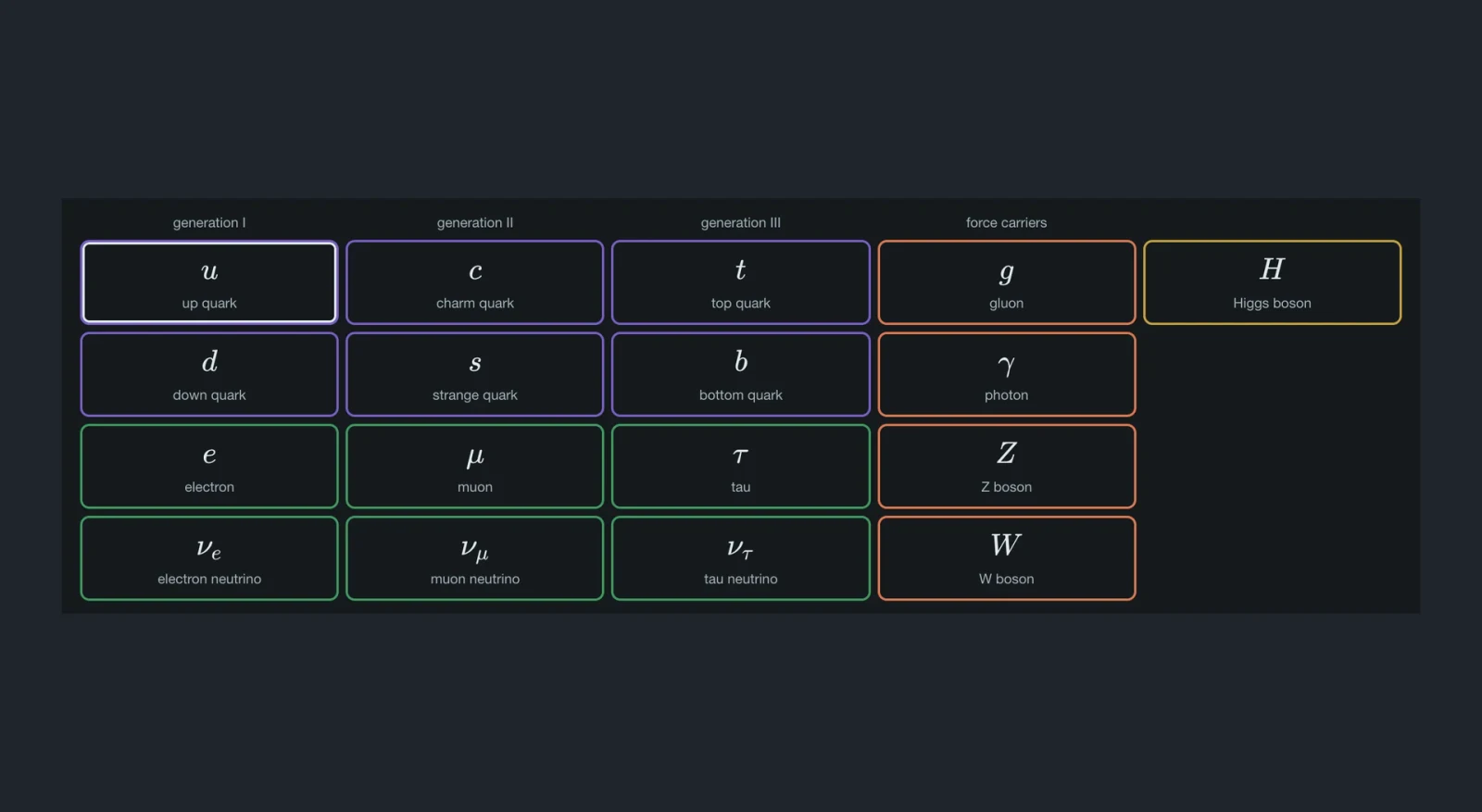
Put the matter particles in a table and a pattern appears. The up quark, the down quark, the electron and the electron neutrino form the first generation. The second generation, charm, strange, muon and muon neutrino, has the same charge pattern, with heavier quarks and a heavier charged lepton. The third, top, bottom, tau and tau neutrino, repeats that pattern, again with heavier quarks and a heavier charged lepton. Ordinary atoms are mainly built from first-generation matter. The heavier charged particles decay rapidly. Neutrino flavours are mixtures of mass states, so we must not assign each flavour a definite mass or assume this generation order is their mass order. Why nature repeats the pattern three times is one of the open questions at the end of the page.
Antimatter
For every matter particle there is an antiparticle with the same mass but opposite charge. The antiparticle of the electron is the positron, with charge , discovered in cosmic rays by Carl Anderson in 1932. Antiquarks have charges and and opposite colours, which is how a meson’s colours cancel. When a particle meets its antiparticle, both can vanish and their energy appears as other particles: an electron and a positron at rest turn into two photons of light. Hospitals use exactly this in PET scanners. A puzzle remains: the universe today contains almost no antimatter, although the laws treat the two almost equally.
How forces are carried
How does one particle push or pull another? In the Standard Model every force is carried by bosons that the particles exchange. A rough picture: two skaters throwing a heavy ball back and forth push each other apart, each throw carrying momentum from one to the other. The picture has a clear limit: it explains a push but not a pull, and the real exchange is a quantum process with no ball flying along a path. But the main idea is right: forces come from exchanging force-carrying particles.
There are three forces in the Standard Model, each with its carriers. The electromagnetic force is carried by the photon, which has no mass and no charge, so the force reaches far. The strong force is carried by eight gluons, which have no mass but carry colour themselves, so they pull on each other; this is what confines quarks. The weak force is carried by the , and bosons, which are very heavy, about and times the mass of a proton, and that heaviness is why the weak force acts only over distances far smaller than a nucleus. Gravity is not part of the Standard Model; a carrier for it, the graviton, has been proposed but never observed. Use the buttons on the table at the end of the page to see which particles feel which force.
The weak force at work: beta decay
The weak force does something no other force can: it changes one flavour of quark or lepton into another. Its best-known work is beta decay. A free neutron lives about fifteen minutes and then turns into a proton, an electron and an antineutrino. Step through it below at the level of quarks.
In the interaction diagram, one down quark changes into an up quark, turning the valence pattern into . A virtual connects this change to the electron–antineutrino pair. The neutron has nowhere near the energy needed to create a real on-shell boson. Therefore the intermediate symbol is part of the quantum calculation, not a heavy particle briefly existing by borrowing energy. The steps below separate the two interaction vertices so that we can check the charge at each one; they are not successive photographs. Using the fractions from chapter 2:
Why an antineutrino and not nothing? Experiments in the 1920s showed that the electrons from beta decay come out with a spread of energies, as if some energy were missing. In 1930 Wolfgang Pauli proposed an invisible neutral particle carrying the rest; it was detected in 1956 near a nuclear reactor. There is also a counting rule: the number of leptons minus the number of antileptons stays the same. Before the decay there are none; after it there is one electron and one antineutrino, .
In beta decay a down quark turns into an up quark. What else must appear to conserve charge?
The Higgs field and mass
Why do the W and Z bosons have mass while the photon has none, and why are the quarks and leptons so different in mass? The Standard Model’s answer is the Higgs field, which fills all of space with a constant value even in a vacuum. Particles that interact with it acquire mass; the stronger the interaction, the larger the mass. The photon and gluons do not acquire mass from this vacuum value. This does not mean they can never interact indirectly with a Higgs boson through other particles; the top quark interacts most strongly and is the heaviest. A ripple in the field is itself a particle, the Higgs boson, with spin , found at CERN in 2012 with a mass of about proton masses.
One common claim needs correcting: the Higgs field does not give you most of your mass. Your mass is almost all in protons and neutrons, and a proton’s three quarks add up to only about per cent of the proton’s mass, as the bars below show. The other per cent is the energy of the fast-moving quarks and of the gluon field that binds them, counted as mass through Einstein’s relation between energy and mass. So the Higgs field gives the elementary particles their masses, but the strong force is responsible for most of the mass of everyday matter.
Masses in MeV/c², a unit particle physicists use; the ratio is what matters here. These are illustrative quark mass parameters at a specified scale, not separately weighable objects inside a proton. The bar comparison is not a unique decomposition of proton mass.
Where does most of the mass of a proton come from?
The whole table, and what it leaves out
Here is the whole table: twelve matter particles in three generations, four force carriers and the Higgs boson. Click a particle to read its charge, spin and mass (in proton masses), and when it was found. Use the force buttons to light up the particles that feel each force.
- Particle
- up quark
- Kind
- quark (fermion)
- Electric charge
- Spin
- Mass
- proton masses
- Found
- 1968
Purple: quarks · green: leptons · orange: force carriers · gold: Higgs boson
The Standard Model has matched a vast range of accelerator measurements, many with high precision. Yet we know it is incomplete. It leaves out gravity. It has no particle that could be the dark matter that astronomers see pulling on galaxies, about five times as much as ordinary matter. In its original form it had massless neutrinos, and they turn out to have small masses. It does not explain why there is so much more matter than antimatter, why there are three generations, or why the masses are what they are. Physicists are searching for the larger theory that the Standard Model is part of.