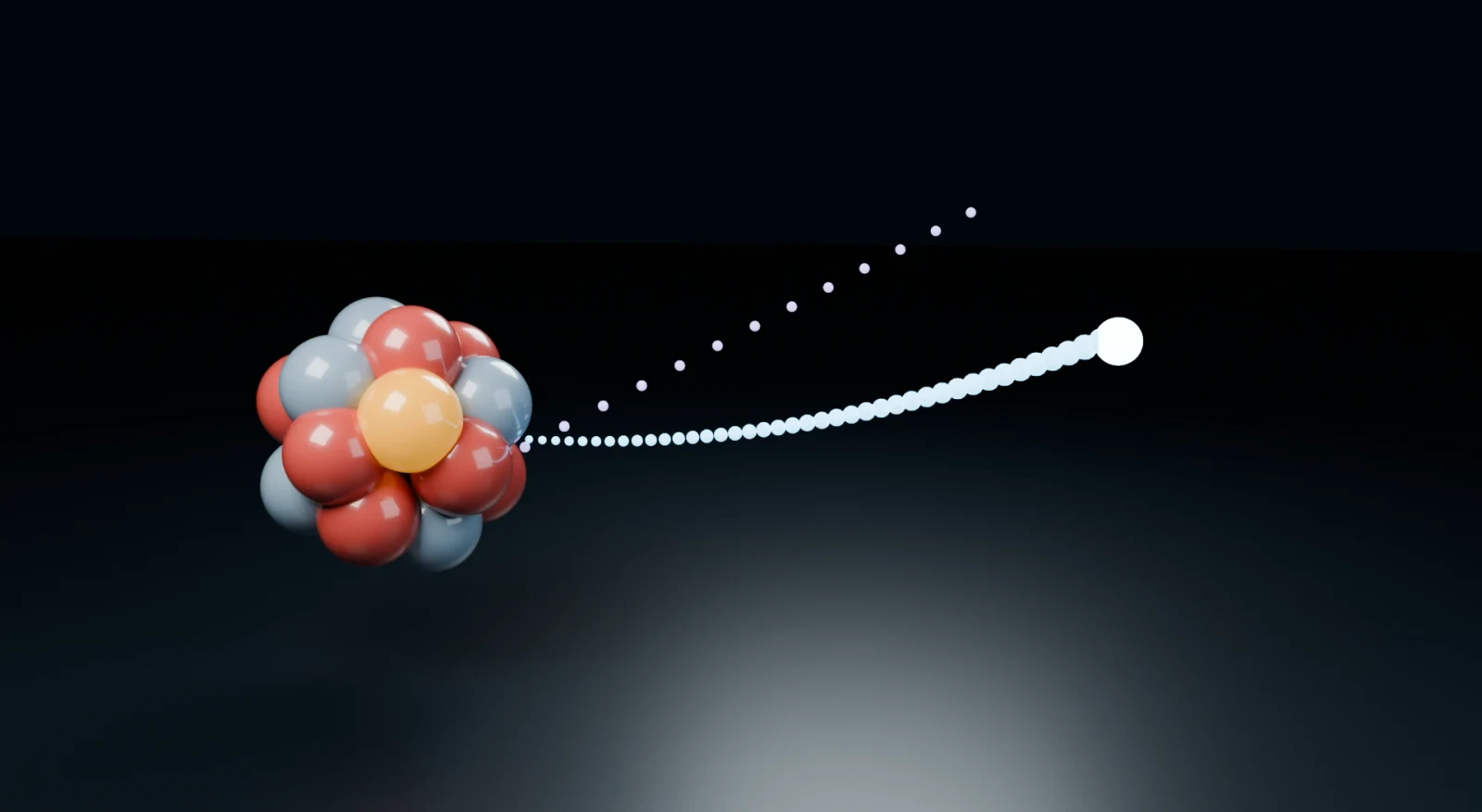
What the weak interaction does
A hand can push a door, and a magnet can pull a piece of iron. So when we hear “weak force”, it is natural to expect a smaller push. Yet one of its most important effects is stranger: a neutron can become a proton while new particles appear. The weak interaction is a fundamental way particles affect one another: it allows particular changes of particle type and particular scatterings. We will now unpack what those words mean.
We will follow one example from ordinary matter down to its ingredients. Then we will keep the before-and-after pictures visible, check the electric charge, and ask what the extra particles tell us. The goal is to understand what the weak interaction does before learning a table of particle names. This page assumes you have met electrons, neutrons and quarks on the Standard Model and strong-force pages; chapter 2 uses the up and down quark charges directly to check the neutron’s total charge.
1. What can change inside matter?
A material is made of atoms. An atom has a small central nucleus and electrons around it. The nucleus contains positively charged protons and, except for ordinary hydrogen, neutrons with no net electric charge. Electrons have negative electric charge. Electric charge is the property involved in electrical attraction and repulsion; “positive” and “negative” name its two signs.
When we rearrange how atoms share or transfer electrons, we can make a chemical change. The number of protons in each nucleus usually stays the same. That number determines the element: a carbon nucleus has six protons. Changing a neutron into a proton inside a nucleus can therefore change which element the atom belongs to. This is a different level of change from rearranging chemical bonds.
Follow one selected part into matter
Choose the steps in order. Gold always marks the piece that the next view enlarges; the trail remains above the picture so we do not lose where it came from.
A piece of carbon contains many atoms. The highlighted dot chooses one atom to follow. The dots are a location map, not a photograph or a scale drawing.
We have reached something inside a neutron: quarks, the smaller particles that make up protons and neutrons. “Up” and “down” are names for two species of quark; they do not describe directions. Experiments so far find no smaller constituents inside quarks or electrons, which is why we call them elementary particles. A neutron and a proton are composite particles because they do have internal constituents.
2. Why does changing one quark change the charge?
We need a common unit before adding charges. Let be the positive size of a proton’s electric charge. An electron has charge , so in units of the proton is and the electron is . Here the letter names a unit size; , with the minus sign, names the electron.
An up quark contributes of this unit, and a down quark contributes . These are measured particle properties used by the theory, not fractions deduced from this picture. To get the net charge of the neutron’s three-quark content, we add one up contribution and two down contributions. Because the denominators are equal, we add the numerators and keep the denominator.
Build the charge from three contributions
The two buttons compare compositions; they do not cause a physical decay. Keep the first two quarks fixed and watch the outlined third one. Its name, colour and contribution change together.
Total charge: 0e$. The positive and negative contributions cancel, even though each quark is charged.
Now isolate the change. The old contribution was , and the new one is . New minus old gives the increase. Subtracting a negative is adding its positive opposite, so the increase is one whole charge unit. We call this change , with measured in units of .
Electric charge is conserved: the total before an event equals the total after it. That is an experimentally tested conservation law, which we use as a starting rule. Therefore the quark change cannot be the complete account on its own. Something else must carry the balancing negative charge.
3. A neutron does not contain a hidden electron waiting to escape
A free neutron can decay into a proton, an electron and an electron antineutrino. “Decay” means an unstable state transforms into a different allowed set of particles; it does not mean the neutron slowly rots or merely breaks into pre-existing little pieces. This process is called beta-minus decay because the emitted beta particle is the negatively charged electron.
A neutrino is an electrically neutral elementary particle that interacts very rarely with ordinary matter. An antineutrino is its corresponding antiparticle. “Anti” does not mean negative electric charge: both have zero electric charge. The small in says this is the electron-family antineutrino; it does not mean an electron is inside it.
Inspect one neutron beta decay
The left panel always keeps the original neutron. The right panel appears only when we reach the products. Gold marks the same selected quark slot in both. These are explanation steps, not frames from a movie of an observed decay.
Before: neutron
Total charge, in units of
Keep following the selected part
The products will be shown in step 3. First identify which contribution changes.
We start with a free neutron, not an entire atom. It has one up quark and two down quarks in its net composition. There is no little electron or antineutrino stored inside this three-quark list.
The charge check explains why the electron’s negative charge fits, but it does not by itself predict the antineutrino: zero charge could not tell us whether an extra neutral particle was present. Other conservation rules and experimental observations are needed. Nor does charge conservation alone decide whether a decay is possible. The initial system must have enough energy, and all the other relevant conservation rules must also be satisfied.
A neutron bound in a nucleus does not necessarily have the same possibilities as a free neutron. We must compare the energy of the whole initial nucleus with the whole final system. This is why the stable carbon nucleus used for our magnifying example is not being animated as though every one of its neutrons must decay.
4. What makes this a weak interaction?
In everyday mechanics, a force often changes an object’s motion. At the particle level, an interaction can also change which particles are present. The weak interaction is a fundamental set of rules governing certain such changes and scatterings. Calling it a “force” does not require a tiny arrow that pushes a down quark until it becomes an up quark.
The accepted quantum theory uses fields, quantities defined throughout space and time, to describe particles and their interactions. The weak interaction involves fields whose particle excitations are called , and bosons. The W particles carry positive or negative electric charge; the Z carries none. “Boson” is a classification of quantum particles. For this explanation, the relevant feature is the role each field plays in connecting the participating matter particles.
For neutron beta decay, we can split the charge bookkeeping at a W connection. The quark side changes from down to up; the lepton side produces the electron and antineutrino. Electrons and neutrinos belong to the particle family called leptons. The two lines below check charge at the two connections. They are parts of one quantum process, not two separately observable decays occurring one after the other.
The star on marks a virtual W: an internal contribution in the quantum calculation. It is not a freely flying W with its ordinary measured rest mass. The neutron does not have enough available energy to produce such a real W. The full process conserves energy; there is no need to say energy is temporarily “borrowed”. A drawn W connection helps us organise the allowed interactions, but is not a photograph of an intermediate object.
At sufficiently high collision energies, real W and Z bosons can be produced and their decay products measured; CERN experiments did so in 1983. These observations, together with many scattering and decay measurements, test the theory behind the bookkeeping. A balanced charge equation is a necessary check, not a proof of the complete weak-interaction theory.
5. Weak does not always mean “changes the particle’s type”
The W connection can transfer electric charge between the participating parts, so we call these charged-current processes. “Current” here names a term in the interaction theory; it does not mean a current flowing in a household wire. The Z connection transfers no electric charge. It gives neutral-current processes, which can change the motion of particles while leaving their species unchanged.
Does the particle’s identity have to change?
Choose an interaction, then show its outgoing particles. The top row starts with a purple neutrino. The bottom row starts with a blue neutron in the first example or a green electron in the second. Outgoing protons are peach, and outgoing electrons are green. Lines connect incoming and outgoing species; they are a comparison map, not measured trajectories. For the neutral-current example we choose a muon neutrino, a different member of the neutrino family, so the example cleanly illustrates Z exchange.
Reveal when ready.
This distinction tells us why “the weak force turns one particle into another” is useful but incomplete. Beta decay is one important example. A neutrino scattering from an electron through a Z connection is another, and neither outgoing particle has to acquire a new name. The neutral-current observations made at CERN in 1973 were important evidence for this second branch of the theory.
Why the word “weak”? For many low-energy processes its effects are strongly suppressed compared with electromagnetic or strong interactions. The large masses of W and Z are central to that suppression and their short-range influence. This is not a universal ranking of every possible event: the size of an effect depends on energy, particles and which process is allowed. A neutrino can travel a long way between rare interactions; that travel distance is not the range of one weak interaction.
6. Why add a particle we often fail to detect?
In beta decay, the outgoing electron does not always carry the same energy. If we measured only the electron and the recoiling nucleus, some of the energy and momentum would appear to be missing. An escaping antineutrino can carry that share. The proposal became convincing through further experiments, including detection of neutrinos; it is not justified merely by drawing a third circle.
Follow an energy remainder
Here we practise only the accounting. Suppose ten teaching units are available after already accounting for recoil. The green part is the electron’s energy; purple is the remainder carried by the antineutrino. Change the electron’s share while keeping the total fixed. These invented units and choices are not a measured spectrum or a calculation of allowed momenta.
In the calculation, means energy and the antineutrino symbol underneath says whose energy we are finding. Subtract the electron’s share from the fixed total.
Removing the purple entry would make the written total too small, not make the energy disappear. The real experiment must also conserve momentum and include the recoil of the proton or nucleus. Energy accounting motivates a missing particle, but identifying it requires experimental evidence beyond this subtraction.
The weak interaction also matters in the Sun. In one branch of the solar fusion chain, two protons ultimately form a deuterium nucleus, containing one proton and one neutron, while producing a positron and an electron neutrino. A positron is the electron’s antiparticle and has charge in our units. The weak part allows the proton-to-neutron conversion inside this reaction; the bound final nucleus and the whole energy balance matter.
The hydrogen symbol with the raised 2 names deuterium, the two-nucleon nucleus just described. On the left we have two positive units. On the right one remains in the deuterium nucleus and one leaves with the positron, giving the same total. This reaction does not say that a lone free proton can spontaneously decay into a neutron, positron and neutrino: that isolated change lacks the required energy.
7. Put the explanation back together
A neutron becomes a proton. A diagram shows only an antineutrino leaving. What is missing from its charge account?
A neutrino leaves a collision still as the same type of neutrino, but with a different motion. Does that rule out the weak interaction?
Why is “a neutron spits out a heavy W, which then breaks apart” a misleading movie of ordinary beta decay?
We can now answer the opening question. The weak interaction is not merely a faint push. It is a fundamental interaction that allows particular particle conversions and scatterings, including neutron beta decay. Its charge-changing W branch and neutral Z branch explain why it can either change the ingredients or leave their identities unchanged while changing their motion.
Sources and a way to continue
The diagrams above are teaching constructions. These laboratory and experiment pages support the physical account and let you inspect the underlying evidence.