

Mathematics
Group theory · foundations

What is a group? Start with calculations we know

Why study groups?

Start with an ordinary problem: an integer plus 3 gives 7. What was the integer? Write xx for the number we do not yet know, so the question becomes x+3=7x+3=7. Add −3-3 to both sides. The right side becomes 4; on the left, adding 3 and then adding −3-3 cancel. This gives x=4x=4. Here xx only stands for the unknown number.

Why can we do that? Adding integers keeps us among the integers. In a string of additions, we can change the brackets while keeping the numbers in the same order. Adding 0 changes nothing. Every integer has an opposite that adds to it to give 0. These rules usually sit quietly inside a few lines of working. We are going to make each of them explicit.

Could similar rules hold when our objects are not integers, but operations that can be undone? For example, doing two operations one after the other can count as one combined operation. Doing nothing is an operation that keeps things as they are. And an operation may have another operation that undoes it. This question is worth asking. If two different-looking kinds of object follow the same rules, some reasoning can be shared. We need not invent a new method for each kind.

Group theory studies a set of objects together with a way of combining them, where the combining follows certain rules. It makes clear when calculations can be regrouped, how to undo something and how to find a missing piece. It also shows which orders can be swapped and which cannot. The point is not to give adding and subtracting a new name. It is to say exactly which conditions a piece of reasoning depends on. Then the same reasoning can work for numbers, rearrangements and geometric moves. Not every set and operation meet these conditions.

We will first make the definition clear and check it fully for integer addition. Then we will work out a method for finding an unknown element ourselves. Only after that do we apply the same rules to a labelled square. So even without a later lesson on abstract algebra, we can already solve a complete problem with the rules of a group. You only need integer addition and subtraction, and how to read an equation. Every new symbol is explained before it is used.

Sets and operations

Before discussing a calculation, we must say which objects are allowed. A collection of objects considered together is a set, and each object in it is an element. For example, the integers include zero, positive integers and negative integers: Z={…,−2,−1,0,1,2,…}\mathbb{Z}=\{\ldots,-2,-1,0,1,2,\ldots\}. The braces put the objects into a set, and the dots mean that the integers continue in both directions. Z\mathbb{Z} is the usual symbol for this set.

But saying “the integers” does not tell us how to calculate. With the same 2 and 3, addition gives 5 and multiplication gives 6. So we must also choose an operation. A binary operation is a rule that takes two inputs and gives one definite output. “Binary” refers to the two inputs, not to binary numbers. We also keep the first input apart from the second. We must not assume that swapping them gives the same output.

From now on, GG is our chosen set, and a,b,ca,b,c stand for any elements of that set. We write a∈Ga\in G for “aa is an element of GG”. We write a⋆ba\star b for “combine the first input aa with the second input bb by the chosen rule”. The star ⋆\star only holds the place of that operation; it does not mean ordinary multiplication. In the integer-addition example, it is the plus sign.

First inputaSecond inputbChosen rule⋆One resulta ⋆ b

For addition: first input 2, second input 3, rule +, result 5. The operation is the rule +; 5 is its result for this pair.

The standard definition

Here is the standard definition. Take a nonempty set GG and a binary operation ⋆\star on GG. If they satisfy the conditions below, together they are called a group, written (G,⋆)(G,\star). Nonempty means that the set has at least one element. Writing them as a pair reminds us that a group depends on both the set and the operation. The same set with another operation may not be a group.

1. Closure: stay in the chosen set

a,b∈G⟹a⋆b∈Ga,b\in G\quad\Longrightarrow\quad a\star b\in G

Take any two elements of GG. The rule must give one definite result for them, and that result must still be in GG. Only then can the result be used in another calculation of the same kind. Strictly, “a binary operation on GG” already includes this requirement. We list it separately so that we do not miss it when checking an example.

2. Associativity: brackets can change

(a⋆b)⋆c=a⋆(b⋆c)(a\star b)\star c=a\star(b\star c)

This must hold for every three elements of GG. The brackets on the left group aa with bb, and that result is combined with cc. The brackets on the right group bb with cc, and aa is combined with that result. The order is a,b,ca,b,c on both sides; only the grouping changes. This does not allow us to swap aa and bb.

3. Identity: one element changes nothing

e⋆a=a⋆e=ae\star a=a\star e=a

There must be an element, written ee, that leaves every element aa unchanged when combined with it. It must work on the left and on the right, and the same ee must work for every aa. In addition, 0 plays this role. The name “identity” does not mean that the element must be the number 1.

4. Inverses: each element can be cancelled to the identity

a−1⋆a=a⋆a−1=ea^{-1}\star a=a\star a^{-1}=e

For each aa, there must be an element in the same set GG, written a−1a^{-1}, that combines with aa to give ee in either order. Different elements usually have different inverses. Here the small −1-1 means “the inverse under the chosen operation”. It does not automatically mean the fraction 1/a1/a. Under addition, the inverse of aa is −a-a.

The definition of a group does not require a⋆b=b⋆aa\star b=b\star a. That extra condition is called commutativity. It swaps the order of two elements, which is different from associativity, where only the brackets change. A group that is also commutative is called a commutative group, or an abelian group. Integer addition is commutative. Later, the reflections and rotations of a square will show us a case that is not.

These are the conditions that define the word “group”. They are not laws of nature read off a picture. To decide whether a particular set and operation form a group, we must show that each condition holds. An example can help us understand a condition. But a claim about every element needs a reason that works for every element.

Check integer addition

Now choose G=ZG=\mathbb{Z} and let a⋆b=a+ba\star b=a+b. Our set contains all integers, and our operation is ordinary addition. Keep both choices in mind: the claim is that (Z,+)(\mathbb{Z},+) is a group.

First look at addition on a number line. Start at 0. Each step right adds 1, and each step left subtracts 1. Adding a positive integer moves right by that many steps. Adding a negative integer moves left. Adding 0 stays put. The two tracks below use the same number-line scale. The first track keeps the first part of the walk, and the second keeps the next part. They are drawn one above the other only to keep the steps apart; this is not an extra direction of motion.

Integer addition, one part at a time-101234

Start at 0. Choose the two integers, then reveal one part at a time. Each dot on a route marks one integer position.

00

The scale extends to keep the chosen positions visible; one interval always means one unit. The sliders choose examples from −6 to 6. The group itself contains every integer, with no upper or lower limit.

Closure: each integer stands for a whole number of unit steps, to the right or to the left. Put two such walks together, and the net number of steps is still a whole number. No half step appears from nowhere. So a+ba+b is an integer for any integers a,ba,b. For example, 3+(−2)=13+(-2)=1, and 1 is still an integer. The picture shows only a short piece of the line. The whole set Z\mathbb{Z} has no left or right end.

Associativity: with integer addition, we can group the same string of signed unit steps in different ways. The total distance moved does not change. Hence (a+b)+c=a+(b+c)(a+b)+c=a+(b+c). This uses a basic property of integer addition itself. A few slider values do not prove it. For a worked example, (3+(−2))+4=1+4=5(3+(-2))+4=1+4=5, while 3+((−2)+4)=3+2=53+((-2)+4)=3+2=5. The numbers stay in the order 3, −2-2, 4.

Identity: 0 means no increase or decrease. For any integer aa, a+0=0+a=aa+0=0+a=a, so the identity is 0. Inverses: every integer aa has an integer opposite −a-a. Equal numbers of steps in opposite directions cancel, so a+(−a)=(−a)+a=0a+(-a)=(-a)+a=0. This includes a=0a=0, whose inverse is itself. All four conditions hold, so (Z,+)(\mathbb{Z},+) is a group.

When a condition fails

Does addition still give a group if we keep only nonnegative integers?

The nonnegative integers are {0,1,2,3,…}\{0,1,2,3,\ldots\}. Adding them stays in the set, associativity still holds, and 0 is still there. But an inverse of 1 would have to satisfy 1+b=01+b=0, so b=−1b=-1. And −1-1 is not in the set. The inverse condition fails, so this is not a group. One counterexample is enough to show that “every element has an inverse” is false.

What if we keep all integers but use multiplication?

A product of integers is still an integer, multiplication is associative, and its identity is 1. But an inverse of 2 under multiplication would need 2b=12b=1, so b=1/2b=1/2, which is not an integer. And 0 times any integer can never give 1. So (Z,×)(\mathbb{Z},\times) is not a group. The same set with a different operation gives a different answer.

Why does integer subtraction fail too?

The difference is still an integer, but associativity fails: (5−3)−1=2−1=1(5-3)-1=2-1=1, whereas 5−(3−1)=5−2=35-(3-1)=5-2=3. The same 5, 3 and 1 appear in the same order; changing only the brackets changes the result. Also, a−0=aa-0=a works only with 0 on the right. On the left, 0−a=−a0-a=-a generally differs from aa, so 0 is not a two-sided identity.

Use the rules to solve an equation

Now we can see what this is good for. Instead of only integer addition, suppose (G,⋆)(G,\star) is any group. We know two elements, aa and bb. We want an element xx such that a⋆x=ba\star x=b. In words: we know the first input and the result, and we want the second input.

We cannot just say “move aa to the other side and change its sign”, because our operation may not be addition. What we do have is the inverse that the definition promises: a−1⋆a=ea^{-1}\star a=e. We want it next to the aa on the left. So we combine both sides with a−1a^{-1}, on the left. Doing the same operation to two equal things keeps them equal.

Keep the original equation above. Reveal a line to see the exact rule used; earlier lines remain available.

  1. a⋆x=ba\star x=b

    Begin with the equation we want to satisfy.

1 / 5

So far we have shown that any solution must equal a−1⋆ba^{-1}\star b. We still need to check two things: that this candidate is in the set, and that it really solves the equation. Closure gives a−1⋆b∈Ga^{-1}\star b\in G. Now substitute it: a⋆(a−1⋆b)=(a⋆a−1)⋆b=e⋆b=ba\star(a^{-1}\star b)=(a\star a^{-1})\star b=e\star b=b. This uses associativity, then the inverse condition, then the identity condition. So it is a solution. And because every solution must equal it, there is exactly one.

For integer addition, take a=3,b=7a=3,b=7. The inverse of aa is −3-3, so x=(−3)+7=4x=(-3)+7=4. Substituting gives 3+4=73+4=7, which is true. Our opening example was written x+3=7x+3=7, and it also gives 4, because integer addition lets us swap the order. A general group does not promise that. If the unknown is on the left, x⋆a=bx\star a=b, we must combine with a−1a^{-1} on the right. That gives x=b⋆a−1x=b\star a^{-1}. The side matters.

Here is the right-side calculation in full. First, (x⋆a)⋆a−1=b⋆a−1(x\star a)\star a^{-1}=b\star a^{-1}. Associativity gives x⋆(a⋆a−1)=b⋆a−1x\star(a\star a^{-1})=b\star a^{-1}. The inverse condition gives x⋆e=b⋆a−1x\star e=b\star a^{-1}. The identity condition gives x=b⋆a−1x=b\star a^{-1}. Substitution gives (b⋆a−1)⋆a=b⋆(a−1⋆a)=b⋆e=b(b\star a^{-1})\star a=b\star(a^{-1}\star a)=b\star e=b. This equation also has exactly one solution.

Now we can study the square

We now know exactly what a group is: a set and an operation, with four conditions that hold for all its elements. The conditions are closure, associativity, identity and inverses. We have also used them to find a way of solving for an unknown element. Next we change the objects and see whether the same definition really works.

In the square model below, the elements are moves of a labelled square: turns or flips that leave it exactly over its original outline. Combining two elements means doing one move and then another. The elements are not the colours, and not the four corners. Why label the square? Without labels, a turned square may look unchanged, and we could not track what the move did. The model shows the start, the middle and the end for you to compare. Then it checks the definition one condition at a time.

Definition reference: MIT 18.703 · Groups
Mathematics
Begin with a move we can see

A first look at groups

Suppose we have a list of instructions for placing a square card. Its corners are labelled A,BA, B, CC and DD. We may turn it or turn it over, but it must finish exactly on the square outline on the table. When the list gets long, we want to know which steps can be combined, whether their order matters, and how to undo the whole list.

These questions ask what several moves do together; the size of the square does not matter. Group theory studies how objects in a set combine under an operation. As we solve the square problem, we will check whether the set and operation meet the definition of a group. We will use those rules to shorten lists of moves and undo them, so their use is shown within this lesson.

We need to recognise four corners, a clockwise direction and integer addition and subtraction. We will explain angles, reflections and the new notation before using them.

01

Why keep a record when the outline stays the same?

First look at the left picture below. Top left, top right, bottom right and bottom left are fixed positions on the table, and the centre stays fixed too. A is gold, BB green, CC blue and DD pink. The letters and their colours belong to the card and move with it; each corner keeps its own letter.

Turn the card a quarter-turn clockwise: A goes from top left to top right, BB goes to bottom right, CC to bottom left and DD to top left. The outline is still the same square, but the four letters are in different positions. A record that only says “still a square” loses the information we need.

Starting positions

Starting positionstop leftAtop rightBbottom rightCbottom leftD
A · B · C · D
Read clockwise from top left

After a clockwise quarter-turn

After a clockwise quarter-turntop leftDtop rightAbottom rightBbottom leftC
D · A · B · C
Read clockwise from top left

We should distinguish two things here. Where the letters are now is an arrangement, or state. “Turn a quarter-turn clockwise” is a move that changes a state. We can perform the same move from different starting states. We will write RR for the instruction, not just for the picture with A at the top right.

Here is why we want a theory of these moves: we want to calculate with a long instruction list. For example, which single move has the same effect as RR followed by RR? Re-enacting every long list is awkward. Instead, we can work out how a small collection of moves combine and reuse those rules.

02

First, allow only rotations

We measure a full turn as 360°, so a quarter-turn is 360∘÷4=90∘360^\circ \div 4 = 90^\circ. Two quarter-turns give 90∘+90∘=180∘90^\circ + 90^\circ = 180^\circ; three give 180∘+90∘=270∘180^\circ + 90^\circ = 270^\circ; four give 270∘+90∘=360∘270^\circ + 90^\circ = 360^\circ. At that point, every corner is back where it started.

Press “Next move” to perform RR once. Follow A as it moves, and check the other three corners too. The left picture keeps the starting arrangement while the right one holds the current result. “Play steps” performs four moves and stops. You can pause, reset or select a completed step; it will not advance the lesson.

Keep the starting arrangement here

Keep the starting arrangement heretop leftAtop rightBbottom rightCbottom leftD
A · B · C · D
Read clockwise from top left

After 0 moves

After 0 movestop leftAtop rightBbottom rightCbottom leftD
A · B · C · D
Read clockwise from top left
Completed: 0 / 4
No instruction has been performed yet.

Selecting a step pauses playback so you can inspect it. The pictures keep the completed arrangements; they do not animate the path between them.

Write R2R^{2} for two successive RR moves and R3R^{3} for three. The superscript counts repetitions; we are not squaring an angle. Write ee for doing nothing. Turning through a full circle has a different physical history from doing nothing, but it sends every point to exactly the same final position. As rules for final positions, R4R^{4} and ee are the same object.

Why keep just four rotations? The card must finish exactly on its original outline. A can finish at one of four corners. If we only rotate, choosing where A finishes fixes where BB, CC and DD finish as well. The moves e,R,R2e, R, R^{2} and R3R^{3} already use all four possible destinations of A. A 45° turn leaves corners and edges outside the outline, so it is not in our collection.

We use the notation a⋆ba \star b to mean perform bb after aa. Throughout this page, moves are carried out from left to right. This is not ordinary multiplication of numbers; it is our notation for combining two moves.

R⋆R2=R3,R3⋆R2=R5=RR\star R^2=R^3,\qquad R^3\star R^2=R^5=R

The first expression joins one turn to two turns, giving three. The second joins three to two, giving five. The first four restore the starting position and the fifth turns 90° again, so the result is RR. We obtained this by following the moves, not by memorising a table. Below, set the selectors to R3R^{3} and R2R^{2} and check each corner through the starting, intermediate and final pictures.

1. Before both moves

1. Before both movestop leftAtop rightBbottom rightCbottom leftD
A · B · C · D
Read clockwise from top left

2. After RR

2. After Rtop leftDtop rightAbottom rightBbottom leftC
D · A · B · C
Read clockwise from top left

3. Then R2R^2

3. Then R²top leftBtop rightCbottom rightDbottom leftA
B · C · D · A
Read clockwise from top left
R⋆(R2)=R3R\star (R^2) = R^3
Follow A: top left → top right → bottom left.
03

Add a move that rotation cannot do

Rotating does not reverse the order A,B,CA, B, C, DD around the boundary. But turning the card over across its vertical middle line exchanges left and right: top left swaps with top right, and bottom left swaps with bottom right. The order A,B,CA, B, C, DD that was clockwise is now anticlockwise. No rotation produces that reversal, so we need a new move.

A reflection sends each point to the other side of a line, the same perpendicular distance from that line. Choose the vertical middle line and call this move FF. Assume the corner letters are readable from both sides of the card. The pictures record corner positions rather than asking you to imagine a three-dimensional flip. The dashed line stays fixed on the table, and the second picture shows the exchanged destinations.

Before the reflection

Before the reflectiontop leftAtop rightBbottom rightCbottom leftD
A · B · C · D
Read clockwise from top left

After reflection across the same line

After reflection across the same linetop leftBtop rightAbottom rightDbottom leftC
B · A · D · C
Read clockwise from top left

Performing FF twice exchanges each pair back, so F⋆F=eF \star F = e. We can also perform FF after a rotation. Turns of 0°, 90°, 180° and 270° give four different reflected results. Choose the rotation below. The middle picture keeps its result; exchanging its left and right positions across the fixed vertical line gives the last picture.

Starting arrangement

Starting arrangementtop leftAtop rightBbottom rightCbottom leftD
A · B · C · D
Read clockwise from top left

After the rotation

After the rotationtop leftAtop rightBbottom rightCbottom leftD
A · B · C · D
Read clockwise from top left

Then perform F

Then perform Ftop leftBtop rightAbottom rightDbottom leftC
B · A · D · C
Read clockwise from top left
e⋆F=Fe\star F = F

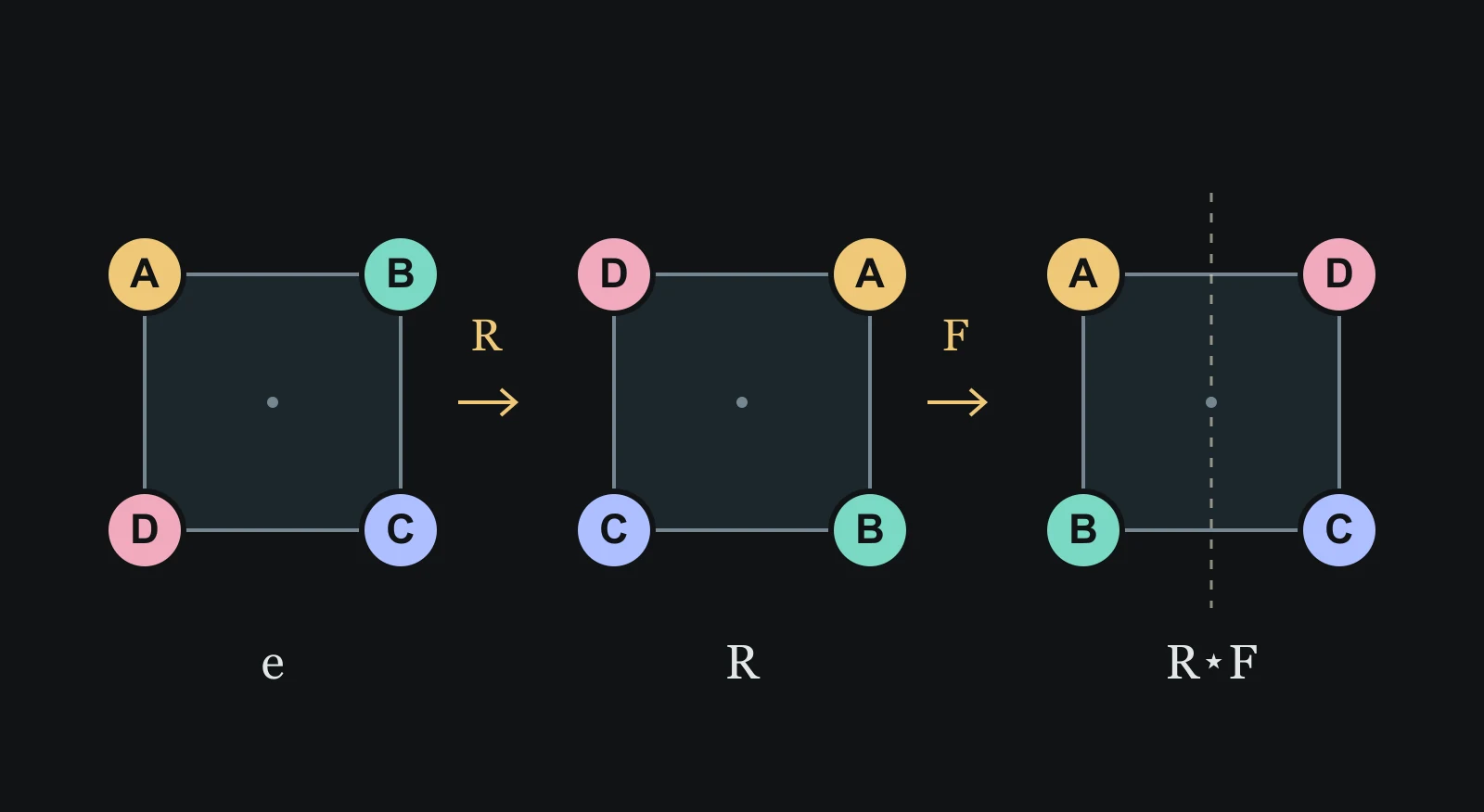
These four results are also reflections across four different lines. Check the destinations: FF exchanges left and right. R⋆FR \star F fixes AA and CC but exchanges BB and DD, so it reflects across the diagonal from top left to bottom right. R2⋆FR^{2} \star F exchanges top and bottom. R3⋆FR^{3} \star F fixes BB and DD but exchanges AA and CC, so it reflects across the other diagonal. The dashed lines below show those equivalent reflection lines, with the final arrangements.

Why are there exactly eight moves, with none missing? A has four possible destinations. BB starts next to A, and a rigid move preserves the side length, so BB must finish at one of the two corners next to A’s destination, not at the opposite corner. Once AA and BB are placed, CC must be the unused neighbour of BB, and DD takes the final corner. There are at most 4×2=84 \times 2 = 8 possibilities. Our four rotations and four reflections are different and already give eight, so they exhaust the possibilities.

We distinguish the moves by their final point positions. A move that preserves the whole outline this way is a symmetry of the square. The four rotations are commonly called C4C_{4}. On this page we call the collection of eight symmetries D4D_{4}: the 4 refers to the four sides, not to the number of moves. Next we will check why these collections deserve the name “group”.

04

Does the order really matter?

With rotations, turning 90° and then 180° gives 270°, as does the reverse order. That might tempt us to think all moves can be swapped. With reflections, we need to check again. Choose RR first and FF second below. The three pictures preserve the start and both steps, and the lower pair compares the two final results in opposite orders.

1. Before both moves

1. Before both movestop leftAtop rightBbottom rightCbottom leftD
A · B · C · D
Read clockwise from top left

2. After RR

2. After Rtop leftDtop rightAbottom rightBbottom leftC
D · A · B · C
Read clockwise from top left

3. Then FF

3. Then Ftop leftAtop rightDbottom rightCbottom leftB
A · D · C · B
Read clockwise from top left
R⋆(F)=R⋆FR\star (F) = R\star F
Follow A: top left → top right → top left.

R→FR \to F

R \to Ftop leftAtop rightDbottom rightCbottom leftB
A · D · C · B
Read clockwise from top left

F→RF \to R

F \to Rtop leftCtop rightBbottom rightAbottom leftD
C · B · A · D
Read clockwise from top left

Left: the chosen order. Right: the same two moves in the opposite order, starting again from the original square.

The arrangements differ: this pair cannot be swapped.

Let’s follow A. The move RR sends it from top left to top right, and the following FF sends it back to top left. In reverse order, FF sends A to top right, but the following RR carries it to bottom right. A ends at different corners, which proves that the combined moves differ. So these moves do not satisfy the commutative law: we cannot claim a⋆b=b⋆aa \star b = b \star a for every pair. This does not mean every pair differs; ee, for example, can be swapped with any move.

Now we can organise all combinations in a table. For row RR and column FF, we already followed A. BB goes from top right to bottom right, then to bottom left. CC goes from bottom right to bottom left, then to bottom right. DD goes from bottom left to top left, then to top right. Reading the final letters clockwise from top left gives A,D,CA, D, C, BB, exactly the picture for R⋆FR \star F. Every cell is worked out this way: feed each destination of the first move into the second move.

Counting how many rotations and reflections occur is not enough. RR then FF and FF then RR each contain one rotation and one reflection, yet their results differ. We need to record the order and how the moves combine. The table keeps the information that a count alone loses.

Row: first move; column: second move. Select a cell to see how all four corners get there. Scroll sideways on a small screen.
1st move ↓ / 2nd move →eeRRR2R^2R3R^3FFR⋆FR\star FR2⋆FR^2\star FR3⋆FR^3\star F
ee
RR
R2R^2
R3R^3
FF
R⋆FR\star F
R2⋆FR^2\star F
R3⋆FR^3\star F
Selected combination:(R)⋆(F)=R⋆F: (R) \star (F) = R\star F
Use each intermediate position as the input to the second move.
CornerStartAfter firstAfter second
Atop lefttop righttop left
Btop rightbottom rightbottom left
Cbottom rightbottom leftbottom right
Dbottom lefttop lefttop right

Check the four destinations

Check the four destinationstop leftAtop rightDbottom rightCbottom leftB
A · D · C · B
Read clockwise from top left
05

Which properties make these calculations reliable?

The table gives results, but we also want to know why we can keep using it. The next four properties describe what makes combining and undoing these moves work.

1. Combining two moves stays inside the collection

Each move preserves distances and returns the square to its outline. After the first move, distances are unchanged; after the second, they are still unchanged and the outline is still the original one. The combined move is therefore another symmetry of the square. We proved that our eight moves exhaust those symmetries, so the result must be one of them. When combining any two objects in a set always gives another object in that set, we call this closure.

2. We can change the brackets, without changing the order

Suppose the execution order is aa, bb, cc. We could look up the combined effect of aa and bb and put cc after it. Or we could look up the combined effect of bb and cc and put that after aa. A few trials do not prove that these groupings always agree. We can check an arbitrary point PP instead.

Write a(P)a(P) for the position of PP after aa. Then b(a(P))b(a(P)) means apply bb to that new position. Through all three moves, the route is PP → a(P)a(P) → b(a(P))b(a(P)) → c(b(a(P)))c(b(a(P))). Whether we group the first two moves or the last two, every point finishes at c(b(a(P)))c(b(a(P))). At no stage did we exchange the order of aa, bb and cc.

(a⋆b)⋆c=a⋆(b⋆c)(a\star b)\star c=a\star(b\star c)

This is associativity. Brackets decide which part we calculate first, not which move happens first. It lets us combine adjacent pieces of a long list. It does not contradict the fact that RR and FF cannot be swapped.

3. We have a move that changes nothing

Doing nothing and then performing aa has the same effect as aa alone, as does performing aa and then doing nothing. Thus e⋆a=ae \star a = a and a⋆e=aa \star e = a for every aa. We call ee the identity. It is not the number 1; it plays the role of leaving the result unchanged under this operation. The starting arrangement is a state, whereas ee is a move that leaves any starting state unchanged.

4. Each move can be undone

After RR, performing R3R^{3} gives four quarter-turns and restores the starting position; R3R^{3} followed by RR does the same. We call R3R^{3} the inverse of RR. Performing R2R^{2} twice gives 180∘+180∘=360∘180^\circ + 180^\circ = 360^\circ, so R2R^{2} is its own inverse. The inverse of ee is ee. Reflecting across the same line twice sends each point back from the opposite side, so each of our four reflections is its own inverse.

Write a−1a^{-1} for the move that undoes aa; it does not mean dividing a number by a move. It satisfies both a⋆a−1=ea \star a^{-1} = e and a−1⋆a=ea^{-1} \star a = e. Below is the calculation for the reflection selected earlier; you can also check it in the table.

(F)⋆(F)=e(F) \star (F) = e

Now give this structure a name

A set is a collection of objects; it may be finite or infinite. An operation takes two objects and gives a result by a definite rule. Put a set GG together with an operation ⋆\star. If they satisfy the following four conditions, we call (G,⋆)(G, \star ) a group. These conditions define the word “group”; we are not claiming that all operations satisfy them.

  1. Closure: any aa and bb in GG combine to give a⋆ba \star b in GG.
  2. Associativity: (a⋆b)⋆c=a⋆(b⋆c)(a \star b) \star c = a \star (b \star c) for every three objects.
  3. Identity: GG contains an ee such that e⋆a=a⋆e=ae \star a = a \star e = a for every aa.
  4. Inverses: each aa has an a−1a^{-1} in GG with a⋆a−1=a−1⋆a=ea \star a^{-1} = a^{-1} \star a = e.

The square itself is not the group. The group is the eight moves together with their composition operation. The four rotations alone also form a group: combining rotations stays among those four, the same point-by-point proof gives associativity, ee belongs to the collection, and their inverses are e,R3,R2e, R^{3}, R^{2} and RR, all still in it. Commutativity is not on the list. A group may allow all pairs to commute, as the rotations do, or may not, as with all eight moves.

06

Return to the instruction list

Here is a specific list: R,F,R,F,RR, F, R, F, R, RR — turn, reflect, turn, reflect, turn, turn. We want a shorter list that leaves every corner in the same final position. We also want an instruction that restores the starting arrangement. Use the buttons to step through the list and compare each position with the calculation underneath.

Keep the starting arrangement here

Keep the starting arrangement heretop leftAtop rightBbottom rightCbottom leftD
A · B · C · D
Read clockwise from top left

After 0 moves

After 0 movestop leftAtop rightBbottom rightCbottom leftD
A · B · C · D
Read clockwise from top left
Completed: 0 / 6
No instruction has been performed yet.

Selecting a step pauses playback so you can inspect it. The pictures keep the completed arrangements; they do not animate the path between them.

The first pair is R⋆FR \star F, and the third and fourth moves form the same pair. We saw that R⋆FR \star F is a reflection across a diagonal. Repeating that reflection twice restores the starting arrangement, so the first four moves combine to ee. The two remaining RR moves combine to R2R^{2}. The whole six-move list therefore has the same effect as one 180° clockwise turn.

(R⋆F)⋆(R⋆F)⋆(R⋆R)=e⋆R2=R2(R\star F)\star(R\star F)\star(R\star R)=e\star R^2=R^2

Each step has a reason: associativity lets us group adjacent moves, the reflection is its own inverse, and the identity leaves the remaining R2R^{2} unchanged. We did not exchange RR and FF in order to cancel them. To restore the original, perform R2R^{2} again, since R2⋆R2=eR^{2} \star R^{2} = e. The six moves leave C,D,AC, D, A, BB clockwise from top left; after the extra half-turn we read A,B,CA, B, C, DD again.

After six moves: equivalent to R2R^2

After six moves: equivalent to R²top leftCtop rightDbottom rightAbottom leftB
C · D · A · B
Read clockwise from top left

Another R2R^2: original restored

Another R²: original restoredtop leftAtop rightBbottom rightCbottom leftD
A · B · C · D
Read clockwise from top left

Even without finding a shortcut, we can undo the list by taking the inverse of each move in reverse order. The inverse of the final RR is R3R^{3}; the preceding RR also has inverse R3R^{3}. The remaining inverse moves are F,R3F, R^{3}, FF and R3R^{3}. Why reverse the order? Undoing the last move brings us back to the state before it happened. Repeating this for the earlier moves takes us back to the start.

This is the use we have completed here: replacing six instructions with one, proving that two different lists have the same effect, and finding how to undo them. The group conditions collect the reasons that make this possible. Other objects satisfying the same four conditions can be combined and undone using the same reasoning. The rules do not solve every problem for us; they tell us why these particular manipulations are justified.

07

Can we leave the square and keep the rules?

The definition did not require rotations or a finite collection. Let’s check familiar objects: the integers …, −2,−1,0,1,2-2, -1, 0, 1, 2, …, usually written Z\mathbb Z, with ordinary addition. We can read +3+3 as moving three places right on a number line and −2-2 as moving two places left. Completing both moves leaves us one place to the right of the start: 3+(−2)=13 + (-2) = 1.

Integer addition as signed steps-3-2-101234First: +3Then: −2
Each tick is one unit. The gold route takes three unit steps right; the green route takes two left. The routes are drawn above the line to keep them separate, not to represent a second direction of movement.

Closure follows because adding whole-number steps still ends at an integer position. For associativity, consider the same list of unit steps left or right. Total the first two sections first or total the last two first: no step is added, removed or altered, so the total displacement is the same. This gives (a+b)+c=a+(b+c)(a + b) + c = a + (b + c). We are using the rules of integer addition, not assuming this for every new operation.

Adding 0 means taking no steps, so 0+a=a+0=a0 + a = a + 0 = a: the identity is 0. After the steps for aa, take the opposite steps for −a-a. Each step is paired with an opposite one, giving a+(−a)=(−a)+a=0a + (-a) = (-a) + a = 0. The inverse of aa is −a-a, still an integer. Thus (Z,+)(\mathbb Z, +) is a group. It has infinitely many objects, unlike our eight square moves, but satisfies the same four conditions.

In this comparison, 0 plays the role of ee, adding an integer plays the role of appending a move, and adding its negative undoes it. We use the same word because the combination rules share the four properties, not because an integer is literally a square.

Not every collection or operation works

Keep only 0, 1, 2, 3, … and still use addition. We retain the identity 0, associativity and closure. But undoing +3+3 requires a bb with 3+b=03 + b = 0. Subtracting 3 from both sides gives b=−3b = -3, which we excluded. Missing even one required inverse breaks the definition, so nonnegative integers under addition are not a group.

Now restore all integers but change the operation to subtraction. We get (5−3)−1=2−1=1(5 - 3) - 1 = 2 - 1 = 1, whereas 5−(3−1)=5−2=35 - (3 - 1) = 5 - 2 = 3. The groupings differ, so associativity fails and integers under subtraction are not a group. We must specify both the set and the operation; saying only “integers form a group” leaves out important information.

08

Try it yourself, including the reason

Use the diagrams and table above if needed. Pause to write your reasoning, then open the answer. The answers include how we obtain the result, not only the move name.

1. After R3R^{3}, which rotation restores the original?

Perform RR. Three quarter-turns followed by one give 270∘+90∘=360∘270^\circ + 90^\circ = 360^\circ, restoring every point, so R3⋆R=eR^{3} \star R = e. Repeating three more turns would give six; remove four for a full turn and two remain, giving R2R^{2} instead.

2. Why can we change brackets but not freely exchange RR and FF?

Changing brackets keeps the execution order. Each point undergoes the same three moves in the same order, so it reaches the same destination. Swapping RR and FF changes the route: A ends at top left after R⋆FR \star F but at bottom right after F⋆RF \star R. Associativity concerns grouping; commutativity concerns order.

3. Is exchanging only AA and BB, with CC and DD fixed, a square symmetry?

No. Originally BB is at top right and CC at bottom right, so the segment BC follows the right boundary. After the exchange, BB is at top left while CC stays at bottom right: BC is a diagonal through the interior. A rigid move carries a straight segment to the straight segment between its new endpoints. Part of the old boundary would be carried into the interior, so the whole boundary would no longer map back to the boundary. That exchange is not one of our eight symmetries.

Before: BC is the right edge

Before: BC is the right edgetop leftAtop rightBbottom rightCbottom leftD
A · B · C · D
Read clockwise from top left

Only AA and BB exchanged

A permutation that fails to preserve the boundarytop leftBtop rightAbottom rightCbottom leftD
Dashed segment: BC is now inside, not on the boundary.
4. Keep only ee and RR, with the same move-combination rule. Is this a group?

No. Combining ee with ee gives ee, and combining ee with RR in either order gives RR; those results remain in the collection. But RR followed by RR gives R2R^{2}, which is not in the chosen set containing only ee and RR. Closure fails, so we already know this is not a group without checking the other conditions. Selecting a few objects from a group does not automatically produce another group; we must check the smaller collection itself.

We began by wanting to place a square correctly, shorten a list and undo it. Following those concrete questions led us to composition, closure, associativity, identity and inverses. Only then did we give a name to a set and operation satisfying all four conditions: a group. We have finished a complete small problem here; we do not need another group theory lesson to justify what we have done.