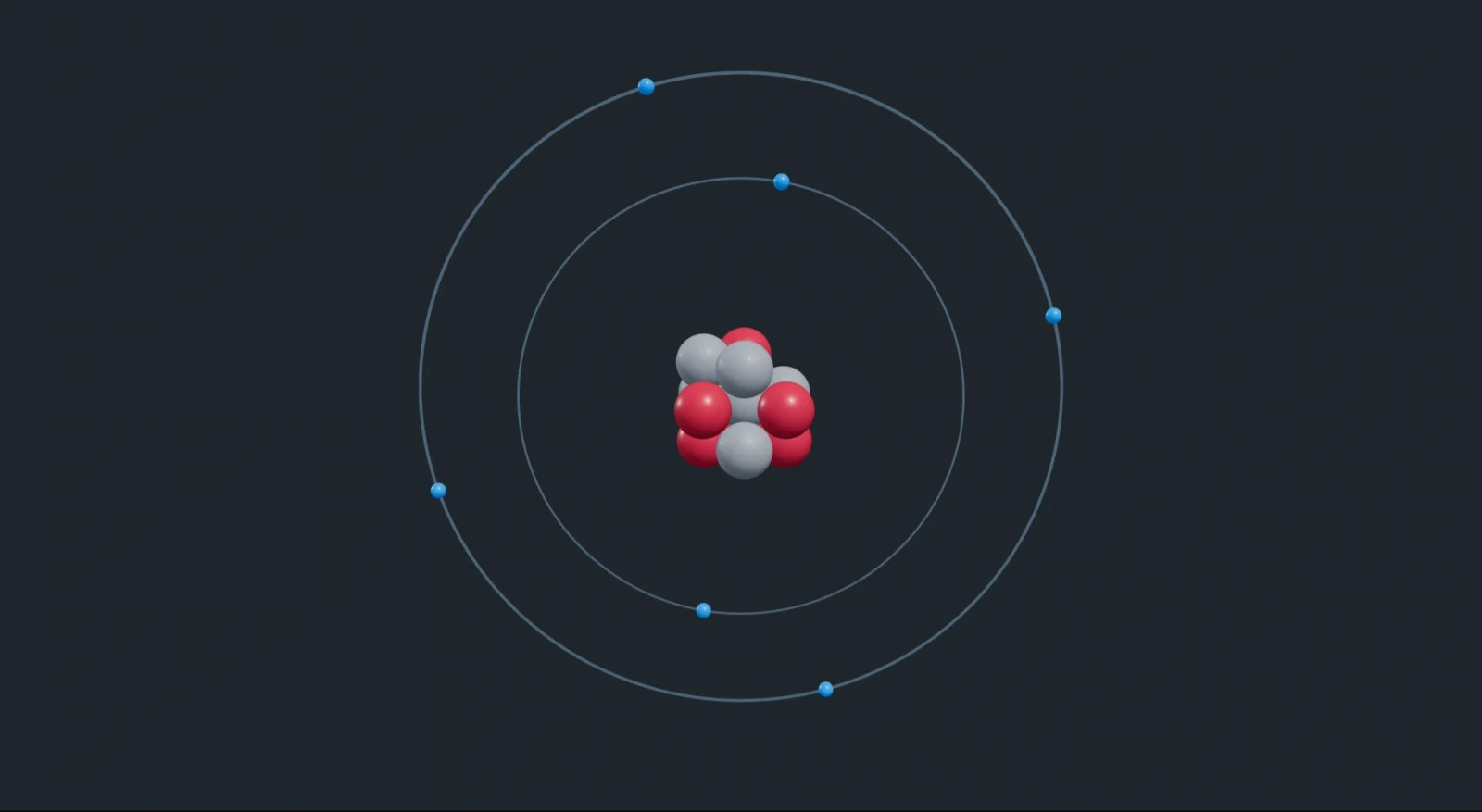
The Bohr atom
If every atom were a uniform solid sphere, we could not explain why hydrogen, sodium, and chlorine exhibit completely different chemical properties, nor where electric charge in matter originates. Inside an atom lies a compact central cluster, the nucleus, surrounded by layers of negatively charged electrons. Accounting for these constituent particles reveals the systematic order behind the 118 entries of the periodic table.
Begin directly with the model by selecting hydrogen, which has 1 electron, and then helium, which has 2 electrons, before choosing any of the 118 elements to inspect its protons, neutrons, and electron shells. Keep in mind that the concentric rings sort electrons into layers and do not represent fixed circular orbits. The spatial regions where electrons are actually likely to be found are examined in hydrogen orbitals, while the outermost electrons counted here are the ones transferred in ionic bonding.
After this page, you should be able to solve
- Given any entry in the periodic table and a specified isotope such as sodium-23 or carbon-14, calculate the proton, neutron, and electron counts of a neutral atom and verify why its net charge is zero.
- Compare the electric charges and relative masses of protons, neutrons, and electrons, and explain why nearly all of an atom’s mass is concentrated in the nucleus.
- Read an element’s shell distribution, such as for sodium, to identify its outermost electrons and match the atomic number to the proton and electron counts of a neutral atom.
- State the proper role of the concentric rings in the Bohr model for sorting electrons into shells, and explain why they must not be interpreted as fixed planetary orbits.
01Choose an element, then count its particles
Start with hydrogen. Select helium and see how many blue dots it adds.
1 counts the protons and neutrons together. Subtract the 1 protons: 1 − 1 = 0 neutrons. Atoms of the same element can have different neutron counts; these are called isotopes. This model shows one named isotope of each element.
Particle sizes, shell spacing and motion speeds are adjusted so you can see the structure. The nucleus would be far smaller relative to the whole atom at the same scale.
The periodic table
Select a box to change the atom above. Every element is selectable.
Try hydrogen, then helium. One proton becomes two, and the neutral atom also needs two electrons. Now choose sodium: its 11 electrons are arranged as 2 + 8 + 1. The outermost electron will matter when we discuss sodium losing an electron to form an ion.
02What are we going to put in the model?
The red balls stand for protons, which carry positive charge. The grey balls are neutrons, which carry no charge. These two kinds of particle gather in the centre to form the nucleus. The blue dots outside it are electrons, which carry negative charge.
Each proton has one positive charge and each electron one negative charge. The atoms here have no charge overall, so their proton and electron counts match. The number at the top of a box in the periodic table tells you how many protons there are. It is called the atomic number.
Proton
In the nucleus
- Relative charge
- Relative mass
Neutron
In the nucleus
- Relative charge
- Relative mass
Electron
Outside the nucleus
- Relative charge
- Relative mass
Here we use the mass of one proton as 1. A neutron has almost the same mass, while an electron has only about of that mass. So most of the atom’s mass is in its nucleus. The charge works differently: a proton and an electron have equal amounts of charge, with opposite signs. A neutron has no electric charge.
The +1 and −1 use one elementary charge as the unit. One elementary charge is the amount carried by a single proton or a single electron. We call its size : a proton carries +e and an electron carries −e. The unit symbol stands for coulomb, the unit of electric charge. 10⁻¹⁹ means 1 divided by 10 nineteen times, so the first 1 sits at the 19th decimal place; written out, this charge is only 0.00000000000000000016 coulomb.
The nucleus here includes what we learnt after Bohr: the neutron was discovered in 1932. Hydrogen-1 is an exception to the usual proton-and-neutron picture: its nucleus is just one proton.
03From a solid sphere to an atom with parts
Ancient Greek thinkers proposed that matter was made from very small units which could not be divided further. The word atom comes from atomos, meaning “indivisible”. This was an early idea about matter; experiments would later show that an atom itself has smaller parts.
Dalton’s model
Dalton used atoms to explain patterns in chemical reactions. We represent his atom as a small, solid sphere with no internal structure.
A smaller charged particle
J. J. Thomson studied cathode rays. Their deflection in electric and magnetic fields showed that they contained small, negatively charged particles: electrons. An atom could no longer be treated as indivisible.
A nucleus, then electron shells
Scattering experiments led Rutherford to a small, positive nucleus. Bohr then placed electrons in allowed orbits around it. This gives us a picture we can build and inspect.
04Why would an electron orbit the nucleus?
The Bohr model is a model that is easy for beginners to understand. Real atoms do not completely follow this model: why would electrons orbit the nucleus?
The positive nucleus attracts the negative electrons, so we have a reason for an inward force. But attraction alone does not explain why an electron should remain in one particular circular orbit. Bohr introduced allowed orbits as a rule of his model. In quantum mechanics, we instead describe where an electron may be found, using an electron cloud; we do not assign it a fixed planetary path.